

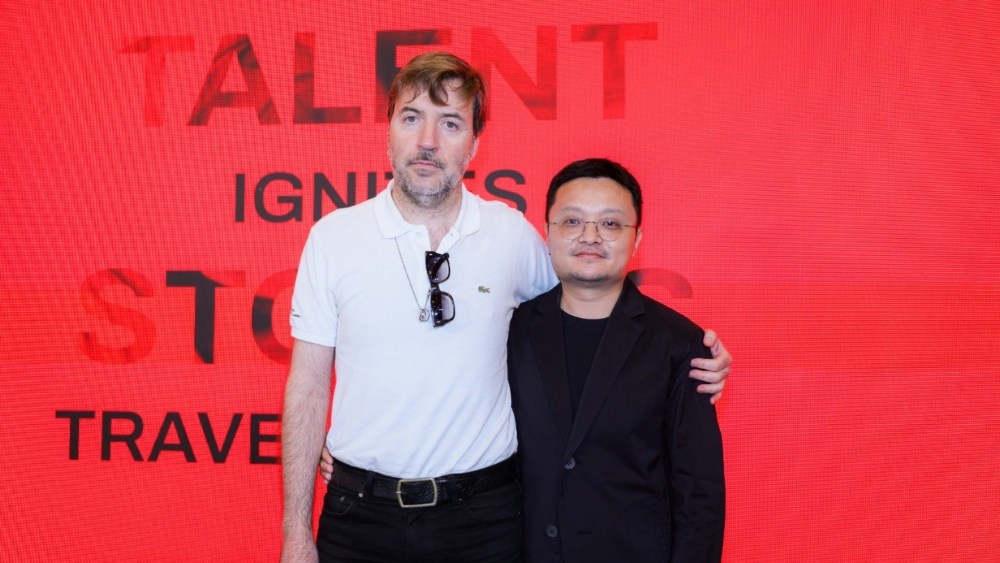
Spanish director Albert Serra and Chinese writer Bi Gan only met for the first time in Paris last month, but at the Shanghai International Film and Television Market the two directors sat together as if they had been discussing literature for years.
The panel titled “The Story Travels Further: Literature and Cinema in the Spanish-Chinese Dialogue” opened with a short film by Carla Simón, Turbo and Nicolas Mendes, and a presentation by the Spanish Federation of Publishers Guilds on the cinematic potential of Spanish literature.
Director Serra’s films are based on classic texts without using them as blueprints, and he says that by the time he started working, he had little memory of the original material.
“I just used some tools and very basic ideas that everyone knows and created something myself from that starting point,” he said. “So the truth is, there’s not much difference between writing a screenplay according to[literary]principles and writing a screenplay based on new ideas. The development of what you do in the film is completely new and creative.”
“I don’t care. I just want to make good movies, original and personal movies,” Serra added. “I started thinking more about my style and how to develop it.”
Bi took a more moderate stance on the issue, describing his relationship with literature as structural rather than reverent. “A film’s title is its face. I often use literary book titles as film titles, giving the audience the perfect entry point into the story. Apart from that, (my films) incorporate a lot of literary and even poetic structures, which allows them to stand out from typical genre films, because their narrative thread, storytelling approach and character development are all adapted to poetic structures,” he said.
The two directors expressed their admiration for each other’s work. Serra praised Bi’s use of poetry in “Resurrection,” saying it can encourage people to think about images and use language differently. Bi said that watching Sera’s “Afternoon of Loneliness” gave him a literary experience. This is because the film’s narrative logic was completely unexpected.
“His films structured literature in a cinematic language, which was completely new and fresh to me,” Bi said. “I watched the cloud scenes. Some of them might be a little long, but I didn’t really find them boring.”
“Why did you choose to adapt material that wasn’t your own?” Serra said. “You have to respect the material in some way, because otherwise you’re creating your own story. You don’t adapt someone else’s story just to destroy someone else’s story.[It’s]like an exercise in foolish narcissism. But at the same time, you have to betray the source material to create your own story. You have to be brave.”
Serra continued, “I don’t see the point in adapting it. It’s a work for lazy people who don’t want to come up with original ideas.”
“Literary adaptation has always been an important element in the historical development of film,” Bi said. “Some films, like Serra’s The Honor of the Order, succeeded in completely deconstructing the source text, which I think is a very appealing approach. But there were also many classic adaptations, such as those in which novelists were involved in the project. During Hollywood’s film noir movement, literature became a major aesthetic event and symbol, ultimately pushing the boundaries of film language.”
The filmmakers also agreed on something counterintuitive: The idea was that a mediocre original story often produced a better movie than a great book. “People who own good books are not free because they have too much respect for those books,” Serra says. “They feel like they’re in a prison. It’s all about the book, so they want good on every level: the artistic direction, the photography, the script. But they don’t match up and there’s no glue. With bad books, people don’t have as much respect, so they do whatever they want. It’s different than an adaptation, because they feel more free.”
Director Bi clearly stated this issue. “Adapting text for the screen is a daunting task full of obstacles, and truly successful literary films are extremely rare.”
“Try to forget,” Serra said. “Because if we don’t forget about other outputs, we have to create our own world.”
Bi named Federico García Lorca among the literary figures who shaped him, and described his poems as “short and beautiful, like small, soft cries.” That influence, he said, goes deeper than what is always visible on the screenplay page, into issues of death and fear that fundamentally shaped his sensibilities.
Both directors rejected the idea that AI could open up filmmaking to everyone. Mr. Bi questioned the very premise of communication between humans and AI. “Language is a huge illusion in itself. We thought that AI would create something based on what we input, but miscommunication itself cannot be resolved. There is a natural contradiction in telling AI to complete what you want it to complete.”
“The one thing AI will never have is innocence, because AI is based on data collection, and innocence is based on data deletion,” Serra said. “Real artistic filmmakers are unpredictable because they disrupt what everyone has done before to create something new. If you think of a new format that has nothing in common with previous formats, you will always be ahead of the AI.”
The Shanghai International Film and Television Market is held in parallel with the Shanghai International Film Festival.
