

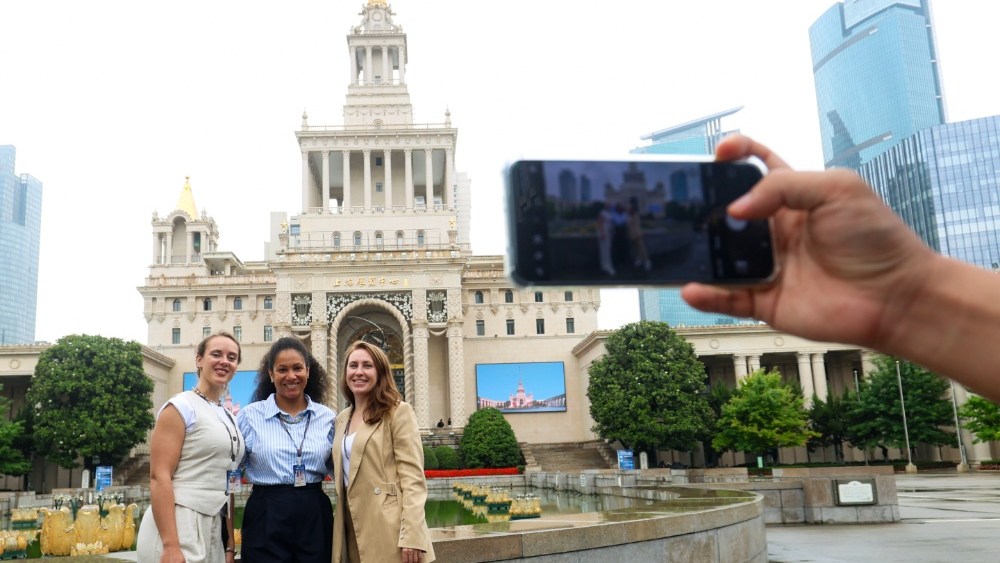
This year, the Shanghai International Film and Television Market will launch a new dual-venue format at the Shanghai Exhibition Center, with a separate space for international corporate pavilions and a dedicated arena to pair Chinese content sellers with buyers from key markets such as the UK, France, Brazil and Canada.
The international pavilion will bring together institutions from Thailand, Russia, Saudi Arabia, South Korea, Brazil, and Spain, with programs focused on showcasing overseas productions and promoting filming locations in Europe and the Middle East. At China’s promotion venue, matching sessions organized by category such as movies, drama series, and micro-dramas will be held in parallel with the promotion of international industry salons and cultural tourism routes.
Chen Guo, managing director of Shanghai International Film and Television Event Center, said this year’s TV Forum program will focus on promoting global content trade. “This thematic forum will bring together decision makers from major global platforms for in-depth conversations about the latest market trends, key purchasing needs and diverse collaboration opportunities,” she told Variety. “They will work together to explore new avenues and possibilities for Chinese stories, including microdramas, to ‘go global’.”
This year, the market is also introducing an official award category for microdramas, which recognizes short films that excel across four criteria: value orientation, narrative and creativity, production and audiovisual quality, and distribution and reputation. Chen said the honor is aimed at addressing uneven production quality across the sector. “We aim to discover and honor outstanding microdramas with ideological depth, artistic warmth and contemporary character,” she says. “The introduction of this honor aims to leverage the Magnolia Award’s exemplary and leadership role to guide the industry toward premium production.”
A broader market is entering what Chen describes as a rebound cycle after a period of inventory clearance, with AI tools attracting young creators and raising the bar for storytelling. “Viewers never stop chasing quality content,” she says. “While the industry has evolved rapidly in recent years, the changes have primarily occurred in presentation formats: between horizontal and vertical screens, long versus short content, and traditional television broadcast versus online streaming, among others.”
Last year, international guests accounted for 12% of the total market participants, with creative talent accounting for the largest specialty at 35.54%. Chen says the market’s central goal this year is to go beyond one-off deals. “We not only aim to facilitate single-project deals, but also encourage Chinese and foreign institutions to sign annual strategic partnerships, long-term slate purchase agreements, and joint development framework agreements,” she says.
The Shanghai International Film and Television Market is held in parallel with the Shanghai International Film Festival.
