

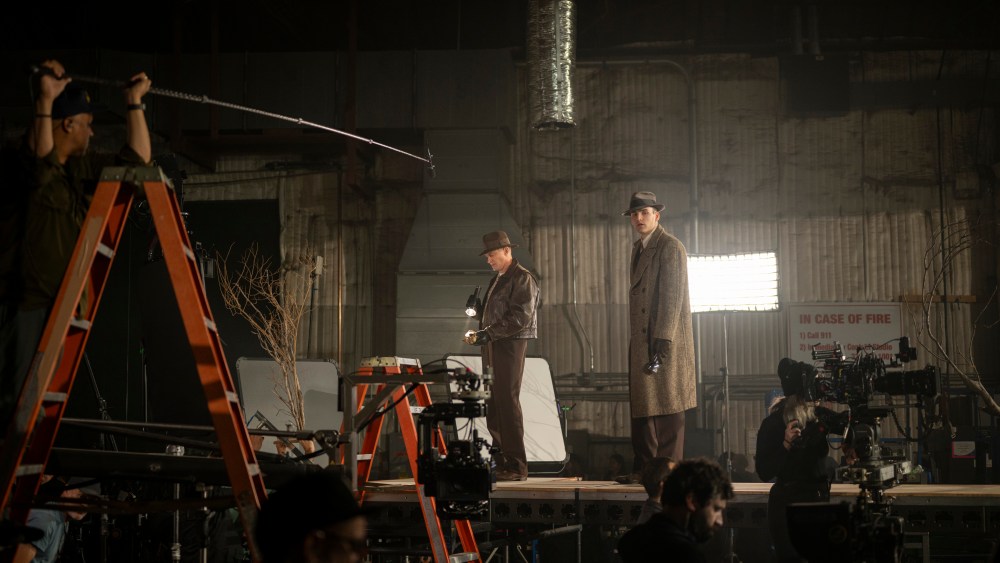
When cinematographer Michael Bauman began researching Netflix’s Monster: The Ed Gein Story, he gained unique insight into the story.
The eight-part series, directed by Charlie Hunnam, follows a serial killer who murdered at least two women and exhumed their bodies for a heinous purpose in the 1950s. Raised by an obsessive evangelical mother who desecrated human corpses to make skinsuits, Gein and his story are filled with an unprecedented and disturbing psychological drama. The incident inspired films such as Psycho, The Texas Chainsaw Massacre, and The Silence of the Lambs.
Like Gein, Bauman is from Wisconsin, so he was able to connect with family and friends who had vivid memories of getting around town.
Aside from hearing from primary sources, Bauman worked closely with showrunner Max Winkler to create the show’s eerie look, exploring ways to use the house’s architecture to heighten the tension.
The pair, who previously worked together on Monsters: The Story of Lyle and Erik Menendez, consulted more than 300 visual references and movies to figure out how to shape certain information, Bauman said. Winkler said he was very adamant about where he wanted to build tension throughout.
In the sixth episode, titled “Buxom Bird,” two cops discover Gein’s house filled with trash and swarms of flies. Once inside, the two discover the horror of bloody intestines, fingernails, and a human heart boiling on the stove. When they make a horrifying discovery, the sheriff calls for backup. Composer Mac Quayle’s score features deep cello and conveys a deep sense of dread.
Previous episodes hinted at the horrors going on inside the house, but it all culminated in this moment.
“It was really about revealing parts of the story through light,” Bauman says. “Max and I always talk about how it feels like a beautiful winter day outside, with bright sun and snow, but inside this house it’s so dark and so claustrophobic.”
When a discovery occurs, “editor Adam Penn cuts to the officers and their faces and where they’re looking,” Bauman says. “As an audience member, you’re thinking, ‘What am I looking at? Is that what I think it is?'” We used to play around with that a lot. ”
Bauman worked closely with the show’s lead lighting technician and director Manny Tapia, looking at “the reflective nature of their faces” while considering how to make every detail as dark as possible and create mystery. It wasn’t about pushing in a ton of light.
Bauman credits Steadicam operator P. Scott Sakamoto for composing the police in this scene. He previously worked on Killers of the Flower Moon and Complete Unknown.
“He brought interesting ideas to the party,” Bauman says. “He said, ‘Let’s start farther away from them, and then as we start to get closer to realizing what they think is going on, let’s move closer and closer.'”
A wide shot then reveals the entire surrounding area, as one of the officers sees Gein’s mask and another removes the heart from the urn.
“This is basically an externalization of Ed’s mind at the time,” Bauman explains.
Bauman shot with an Alexa 35 and used custom PV Kowa lenses.
“When I panned the flashlight, it had an interesting flare quality,” he says, adding that he also integrated a vintage lens and a 50mm lens for wide shots. “It gives you a shallow depth of field that’s really unusual, and it’s kind of a cool way to build up the tension. Between those two things, lens-wise, it gave the whole thing an interesting texture.”
Watch the video above.
