

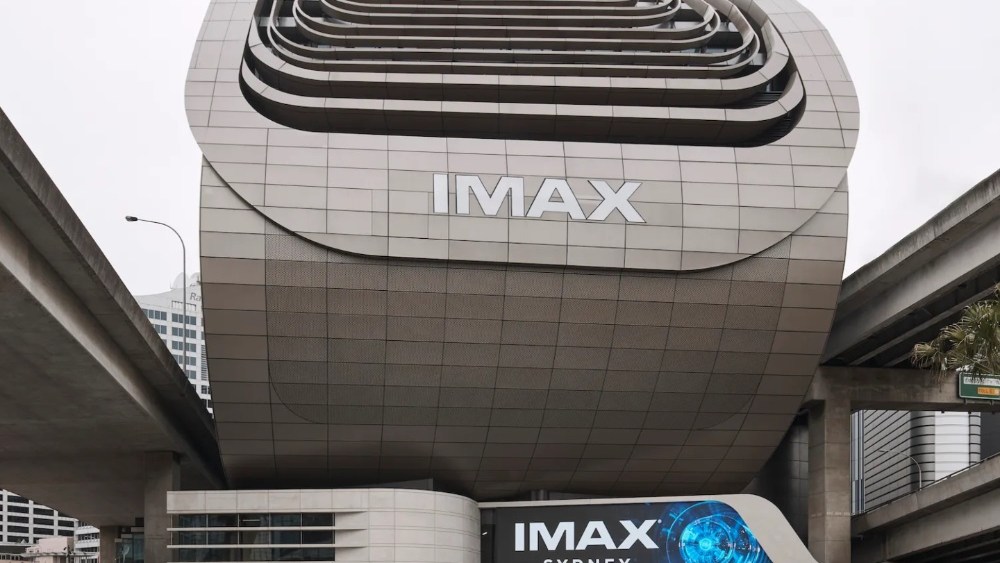
Imax is in an enviable position since the box office underwent a major reset.
It’s no secret that attendance at movie theaters has slumped since the pandemic. But audiences who choose to go to movie theaters are increasingly gravitating toward premium movie-watching options like Imax to differentiate the big-screen experience from watching movies at home. That means Imax posted record ticket sales of $1.2 billion in 2025, even though overall box office revenue was down 30% compared to pre-coronavirus levels. And the tech company is targeting an even bigger benchmark of $1.4 billion in 2026, with the help of marquee films like Christopher Nolan’s The Odyssey and Denis Villeneuve’s Dune Part 3, which were shot with its own cameras.
Imax’s success in an industry with few success stories is remarkable. Buyers have expressed interest as the company’s profile has increased in recent years. However, experts say IMAX was reluctant to negotiate, believing it would be best to operate independently. But Imax management’s attitude has changed in recent months, and the company is in the early stages of considering a sale, as first reported by the Wall Street Journal.
IMAX has not yet commented publicly on its deliberations. But at an investor conference last December, CEO Richard Gelfond hinted at the company’s potential involvement, saying IMAX would be an “incredibly valuable player, either as a fully differentiated public company or as part of a larger company that has the keys to unlocking even more value and developing a strong business around the world.” Gelfond recently returned to work after taking a temporary leave of absence in March to recover from a severe case of pneumonia. Insiders note that the potential sale is unrelated to Mr. Gelfond’s health concerns.
Analysts believe IMax is looking for a buyer to expand its global footprint and is doing so now to capitalize on its position as one of the movie theater industry’s only reliable bright spots. There’s also frustration that Wall Street doesn’t value IMAX enough in terms of its stock price. After news of a potential sale broke, IMAX’s stock price is approaching $40 per share, but the company is expected to remain in the $20s for much of 2025.
“If IMAX is considering selling the company, it’s because the company’s valuation doesn’t reflect the profits it has made since the pandemic,” said Eric Wald, an analyst at Texas Capital Securities. “While box office market share and revenue, unlike other exhibition spaces, are above pre-pandemic levels, valuation multiples are still lower than pre-pandemic.”
“The benefit[of a sale]may be to accelerate growth and return to the public markets at a later date when valuations are higher,” Wald added.
Mr. Gelfond previously lamented that part of the problem is that Wall Street values Imax the same way it values movie theater chains like AMC Theaters, which have fallen into debt. Still, IMAX, which doesn’t own theaters, has a relatively healthy balance sheet. The company makes money by licensing its technology, such as screens, sound systems and projectors, to exhibitors.
Considering how much Imax contributes to box office revenue (5.2% domestically and 3.8% globally in 2025), the company doesn’t have many luxury venues around the world. Imax currently has 1,865 locations in 91 countries and approximately 200,000 screens worldwide. Consumer demand for Imax is further fueled by blockbuster directors like Nolan and Villeneuve, who sing enthusiastically about the experience of watching their films on the biggest, brightest screens. IMAX is so popular among movie fans that some will travel long distances or put up with immoral showtimes to not miss out on the fun.
There’s always a risk that scaling up too much could diminish the appeal of Imax, which has deliberately expanded its resources and film programming. But IMAX officials have suggested the company could double its global footprint to meet demand without over-saturating the market. These screens are expensive for exhibitors to install, but the pitch is simple. Consider all the additional box office revenue.
Imax’s market capitalization is about $2.1 billion, meaning an acquisition would be manageable for most large companies. But who is the right buyer? Potential players could include Hollywood studios, live entertainment companies, private equity, and more.
When it comes to studios, Sony is already investing in exhibition with its acquisition of Alamo Drafthouse, so it makes sense for Sony to do so. Disney, on the other hand, produces many of the spectacle-heavy adventures and superhero epics that hit Imax screens. But both companies are already benefiting from Imax. Do they really need the headache of owning a company outright? Paramount and Warner Bros. are on the verge of merging, and CEO David Ellison has indicated that theater is central to the company’s strategy. Does it make sense for a new giant studio to take control of PLF’s dominant brands, or will the joint venture have too much influence to pull off another deal?
Meanwhile, big tech companies like Amazon and Apple have virtually unlimited resources and ambitions in the film sector. But movie theater operations can be far removed from their main sources of income, such as smart devices and retail.
It also has a live entertainment company, which is already working with Imax to develop concert films and other forms of alternative content. But selling to a studio or live entertainment company could raise concerns that their films and events would receive preferential treatment. That could alienate rivals and suppress their own films and artists. A tense battle has already begun among Hollywood insiders to secure a limited number of premium Imax screens at a time of intense moviegoing competition.
“Although it may be difficult for one of the studio or entertainment partners to acquire Imax and take control of the network, it is possible that one of the major streaming or entertainment companies could use Imax to further penetrate the premium space of the market,” Texas Capital Securities said in a recent report, noting that Netflix and AMC Theaters could be potential buyers. “Given the increasing use of local language content, international companies may make sense.”
Venture capital firms could help studios and exhibitors grow while avoiding the conflicts of interest they would otherwise face. But finding the right partner will be important. IMAX won’t want to do business with companies that want to cut costs and exit investments quickly.
For now, Imax’s possible ownership change may raise more questions than answers. Another question is whether divestitures in the exhibition space, a relatively quiet sector since COVID-19, will prompt other consolidations. If IMAX gets a big deal, other theater companies will likely start calling their bankers.
