

Estonia aims to triple its film industry within five years and two new soundstages under construction form the basis for becoming a full-service hub for international productions, officials said at the Cannes Film Festival.
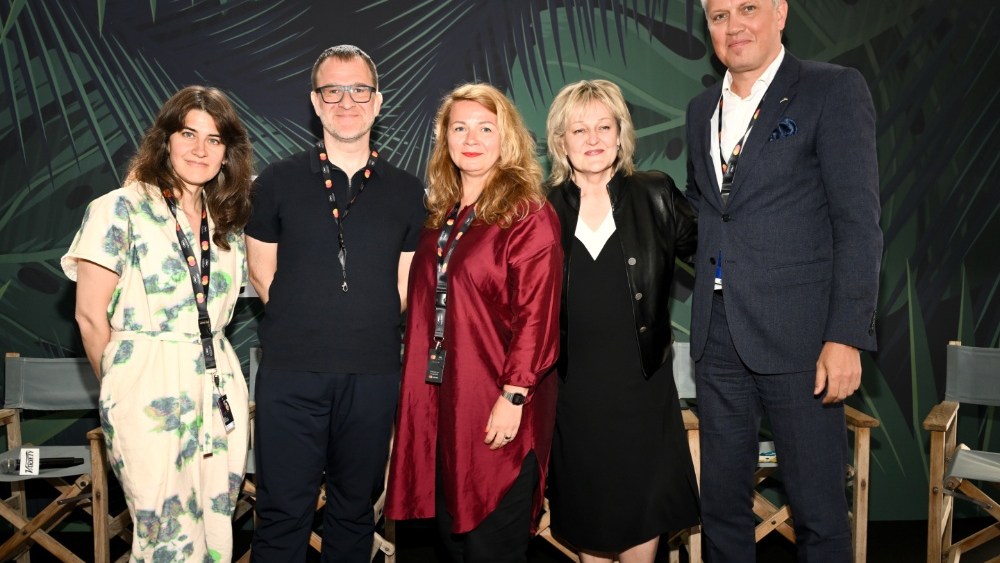
This ambition was made clear during a Variety Global Conversation panel featuring Edith Sepp, CEO of the Estonian Film Institute. Nele Paves, Film Commissioner of Film Estonia. Jonas Tartu, director of Tallinn Film Studio. Evelyn Pentilla, producer and Stella Film partner; and Virdjar Rubi, Estonian Ambassador to France.
Two studio complexes are currently under construction. One is scheduled to open later this year in eastern Estonia, and the other is a purpose-built complex in Tallinn. Tartu explained that the Tallinn project was not driven by real estate interests, but was designed by filmmakers, positioning the new complex as an anchor for the wider Nordic-Baltic region. “Don’t just visit, come and stay,” he said.
The Tallinn studio is seeking LEED Gold certification by incorporating solar panels, geothermal energy and smart water management. Efficiency, according to Tartu, translates into lower operating costs rather than additional production burdens.
Rubi said the government fully supports this expansion. “Estonia is not a market, it’s a country,” he said, arguing that in the absence of a substantial domestic market, the industry has always had to compete internationally from the beginning. He set a five-year goal to triple the size of the industry, primarily through the expansion of studios, adding that he believes the government has a role to play in enabling the industry by cutting regulations and red tape rather than intervening.
The studio’s push is backed by a cash rebate that was recently increased from 30% to 40%, placing Estonia among the top incentive schemes in the region, according to Paves. Sepp pointed out that both Paramount and Warner Bros. are filming in Estonia, and argued that the country’s advantage lies in its system’s agility in a tightening global production environment. “We listen to the filmmakers’ opinions. We always react to them and remain flexible. One of the keywords for Estonia is definitely reducing bureaucracy,” says Sepp.
Stellar Film’s Penttilä is about to launch its 10th Estonian cash rebate project. “It’s like having a boutique hotel experience, very personal and friendly but trusting,” she said of working in the country.
On the question of competency, Paves was straightforward. “You can’t do five big Hollywood productions at the same time. That’s not possible. We just don’t have the staff,” she said, adding that big Hollywood projects could be run alongside several smaller productions if needed, with staff supplemented from neighboring Latvia, Lithuania and Finland. The country’s film school in Tallinn produces new professionals every year, but Penttila said its workforce has roughly doubled since Christopher Nolan’s “Tenet” was filmed in Estonia.
“Tenet” remains the benchmark for what this country can achieve at scale. Director Paves recalled that 4,000 to 5,000 extras showed up on the film’s opening day, and described the production team’s reaction at the closing party: “It’s a small country, but it’s doing some amazing things.”
Paramount Plus’ “The Agency” series, which was filmed in Estonia last year, is the latest indicator of the country’s growing large-scale production footprint.
On the domestic front, Estonian cinema reached a domestic market share of 14% last year against a target of 20%. European titles collectively account for about 45% of the domestic box office, with U.S. releases accounting for most of the rest. The country’s international film festival profile was boosted by Anna Hint’s documentary Smoke Sauna Sisterhood, which won Best Director at Sundance in 2023 and Best Documentary at the European Film Awards, and Hint’s short Sauna Day, which premiered at Cannes Critics’ Week two years ago.
Sepp said that talent development and co-production will be another priority in the coming years, with the IDA hub complex in eastern Estonia particularly focused on developing the next generation of film professionals.
