

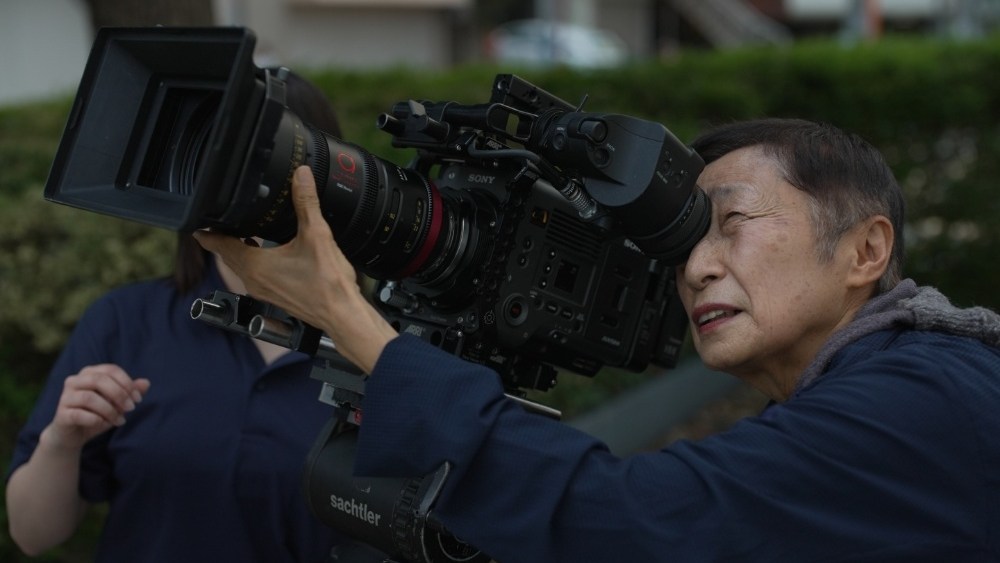
Akiko Ashizawa, a veteran of more than 70 feature films and one of the most accomplished cinematographers in Japanese film history, gave a wide-ranging masterclass at the Cannes Film Festival, tracing her career from her unexpected entry into the industry to her feature films spanning horror, comedy, drama, and historical blockbusters. This session took place before she received the Pierre Angénieux Tribute.
The event began with Ashizawa talking about his upbringing, which had nothing to do with movies until he encountered Jean-Luc Godard’s films as a student at Aoyama Gakuin University in Tokyo. His early ambitions to become a director were dispelled after seeing the 8mm works of his contemporary Yoshimitsu Morita. “He’s really talented and I can’t beat him, so I decided to look for another path. That’s why I chose to be a cinematographer,” she said.
Getting into the industry in the early 1970s required finding a side track. As there were no female camera assistants in the Japanese film industry, Ashizawa saw his potential in cinematographer Hideo Ito, known for filming Nagisa Oshima’s “The Realm of the Senses”, and he accepted her as his assistant. The lessons Mr. Ito imparted turned out to be fundamental. “Whether it’s a big-budget job or a small job like taking photos for a panel, there’s no question that you should give it your all,” she said, adding that she still passes that principle on to her assistants.
With the film industry still largely closed to women, Ashizawa moved into TV commercials in the 1980s, a new field with less entrenched male hierarchies, and returned to feature films in the 1990s.
Her breakthrough to sustained international recognition came in 2005 when she began working with Kiyoshi Kurosawa, Japan’s foremost expert on atmospheric anxiety. She told the audience that she pitched the collaboration herself after hearing that director Kurosawa was looking for someone who could shoot cloudy skies and dark weather. This is contrary to what she says is the preference of most Japanese directors for bright, sunny weather. Since then, eight feature films have been screened, including “Tokyo Sonata,” which won the Cannes Jury Prize in 2008, and “A Journey to the Shore,” which won the same category’s Best Director award in 2015.
Director Ashizawa also screened footage of Masato Harada’s “Mother’s Chronicle,” and expressed his condolences to director Harada, who passed away at the end of last year without fulfilling his ambition to visit Cannes. She described their working relationship candidly, before admitting that their friction produced one of her best results, saying that disagreements on set over camera angles persisted and that she would sometimes quietly patch things up when Harada’s attention was elsewhere. “Even if things don’t go well on set, you can still make a good movie,” she says. “On the other hand, even if you have fun on set, sometimes the movie doesn’t go well.” For this film, Ashizawa won the Cinematography Award at the 2012 Mainichi Film Competition.
“Journey to the Shore” prompted one of the more revealing technical discussions of the session. Ashizawa, who shot during the transition from analog to digital, said he rejected the “film-like” trends that were popular at the time and decided to take advantage of what digital could uniquely do. She pushed the Sony camera beyond the manufacturer’s recommended limits (shooting at ISO 3200 or 4000 instead of the manual limit of 1600) and built a custom LUT designed to preserve rather than eliminate the digital noise that most cinematographers have sought to suppress. The lens is a vintage Kowa CinemaScope glass that is more than 50 years old, and she found it to be an unexpectedly good match for modern digital sensors. The entire movie was shot with three lenses.
Her broader philosophy toward digital technology emerged as a consistent thread. “If you think you can do something later, that means you can’t do anything right now,” she says, explaining that she prefers to fully commit to tone and image during pre-production, rather than deferring to color suites.
Ashizawa also made some green peppers she had bought at a local market the day before on the podium to illustrate her preferred method of camera testing. “It’s easier to understand the natural lighting conditions by taking pictures like this than by setting up a chart.” “Now that I’m in Cannes, I’ve confirmed that peppers are the same color all over the world, so I’m going to continue using this vegetable as a chart for my camera tests.” She joked that once the test is complete, she can turn the vegetable into a salad.
A discussion of his recent work with Indonesian director Edwin (his second collaboration after 2021’s Locarno’s Golden Leopard Award-winning Revenge is Mine, Others Pay Cash) revealed the adjustments required when working across cultural contexts. Regarding the horror film “Sleep No More,” which premiered at this year’s Berlin International Film Festival, Ashizawa said he noticed that the concept of horror in Indonesia and Japan is significantly different. The former is physical and tactile, the latter more conceptual and psychological. “The director also changed his approach, and I think this is a work that can be understood by people all over the world,” he said.
When asked how the industry has changed since she entered the industry as a woman, Ashizawa answered candidly. “It’s changed dramatically,” she said, citing an increase in the number of female cinematographers and assistants and Toho Studios adding day care facilities as evidence of structural change.
At the end of the session, she expressed her desire to shoot her first Korean film. “I haven’t worked with our neighboring country South Korea yet, so I would like to do so if I have the chance,” he said, before going back to first principles. “In this chaotic and dark world, I hope that the film will become a ray of light that brightens the world,” she said.
French actress Irene Jacob, who co-starred with director Ashizawa in Koji Fukada’s “Sayonara,” also participated in the master class. Director Ashizawa becomes the second female cinematographer to win the Pierre Angénieux Award, following Agnès Godard in 2021.
