

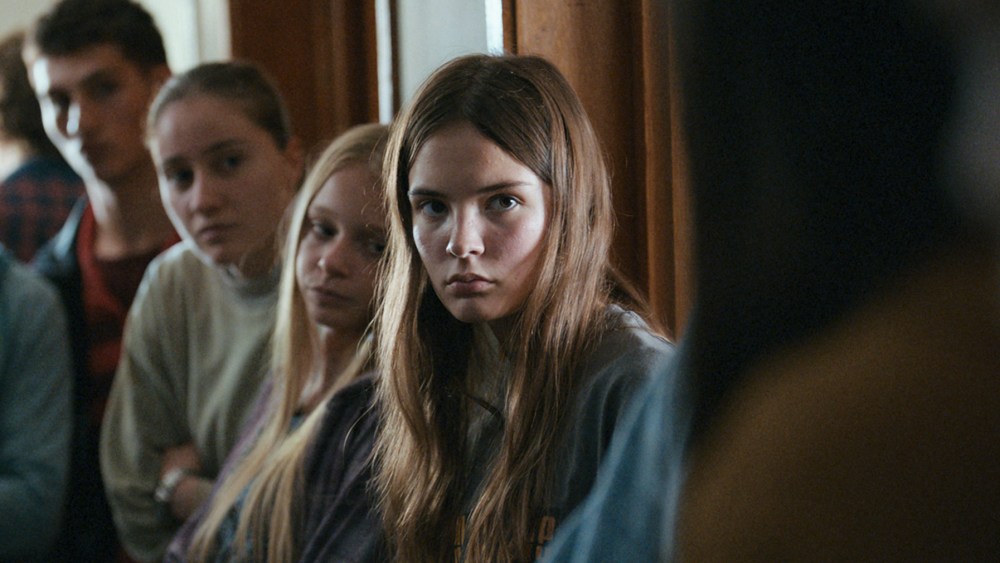
An increasingly moody coming-of-age drama, Blerta Basholi’s second feature, Dua, follows her 2021 Sundance Prize-winning debut, Hive, reflecting on Kosovar women in the late 1990s. However, this time, the director draws on her own experiences as a young girl who came of age in the shadow of the Kosovo war. This conflict looms large for the film’s Kosovar Albanian teens, as does the institutionalized discrimination against them, but Basholi’s purposefully unblinking focus reveals both bondage and liberation through the eyes of her 13-year-old protagonist. Despite its flaws, “Dua” is, by any comprehensive measure, a mixed bag of dramatic experiences, but it unfolds confidently into something fully and richly formed.
Seal’s “Kiss From A Rose” set the tone and era as the camera peered over the shoulder of the reclusive protagonist Dua (Pinea Matoshi) and virtually into the past as her high school classmates passionately debate which boys they would like to flirt with at a party. Through scenes of gossip, frolics, and even foot chases as the cops try to quell the commotion, Basholi introduces her setting (Pristina, Kosovo in the late 90s) as if the audience is an active participant in every conversation and knows the girls’ secrets.
As the lens follows Dua, often from up close and from behind, this mode of expression proves to be alternately absorbing and alienating. But the emotional impact of Basholi’s aesthetic also has an intellectual and political dimension. While the camera is fixed on Dua’s perspective, the world outside of her peripheral vision radically changes in ways we are not allowed to see. The corner of the frame becomes the place where you intuit fear.
But we are allowed to listen to these things. Rather, we are allowed to experience them through an eerie, jagged sound design that embodies each metamorphosis as an echo of a distorted structure. Dua, like the world around it, is still developing, but it may collapse at any time. The closest we come to witnessing this destruction is through frequent (albeit repetitive) radio news broadcasts showing geopolitical developments courtesy of distant world leaders.
More effective and immediate than any political book are the disturbing implications of the state and sexual violence just outside the frame, invading Dua’s innocent story of searching for her first kiss and waiting for her first period. For Dua, adolescence and social maturation are intricately intertwined with unpredictable notions of physical harm (whether action-based or simply threatened). On her way home from school, Serbian boys and men harass her, mixing their abuse with ethnic slurs. In a desperate reaction, she turns to Maki (Vlera Bilali), one of her stubborn refugee classmates, to whom war is a more concrete reality, to help her formulate a response plan. After weeks of judo training, Dua is physically ready for revenge, but lacks the emotional wherewithal to properly channel his righteous anger, which inadvertently paints a target on his family’s back.
As the film moves back and forth between these various plot points, its nature as a collection of memories proves both the film’s greatest strength and weakness. “Dua” lacks the consistency of traditional dramas. Its naturalistic tone does little to compensate for the almost stream-of-consciousness that unfolds, and it could have benefited from a more esoteric, dream-like visual approach. Still, the film’s naturalism also helps connect its disparate parts. Matoshi is a revelation, performing with a deceptive simplicity beyond his years, layering quiet enthusiasm and confusion beneath his stoic exterior. Basholi discovered her young lead role while auditioning for her younger sister, Kaona, and was in turn cast as Dua’s sister Tina on screen. It’s one of several examples of emotional realism that pierces the film’s temporal veil, theoretically turning it from a series of flashbacks into a more urgent contemporary story depicting how the war trickles down and fundamentally alters a young girl’s life.
Dua’s family is at the center of many scenes, captured in uninterrupted long takes by Bashouri and cinematographer Lucie Bourneau. When you look at these shots, your eyes are drawn to Dua, not just as an individual, but as a piece of a puzzle within a larger portrait. There, other important people (her brother, father, etc.) are fighting their own battles in private and on the front lines. Meanwhile, as her younger brother, Dua is excluded from important conversations (sometimes literally, as the bedroom door is closed in her face and important decisions are made without her), and she is branded an outsider even within the household. The whole is rarely coherent as a moment in time and space, but momentarily very exciting.
These stylistic flourishes help make the audience love Dua. She is a child observing and absorbing a changing world, but the film itself has little to do with these observations. At times, as Dua is shaken from within, the frame is transfixed by haunting, practically subliminal changes facilitated on an unconscious level, and the remarkable Matoshi releases a recognizable mass of emotion from beneath his rock-hard exterior. At other points, however, the energy of Vasholi’s subjective camera stagnates. All you can do is follow Dua through hallways and alleys over and over until the seams in the film begin to show and begin to tear.
It’s rare that we get enough of an “objective” point of view to make the film a true retrospective of the times lived and processed, a broader, top-down look at the world around Dua, the filmmaker’s expression of looking back on his childhood with some sort of wistfulness, bitterness, or whatever. Due to its nature, Dua is a good movie that falls short of greatness. But while it’s a reenactment of a moment remembered long ago, it’s also exactly what it wants and perhaps needs to be.
