

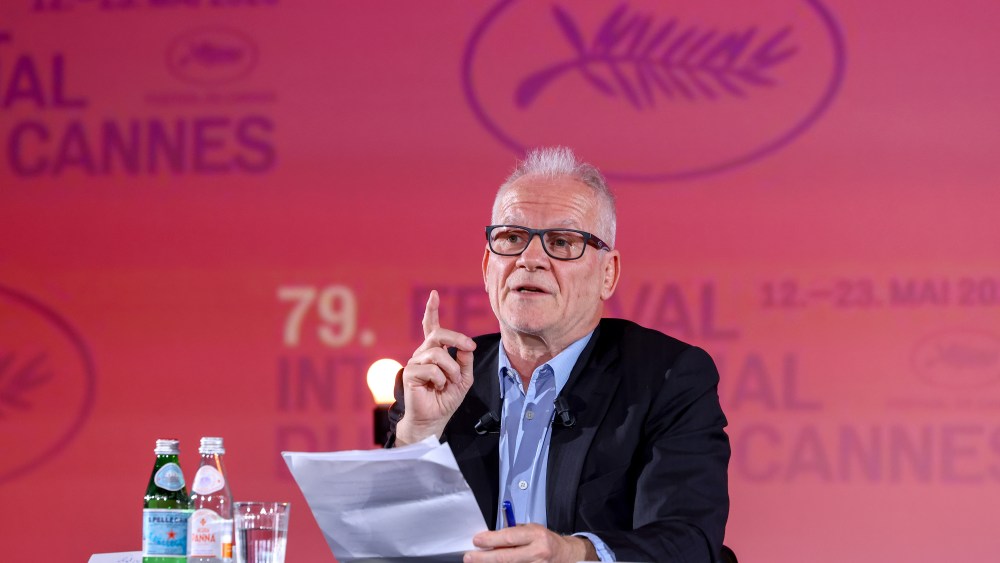
Asked about the Academy’s new rules regarding AI, festival director Thierry Frémaux described them as “obvious”, sounding nostalgic about the days of celluloid film. He claimed that Francis Ford Coppola’s Apocalypse Now was a true symbol of its era and was the “last organic film” he had seen.
“The helicopter in the Valkyrie scene was actually owned by Francis Ford Coppola,” Fremaux said. “Today, thanks to digital technology, a filmmaker can say, ‘I’ve got six helicopters, give me 15,’ and you don’t know what you’re watching. Digital effects are everywhere now, even in arthouse movies.” The problem, he says, is that “the risk of lying is high.”
The Cannes festival director, who is celebrating his 25th year as director this year, also objected to the Academy’s new rules for films that have won the top prize at six major international film festivals.
“People say America is turning against itself, but that’s not true. In any case, Hollywood is embracing universality and opening up to the world. For us, that’s what Cannes is all about, universality is important,” he said.
Fremaux also talked about the festival’s relationship with Hollywood and how there are no new blockbusters scheduled for the 79th edition, which will feature a midnight showing of Universal’s Fast and the Furious to celebrate its 25th anniversary.
“Hollywood, as you know, is going through a huge transformation. After COVID-19, after the writers’ strike (related to issues around artificial intelligence, by the way), after restructuring, mergers, acquisitions, etc. In this context, the triumph of that great invention known as the streaming platform, all of this needs to be reinvented,” he said.
However, Frémaux said he is hopeful for the future of American cinema, noting that the film industry was also facing a crisis in the 1960s, just before the birth of the New Hollywood era of Arthur Penn, Martin Scorsese, Francis Ford Coppola, and William Fritkin.
Frémaux was also asked to react to the fact that France will hold its next presidential election next year and that the country’s far-right party is leading in early opinion polls. Frémaux said that partly due to the fact that the festival was founded during the tumultuous 1940s, festivals are “often asked to play a role in thinking about issues that don’t directly concern them.” However, he declined to comment further on the outcome of these alleged French elections or their potential impact on the cultural sector.
“Certainly, in a year’s time, (the election) won’t be talked about anymore because the election will be behind us and the festival will take place afterwards,” he said. “This has happened quite often in the past, because presidential elections are usually held in April or May, and the Cannes Film Festival is held in May. I myself know several presidents of the republic, so we will see in time.”
The festival opens on Tuesday with a tribute in honor of Peter Jackson and the world premiere of “Electric Kiss.” As previously announced, Park Chan-wook will serve as the head judge.
