

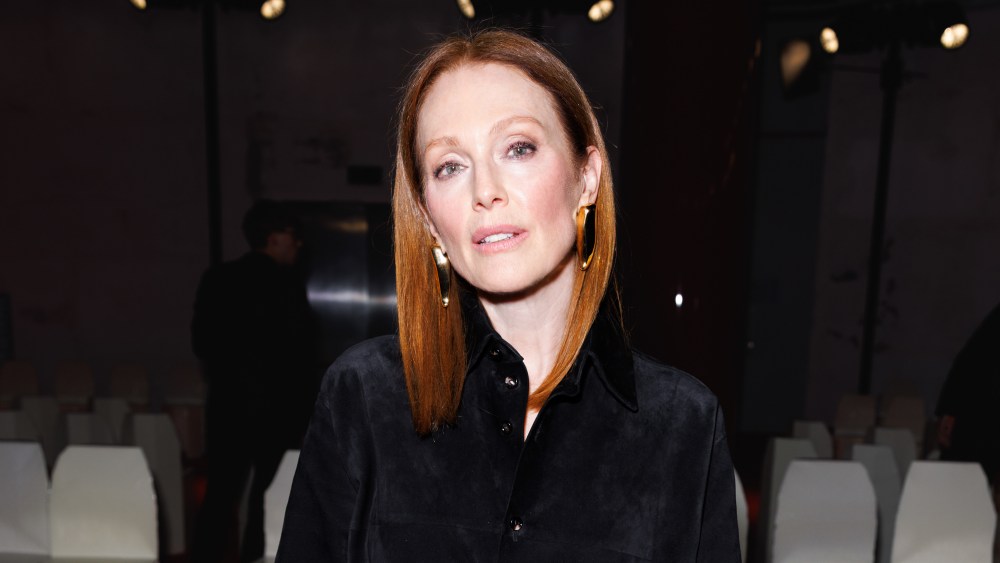
Academy Award-winning actress and activist Julianne Moore will receive the Kering Women in Motion Award at this year’s Cannes Film Festival.
Established in 2015 by Kering, official partner of the Cannes Film Festival, the Women in Motion Award celebrates female artists whose careers and contributions advance the role of women in both film and society.
Moore joins an esteemed lineup of past honorees, including Nicole Kidman, NBCUniversal Entertainment & Studios Chairman Donna Langley, Jane Fonda, Geena Davis and Susan Sarandon, Isabelle Huppert, Patty Jenkins, Gong Li, Salma Hayek Pineau, Viola Davis and Michelle Yeoh. She will be celebrated alongside Italian filmmaker Margherita Spampinato, winner of the Emerging Talent Award, at the official Women in Motion Awards ceremony on May 17th.
“Julianne Moore perfectly embodies the spirit of Women in Motion,” said François-Henri Pinault, chairman of Kering, in announcing her selection. “Through the consistency of her artistic choices, the depth and complexity she brings to her performances, and her long-standing dedication to advancing meaningful representation on and off screen, she has helped redefine what it means to be a leading woman in film. Her career and commitment clearly reflect the values that Women in Motion has championed since our founding.”
The acclaimed actor has built a career defined by versatility and depth, with an extensive filmography that includes “Still Alice,” “Far From Heaven,” “The Hours,” “The Kids Are Alright,” and “Boogie Nights.” She most recently appeared in Todd Haynes’ Golden Globe-nominated May December, Apple TV’s Echo Valley, Pedro Almodovar’s The Room Next Door, the Netflix limited series Sirens, and the historical miniseries Mary and George. Moore will now star in an untitled musical comedy directed by Jesse Eisenberg for A24. Off screen, Moore is the children’s author of the New York Times bestselling “Freckled Strawberry” series and the founding chair of the Everytown Creative Council for Gun Safety.
“I am deeply grateful for this recognition from Kering and the Cannes Film Festival. Being part of the Women in Motion legacy means so much to me,” Moore said in a statement. “I have always believed that visibility is important and that the stories we choose to tell can expand the space for women and a richer diversity of voices both on screen and behind the camera. Continuing to work together to amplify women and diverse voices and support the next generation of creators will help build more open and more representative cinema while driving real change.”
In 2024, Moore spoke at Cannes to support Kering’s Women in Motion program. These in-depth conversations strengthen the Kering Group’s commitment to creating space for dialogue and action, and are key to the success of this initiative.
Iris Knobloch, president of the Cannes Film Festival, said: “Julianne Moore doesn’t use movies to reassure her. For 40 years, she has chosen characters who have been unstable, who have suffered without resolution, who have rejected easy sympathy; “She has claimed territory on screen that didn’t exist before Lean, and the Women in Motion Awards recognize not only what she achieved, but what she enabled for all the actresses who came after her.”
Similarly, Thierry Frémaux, executive director of the Cannes Film Festival, praised Moore as “one of the greatest actresses in modern cinema.” Moore, who won Best Actress at the 2014 Cannes Film Festival, became the first American woman to win the top acting award at the Berlin, Venice, and Cannes Film Festivals, cementing her status as one of the most respected performers of her generation. (Moore won for her performances in Far From Heaven, The Hours, and Maps to the Stars, respectively.)
“Throughout her uncompromisingly rich and diverse filmography, she has constructed her work with remarkable intelligence and patience, delivering performances of rare emotional precision,” Frémaux said. “Working with some of the most important filmmakers of our time, she brought deep sensitivity, an extraordinary sense of nuance, and a fearless engagement with complex characters to each role. Film after film, she left an indelible mark on the history of cinema, fully portraying the strength, contradictions, and freedom of women.”
Women In Motion also presents the Emerging Talent Award each year. The award recognizes a female director who has made her first feature film and provides a grant of 50,000 euros to specifically support the production of the filmmaker’s second feature film. This year’s award went to Spampinato, whose debut film Gioia Mia is said to “reflect the vitality and originality of a new generation of filmmakers shaping the future of cinema.” Spampinato was chosen by previous Brazilian coach Marianna Brennand, who received this honor last year.
“I am grateful and honored to receive the 2026 Women in Motion Emerging Talent Award. It is a great honor to receive this award from Marianna Brennand, a director I greatly admire,” Spampinato said. “This award moves me because it supports the creativity and freedom of new female voices in film and art around the world.”
Spampinato’s “Gioia Mia” tells the story of a boy who “discovers love, memory, and mystery during an unexpected stay in a Sicilian seaside town” at his aunt’s house, and “captures the freshness of childhood while exploring themes of transmission, hidden history, and the invisible.” The film premiered at the 78th Locarno Film Festival and won two Pardi Awards in the Cinesti del Presente category. Following the Locarno Festival, “Gioia Mia” won over 20 awards at festivals in Italy and abroad.
“Like the title, ‘Gioia Mia’ felt like a gem to me. Margherita is the perfect storyteller. She has a very unique and precise way of turning everyday moments into something magical,” Brennand said. “I loved how empathetic she was with the characters. The tender bond between two people from different generations, a boy and his great-aunt, unfolds through heartbreak and impossible love. But beneath the tenderness lies something heavier: the quiet violence of a patriarchal world that resides in the body and soul of an older woman who was never allowed to fully exist. I’m really looking forward to seeing what Margherita does next.”
