

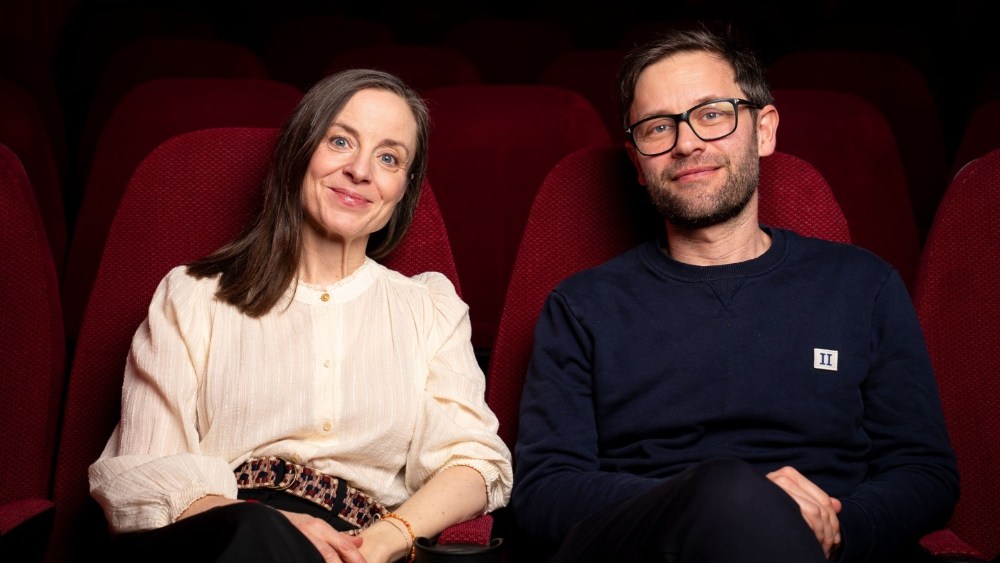
Copenhagen International Airport as elections approach in Denmark. The documentary film festival, also known as CPH:DOX, will be involved in the national debate during its 23rd edition, which runs from March 11 to 22.
“I think that’s our biggest aim: to be an open platform for the democratic dialogue that needs to happen. And we want to make our mark by making people a little bit smarter before they vote two days after the festival,” said Catherine Kielgaard, managing director of the festival.

“Sandbox”
Courtesy of Kenya Jade Pinto
One of the core values proclaimed by the festival is the importance of harnessing curiosity and challenging the status quo. Nicklas Engström, the festival’s artistic director, points to Kenya Jade Pinto’s “Sandbox” as an example of a film that achieves this goal. The film, which will be screened in main competition, “asks difficult questions about how borders are secured using surveillance technology and how it may ultimately be used to surveil us all.”
He added that the topic is also relevant to Denmark, as immigration will be one of the key election issues.
Another hot issue in the Danish election will be the status of Greenland, given President Donald Trump’s stated intention to annex the vast semi-autonomous Arctic island of Denmark. Although the issue will not play a major role at the festival, CPH:DOX will screen Greenlandic filmmaker Johannes Udjo Müller’s “Our Flag,” Engström said. The piece centers on local artist Tu Christiansen’s creation of the Greenland flag in 1985. Unlike other Nordic flags, it does not incorporate a Christian cross, instead drawing inspiration from the sun rising over the sea. “This says a lot about Greenlanders’ long-standing desire to have their nationality and perspective represented,” Engström said.
Engström emphasizes the importance of making the festival a “public space for dialogue.” “It is very important to us that we champion all filmmakers, their voice and their place as artists, and present documentary films in a way that is inspirational and engaging.”
However, he warns: “But we also want to curate a program that is not a safe space, where these films are in a kind of echo chamber. I think the most important thing for festivals today is to curate a space where we can have very difficult conversations about disagreements.”
“Unwanted Palestinians”
Courtesy of CPH:DOX
He added that the festival will “build bridges between people with different opinions, coming from different perspectives and points of view.”
Another film that asks tough questions is Omar Shargawi’s “Unwanted Palestinians,” Engstrom said. It depicts his experiences as a Danish-Palestinian during the Gaza War and “how he perceives the Danish media environment and how the media has covered the Gaza War.”
In particular, Mr. Shargawi has criticized Danish media for refusing to portray what happened in Gaza as a genocide.
“This isn’t a movie that tries to be objective or have a lot of nuance. This is an angry activist movie that could definitely spark some debate,” Engstrom says. “And what we’re doing is inviting the Danish media to a dialogue with the director. So the film won’t be shown in an echo chamber where the only audience is people who already agree with Omar Shargawi, because no one will be any wiser about it.”
“If good luck comes”
Courtesy of CPH:DOX
Another core value of the festival is diversity in the broadest sense. It’s “more than what DEI (diversity, equity, and inclusion) in the United States includes; it’s geographic diversity, political opinion diversity, and perspective on reality,” Engstrom says. “Diversity” also applies to “the broad genre of documentary and how we can expand on what it is and what it can be,” he says.
All of this is reflected in the curation of the program, so that “we create a program that somehow feels like you have all these voices in your head and that the very complex elements of reality are being dealt with in a fair way.”
He points to two films about Afghanistan, “If Luck Will Come” and “Kabul Between Prayers,” to illustrate his point. The first depicts “the horrifying situation young girls find themselves in after the Taliban takeover,” and the second follows Taliban members, Engstrom said. “I’m not saying this is as good as anything else. It’s just that you need to constantly challenge yourself and gain new perspectives to become smarter,” he says.
“Prayer Room in Kabul”
Provided by Silk Road Film Salon
The need to show different points of view also applies to the Israeli-Palestinian conflict, and it is necessary to show both what happened to the hostages taken by Hamas and the fate of the Palestinians in Gaza. “As festivals, we have a huge responsibility to expand rather than narrow reality,” says Engström.
Some film festivals, such as IDFA, exclude Israeli films that receive government funding. CPH:DOX’s position is different. “It is important for us to say that the festival is built on freedom of expression, independence and impartiality, and that, as Niklas said, it is an open platform where different voices are presented and debated in an open and democratic way, as part of an open dialogue, and that perspective. From the point of view, we don’t really impose political boycotts or exclude filmmakers for nationality or any other reason. And it’s very important that we maintain this position, so to speak, and not exclude in advance anyone who might take sides.”
Engström added: “I think it’s important to add that it’s not that we’re not horrified by what’s been happening in Gaza over the last few years. All of us at the festival feel really deeply about how horrible that war was and the enormous human rights violations and atrocities committed by the Israeli military. But we just believe that our role in this world would be seriously undermined if filmmakers started pointing at other countries where they wouldn’t be.” welcome. ”
Variety contacted the Israeli embassy in London for a response to Engstrom’s comments about the Israeli military, but did not receive a response as of press time.
Regarding the recent situation at the Berlinale, referring to its relationship with politicians, Kyilgaard said: “We have an independent policy and I can say that it is working very well. Therefore, we do not believe that there is any political pressure from our funders or supporters.”
Looking at the broader political situation, Engström said: “We are approaching a new world order and a new reality, where polarization is part of it and political pressure is growing in many countries. We are certainly ready to tackle these very difficult questions.”
