

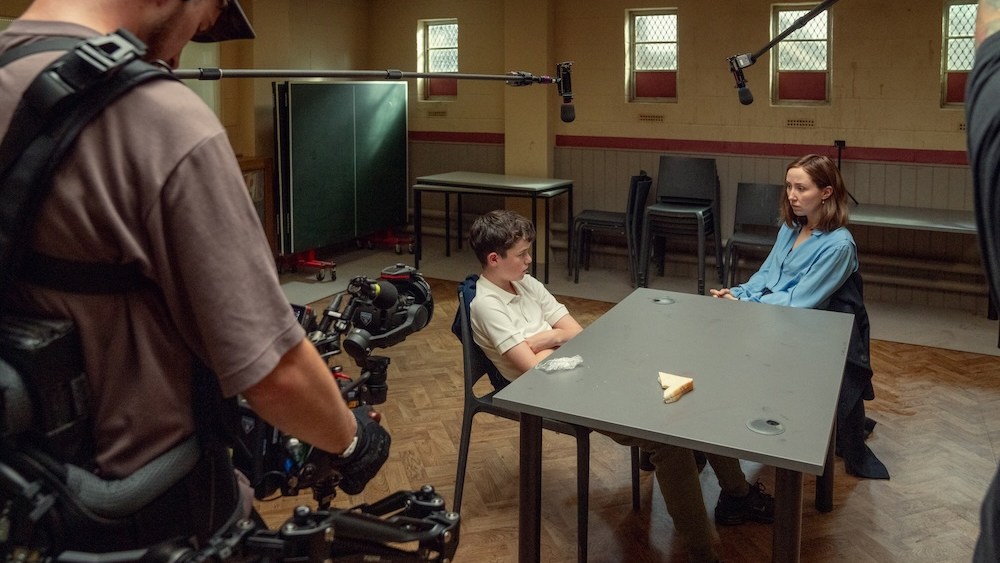
Emmy Award-winning cinematographer Matthew Lewis and camera operator Lee David Brown hinted during a WAVES Film Bazaar panel that they plan to produce a one-off series following Netflix’s Adolescence, but emphasized that the new project will tell a different story.
“No two stories are the same, because that story is definitely over,” Lewis explained in a session moderated by actor Rajdeep Chaudhry. “But we’ll probably make another production in the same format in the future, but not yet. We’re going to let it breathe…We don’t want to saturate the market with one-shot productions, because eventually everyone gets really tired of it.”
Lewis won the 2025 Primetime Emmy Award for Outstanding Cinematography in a Limited or Anthology Series or Movie for the First Season. The series won a total of eight Emmy Awards and rose to prominence through hour-long episodes filmed in seamless single takes.
For production, I used a DJI Ronin 4D and Cooke SP3 lenses. Lewis initially considered Sony Venice and Arri Alexa Mini cameras, but found those setups either technically couldn’t last an hour or were too cumbersome.
“My grip actually suggested we use DJI’s 4D, and we had a test day with it and we loved it,” Lewis said. “This means the camera can be passed between people very easily. It’s so lightweight that we didn’t have to mount the camera.”
The team programmed the lighting into a desk system with cues that corresponded to camera positions, with 50 to 60 different cues for the first episode alone. “We basically had built-in lights connected to the lighting desk, and basically every position the camera went into was like a new cue for us,” Lewis explained.
Blocking was developed through extensive collaboration. “Most of the blocks were conversations between me, the director, the actors, and sometimes the screenwriter,” Lewis said. “If it was a school and we couldn’t tear down the walls, we had to add dialogue to certain walks and conversations, or omit dialogue in certain places.”
Brown emphasized performance-oriented camera work. “The camera movement needs a motive, the lighting needs a motive,” he explained. “I don’t think I’ve ever had a camera move or do something based on something as small as a look or a slight movement.”
Lewis emphasized that the story remains paramount. “It’s easy for a one-shot to make too many compromises and ruin the story. I didn’t want that to happen because I wanted people to forget that it was a one-shot and just get into the story,” he said.
A technical mishap occurred during a long shoot. Lewis hits a wall in episode one and retreats into a fence in episode two. Forty-five minutes into the fourth take, a shock flashed across the actor’s face.
Brown said the ride journey in Episode 4 was particularly difficult. “Every time I turned a corner, went up a hill, or went around a roundabout, I was constantly adjusting the camera remotely from the wheel,” he said.
In episode two, when actor Ryan jumped out of a window at the camera handoff point and neither operator could see the monitor, Brown had to make a quick adjustment. “It was just a reactive moment, but I think it helped add energy to this section,” Brown explained.
The operators had never worked together before production. “The truth is, before ‘Youth,’ we had never met. ‘Youth’ was the first work we made together,” Brown said. Lewis started running eight months before filming, but injured his knee during filming.
Lewis praised stars Stephen Graham and Owen Cooper, but Cooper expressed uncertainty. “With Owen being a kid, we didn’t know he was going to be a good player,” Lewis said. “We were just starting to see that he was very good in this area in energy leads. But at that point, we had already committed to him. Luckily, he was great.”
The decision to use a one-shot format stems from Lewis’ previous “Adolescence” director Philippe Barantini’s “Boiling Point.” “That immediately started a discussion about where this format could be adopted,” Lewis said.
While expressing pride in the project, Lewis emphasized the limitations of the format. “This is definitely not the best way to make everything, there are big compromises everywhere, but it teaches you a lot about camera language and motivation,” he said. “I’m more proud of this project than any other project I’ve ever done. I’m usually very self-critical, so it’s really nice to look back on something and think, ‘Oh, objectively it’s pretty good.'”
WAVES Film Bazaar is part of the Indian International Film Festival Market in Goa.
