

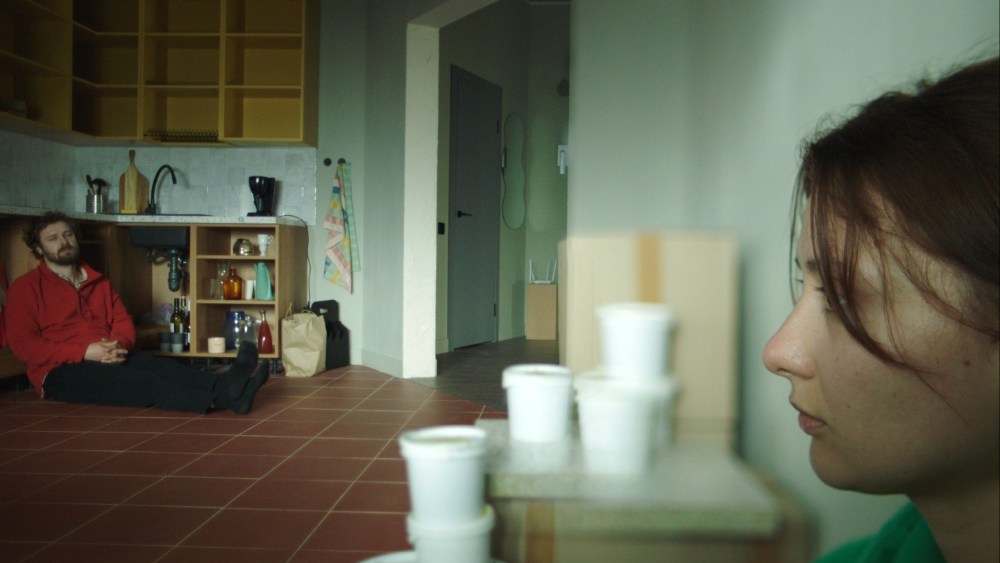
Socially and politically engaged films continue to dominate the lineup at the 40th Friborg International Film Festival in Switzerland. Among the titles in the international competition is “Honeymoon,” a chamber drama by Ukrainian filmmaker Zhanna Ozilna about a newlywed couple trapped in an apartment as Russian troops close in on the Kiev region at the start of the 2022 invasion.
Ozilna’s debut film, which will be shown for the first time in Switzerland at FIFF, takes an intimate approach to a subject that has often been documented through front-line footage and press coverage. Instead of depicting combat directly, she leaves the harsh realities of war largely off-screen, focusing her attention on what happens within human relationships when fear and survival instincts dominate every aspect of daily life.
The project was born out of the testimonies Ozilna encountered early in the war. Her friends endured weeks in hiding, but the story of one family in particular who had to crawl on the floor of their apartment to avoid being seen stuck with her.
“That image stuck with me,” Ozirna says. “Crawling for days just to stay alive felt like a violation of basic human dignity.”
Rather than building the film around a family’s experiences, she drew on multiple testimonies and crafted them into the story of a couple. “I wanted to keep it minimal,” she says. “For me, war was more of a frame, and the real subject matter was human relationships. I was interested in how people behave when they lose their sense of safety and dignity, and how relationships change in such situations.”
That approach also shaped the film’s ethical framework. Ozilna points out that there is an ongoing debate in Ukraine about how to depict the ongoing war. She was determined not to exploit trauma, and one of her early decisions was to avoid casting actors who had lived under occupation.
“We talked to some very strong actors who had been through it,” she says. “But they told us it would be re-traumatizing. So we clearly understood that we couldn’t ask them that.”
Her refusal to show Russian soldiers on screen was equally deliberate. Their presence is conveyed entirely through sound: their footsteps, distant explosions, and a constant sense of threat. This was both a practical decision to create on a limited budget, but also a conceptual one.
“I didn’t want to simplify the enemy, and I didn’t want to humanize the violence that felt false to me,” she says. “So they remain like ghosts, something always nearby, something to fear, something that could come back at any moment.”
As the film continues to be shown around the world, Ozilna is keenly aware of the gap between those living the war and the audiences who encounter it from afar. Although global attention has shifted, everyday life in Ukraine is still defined by uncertainty. “People abroad live their lives and it’s normal,” she says. “But it’s different for us. Sometimes we can’t even plan a few days ahead.”
For Ozilna, fiction offers a way to bridge that gap, allowing audiences to focus on the human cost of war in its most intimate form. “There are a lot of documentaries that show what’s going on,” she says. “But fiction can explore other things by focusing on intimacy, relationships, and how people really feel.”
