

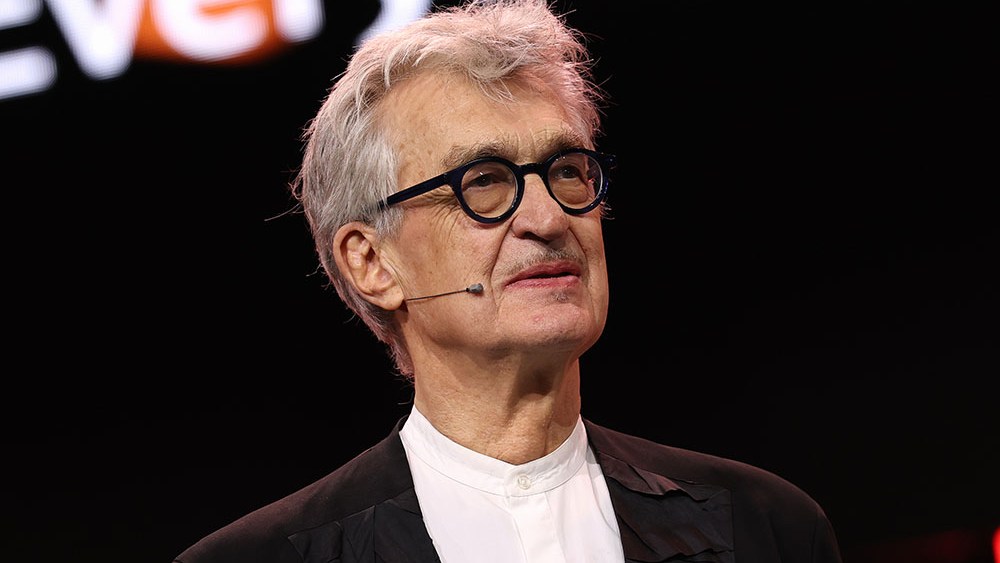
Before beginning the presentation of competition awards, Berlin Film Festival jury president Wim Wenders opened proceedings with a prepared statement in response to the controversy that has ravaged the festival since its opening press conference last week. In it, he controversially said that filmmakers are “opponents of politics; we are the opposite of politics.”
Tonight, he modified those words in a more nuanced and conciliatory way, declaring that the languages of political activists and film artists are different but complementary. His attention-grabbing words came during a ceremony honoring several overtly political films, including Palestinian-Syrian filmmaker Abdallah al-Khatib’s Perspective Award winner Chronicles of the Siege, in which he lambasted the German government as a “partner in Israel’s massacre of Gaza,” which you choose not to care about.
Meanwhile, Wenders’ own jury awarded the award to German-Turkish director Ilker Çatak’s “Yellow Letters,” about the Turkish government’s repression of artistic protest, and fellow filmmaker Emin Arpels’ genocide “Salvation,” which the filmmaker explicitly says is an allegory for multiple global atrocities, including recent events in Palestine and Iran.
Wenders ended his statement sharply by quoting Golden Bear winner Tilda Swinton’s speech at last year’s Berlinale. Swinton was one of more than 100 film artists who signed an open letter this week criticizing Wenders and Berlinale’s “silence” on Palestine.
Wenders’ full statement:
“What is the common language of the Berlinale? How do we express ourselves, apart from words, about what we think and how we feel about the world, this beautiful, insanely complex, scary, out-of-control world we live in right now? It was the language of cinema that this jury of seven countries had in common. It was the dominant language of the Berlinale for 70 years. It was always accompanied by the language of critics and journalists. It was and is a highly politicized place.
And since we live in the 21st century, there is a fast and fast world language: the language of the Internet. Lately, the festival has seen a debate over which language should have the sovereignty of interpretation. Our language, cinema, is highly differentiated, there are as many approaches to this language as there are filmmakers, and the films that you have already seen before us are also part of it. What most filmmakers’ work has in common is compassion. In all 22 films we saw, this was the prevailing attitude, and it will be strongly reflected in all the films that win tonight’s awards. The language of the film is empathetic. Words on social media are effective.
We need to talk about the artificial discrepancies that are happening here in Berlin. Activists are fighting for humanitarian causes – the dignity and protection of human life – primarily on the internet. These are also our causes. As the Berlinale film clearly shows, most of us filmmakers applaud you. We all applaud you. You do the necessary and courageous work. But should it compete with ours? Do our languages need to clash?
Our tools are stories, faces, places, words, and emotions. Our approach can be critical, satirical, comical, dramatic, poetic, but always intricate and complex. Our most effective instrument is called “Anschor” in German. I love this word. It’s hard to translate into English, but it’s like a visual, sensual, existential immersion. But even if we speak very different languages, we need each other: activists, friends of the oppressed, agitators against the oppressors. If we treat each other as allies, as different but complementary languages, our shared cause is more likely to resist the ever-changing winds of consumption, abstraction, and saturation.
Let’s not abandon or underestimate each other’s reach and potential. Movies are less likely to be forgotten and will certainly outlive the short-lived attention spans the internet provides, but our urgency, nay, your urgency, reaches places our movies can’t. This shouldn’t be a competition. It’s a partnership. Tilda Swinton, in her wonderful speech accepting the Golden Bear last year, said it beautifully: “Doing something for something has never, ever meant going against someone else.” This is something so simple that it is always overlooked. ”
