

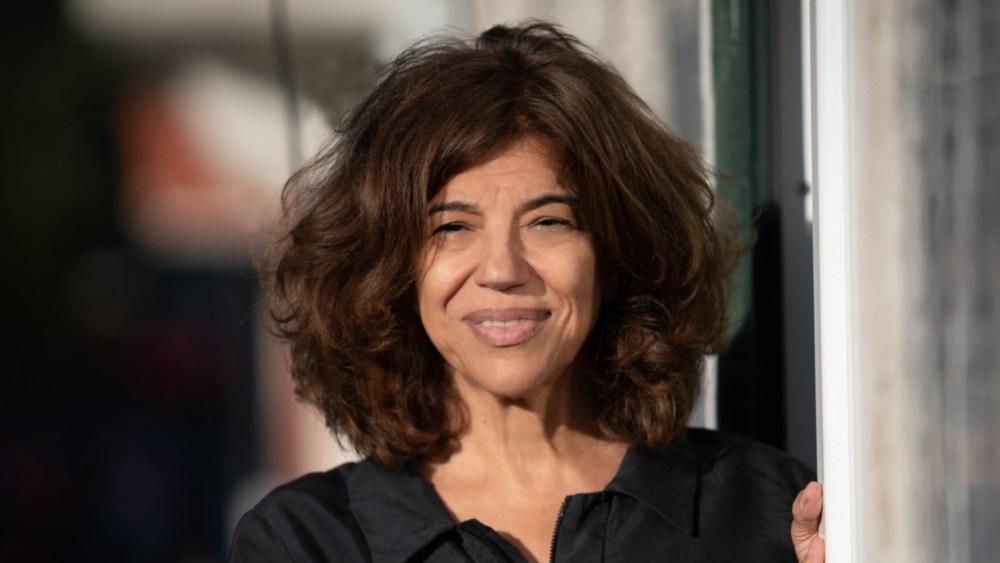
IDFA’s guest of honor, Portuguese documentary filmmaker Susana de Sousa Díaz, spoke this week to the festival’s artistic director, Isabel Arate Fernández, about how she sought to interrogate the repressive methods of her country’s fascist regime through archival and contemporary footage research.
De Sousa Díaz, who became a filmmaker influenced by Italian neorealist masters such as Luchino Visconti, first became interested in digging into archives and revisiting historical subjects when he was asked to direct an episode of a series about Portuguese cinema.
Her story takes place between 1930 and 1945, when fascism tightened its grip on Portugal, beginning a 40-year reign of terror presided over by Antonio de Oliveira Salazar.
She then came across the case of two Portuguese nurses who were imprisoned for protesting a law banning nurses from marrying. She decided to make her first film in 2000, Criminal Case 141/53, about nurses. One of the nurses endured frequent beatings and solitary confinement.
This led her to look deeper into the archives left behind by fascist regimes, especially the records of the political police, which she says are extensive.
This led to his 2005 feature Still Life, based on images from news reports, propaganda films, and prison archives, and 2009’s 48, which juxtaposes regime photos and testimonies of political prisoners decades later to reveal the violence they suffered.
She commented that discovering a photo album of an imprisoned political prisoner inspired her to create “still life paintings.” “It made a huge impression on me, but I can’t express it in words,” she said. But she also realized that there was much missing, including the brutal stories behind the photographs. That’s what she was trying to uncover.
“If you go to the archives of the political police, you won’t find any mention of torture. You’ll see reports about interrogating prisoners, but it won’t say that they tortured them during that time,” she said. “My films, in a way, are trying to bridge that gap.”
She added that the police archives had turned her worldview upside down. “It completely changed my outlook on life, my outlook on history and everything else. Being inside the (police and military) archives is a very unsettling experience,” she said.
Nevertheless, she decided to use only images from police and military archives, as well as archival footage created under the control of the dictatorship.
This posed a dilemma for the director, as these photos and videos were taken from the perspective of the dictatorship. “I wanted to show the other side of the dictatorship, so I had to really look inside the images,” she said.
All of this was done in editing, which she did herself using Moviola, focusing on certain areas of the image and omitting others. She found herself looking for “something in the images that escaped the message the regime wanted to convey,” she said. These details of the image are what she calls a “montage within a shot.” She calls images “active entities” that examine meaning, asking, “What do images do? And what do they do for us?”
The film’s sound effects and music composed by her brother Antonio de Souza Díaz helped her compose the film, and the music composition and editing process worked hand in hand.
“When I started editing, I didn’t even know where to start,” she said. “But when I heard this music, when it clicked, the whole movie appeared in my head. That was the concept. We’re going to structure the film like an exhibition, using different rooms.” These include “the colonial room, the war room, the church room,” and more.
Over time, the Portuguese authorities in charge of the archives made access to the archives even more difficult, insisting that the people in the photographs be granted permission through a process that de Sousa Díaz calls “Kafkaesque.” But she still found a way to do it, she explains, without revealing how, quoting Werner Herzog, who said filmmakers needed “great criminal energy” to make a movie.
However, by contacting former inmates, it was discovered that they could tell us the stories behind the prison mugshots. That led to another realization. “Maybe we can go into the images and see things that we can’t see, like what happened in prison and the signs of torture,” she says. This led to the next film, 48, which was fueled by the simple idea of mugshots and people talking about mugshots.
She explained that she had former prisoners’ testimonies typed up, but at some point she threw them away, working directly with the recordings and images and “editing the film as I listened.” She realized that it wasn’t what you said that mattered, but how you paused. She said the way the testimonies were compiled was likened to Japanese haiku.
