

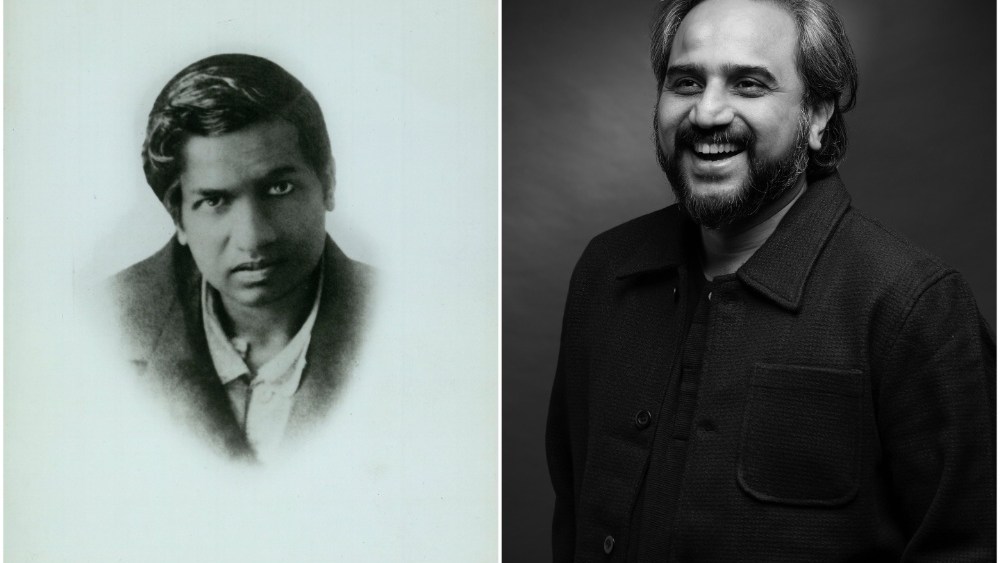
Fresh off the success of Aamir Khan starrer ‘Sitare Zameen Par’, director RS Prasanna is developing a biopic on legendary Indian mathematician Srinivasa Ramanujan and is positioning the project as a global collaboration between Indian and Western creative teams.
The project, titled ‘Ramanujan’s Dream’, is being produced through Prasanna’s banner Eklavya Productions and is currently in intensive script development, with the filmmakers aiming to begin production by the end of the year.
Prasanna has been fascinated by the story of Ramanujan since his school days at DAV in Chennai, where he first learned about the mathematician when he was in 11th and 12th grade. “After ‘Sitaare Zameen Par,’ I’m into this now,” he told Variety. “Ever since I was a student, I’ve wanted to tell the story of Srinivasa Ramanujan. I thought, what a fascinating story. And as a filmmaker, I wanted to see him grow to the point where he could actually tell this story with some kind of authenticity.”
Prasanna made his directorial debut in 2013 with the erectile dysfunction comedy-drama Kalyana Samayal Saadam in Tamil, which he remade in Hindi in 2017 as Shubh Mangal Saavdhan. These films increased Prasanna’s reputation for handling taboo subjects with humor and sensitivity.
His latest film is ‘Sitare Zameen Par’ starring Aamir Khan and Genelia Deshmukh and released in June 2025. The sports drama, about a basketball coach training a team of neurodivergent players, grossed $30 million worldwide, making it the sixth highest-grossing Hindi film of 2025.
Prasanna describes “Ramanujan’s Dream” as a departure from the traditional biopic. “I call it a biopic on steroids,” he said, explaining that the story will weave together historical stories of Ramanujan with modern-day applications of his mathematics. Recent scientific discoveries have prompted his decision to move forward now. “Six months ago, I read an article about how quantum mechanics and black hole behavior make use of Ramanujan’s mathematics,” he explains. “It was shocking.”
The filmmakers plan to frame the story as a film that cuts between modern times and Ramanujan’s extraordinary journey from poverty in early 20th century South India to Cambridge University, where he collaborated with British mathematician GH Hardy.
“For me, ‘Ramanujan’ is a story of immigration. It’s a story of the cross-border bromance between Hardy, who loves mathematics, and Ramanujan,” Prasanna says. “When the British ruled the Indians, there was a bromance between the Indians and the British. It’s a beautiful contrast.”
He sees a deeper theme in the story: “This man may not be aware of his caste privilege, but here he is born into a higher caste, which gives him a lot of time and privilege to work on mathematics, and somehow ends up at Cambridge. In a sense, he is less privileged and lower caste in the academic caste system.”
This project takes a novel approach to depicting Ramanujan’s mathematical genius. Prasanna draws parallels with composer Ilaiyaraaja, noting how both artists express receiving their insights as transcendent experiences. “We have Ilaiyaraaja, who is always pouring out music and is like a living example of Ramanujan to me,” he says. “When you ask him about music, he speaks in esoteric language. That’s why I think a lot of scientists today, neuroscientists, study it as a flow state. When you’re writing, dancing, or doing art with math, you get into this trance state.”
Prasanna has already written about half of the screenplay and is consulting with scientists at the Indian Institute of Science in Bangalore, reuniting with math-loving friends from his school days, and exploring a collaboration with a British writer.
The director aims to make mathematics visually stimulating and accessible to mainstream audiences, citing “The Big Short” as an inspiration.
When Ramanujan attributes his insight to a vision from Goddess Namagiri Devi, Prasanna plans to depict these moments cinematically. “When he says Mrs. Devi came and taught me calculations, what does that mean?” he explains. “If you stay true to the visuals, you get a dreamscape of mathematics.”
This film will be shown in multiple languages. “We keep it mostly in Tamil and where necessary in English,” he says.
Directors maintain creative control during the development stage before bringing in studio partners. “I’m not signing right away because I want to keep this. I want to write as much as possible,” he explains. “Because it’s so unique. It’s interesting to bring it into the studio when so much of the vision is already formed.”
The next six months will focus on developing the script, with production likely to begin by the end of 2026 or early 2027.
Ramanujan’s life has been made into films before, including Gnana Rajasekaran’s 2014 bilingual Tamil-English film Ramanujan, starring Abhinay Vadi, and Matt Brown’s 2015 international production The Man Who Knew Infinity, starring Dev Patel as Ramanujan and Jeremy Irons as Hardy.
Srinivasa Ramanujan (1887-1920) was a largely self-taught mathematical genius who, despite having little formal training in pure mathematics, made significant contributions to mathematical analysis, number theory, infinite series, and continued fractions. After initially being rejected by British mathematicians, Ramanujan’s letter to G. H. Hardy at Cambridge in 1913 led to him being invited to Britain. He became one of the youngest Fellows of the Royal Society and the first Indian to be elected a Fellow of Trinity College, Cambridge, before dying of illness at the age of 32. His notes continue to inspire mathematical research, and his work is now applied in modern physics and quantum mechanics.
