

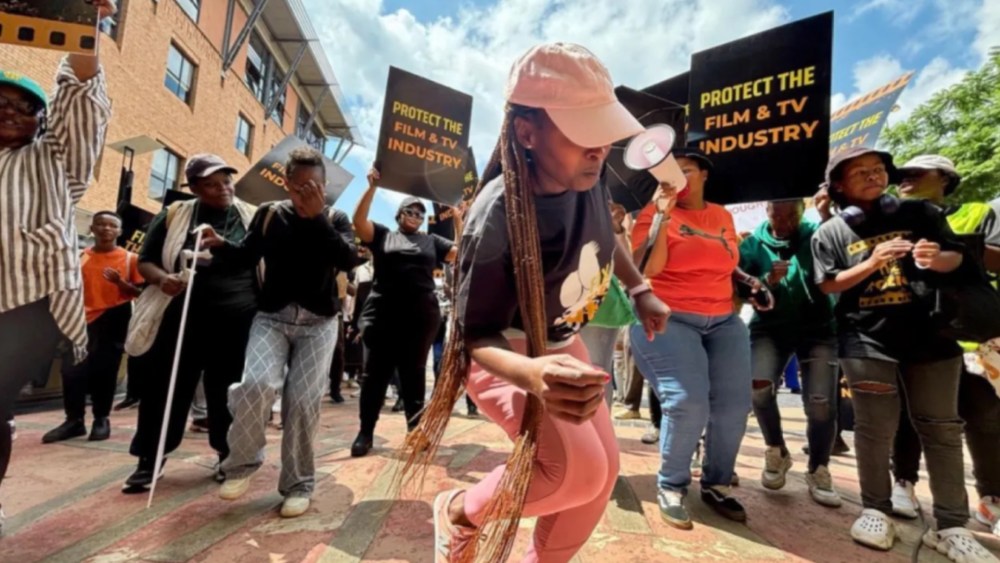
There was another sense of déjà vu at the Joburg Film Festival, with South African film and television officials once again calling on the government to rescue the ailing rebate system and rescue the country’s beleaguered film industry.
Just weeks after hundreds of film and television professionals marched on Parliament in Cape Town demanding immediate action to save an industry in free fall, festival curator Nhlanhla Ndaba addressed the ongoing drama in her opening remarks on Tuesday night, citing a “crisis that is testing our very foundations” as an industry.
“While rebate payments have been delayed, our spirits have not. While international film production companies have left South Africa for Malta and Portugal, where incentive programs are working effectively, our filmmakers have not abandoned their craft,” Ndaba said. “We keep telling our stories while we wait for a system that seems to have forgotten us.”
On Wednesday, industry players gathered at the JBX Market, an industry event held in parallel with the festival, to present the findings of a study by Olsberg SPI, a consultancy specializing in the global film production sector, assessing the impact of the South African Film and Television Production Incentive on the South African film industry and plotting the future direction of the struggling industry.
The study, commissioned by the Independent Producers Organization (IPO), analyzed the 10-year period from 2015 to 2025, during which film and television production added a total of R26.4 billion ($1.6 billion) to the South African economy.
But that contribution peaked in 2022, just as the Department of Trade and Industry (DTIC), the government agency that administers South Africa’s 25% rebate, began developing new guidelines for an incentive system that local filmmakers say is often opaque and unnecessarily complex. At the same time, a backlog of applications that had already been approved for rebates began to build up, and many filmmakers are now facing multi-year delays in rebates.
These problems are exacerbated by industry groups’ complaints about a lack of transparency and communication on the part of DTIC. “Investor confidence has definitely taken a hit” as a result, said Olsberg SPI’s Leon Forde, who presented the findings in Johannesburg.
Hundreds of industry workers marched to parliament on January 28 under the banner “Save SA Film Jobs”, slamming what the coalition described as “paralysis” at the DTIC, with more than R660 million ($40.4 million) still owed to production companies. This is the second time in less than a year that industry groups have held a rally to demand answers from the government over the kickback crisis, following a similar protest against DTIC’s actions last March.
The ripple effects are felt throughout the industry. “It’s really scary,” said Luke Routh, an actor and producer who serves on the IPO’s executive committee.
“That’s why hundreds and thousands of people took to the streets at both large demonstrations. Producers called me and said, ‘I’m sorry I couldn’t be there that day. I had to pack up my house. The bank is foreclosing on my house.'” The staff and actors said, ‘What’s going on? ‘I get calls all the time,”’ Routh said. “We’ve all felt it. It’s painful.”
Producer Deron Bakker, who chairs the IPO, said many South African filmmakers have been left in the lurch for late DTIC payments and have been “blacklisted” by banks and financiers. On Wednesday, he called on the South African government to commit more resources to saving the sector before it is too late.
“It’s not hard to solve this, we just need to allocate more money and things can get better again,” Bakker said. “There are ways to move this forward.”
Following January’s protests in Cape Town, representatives from both the South African film industry and DTIC were invited to present their case to Parliament, raising hopes that a productive dialogue could finally lead to a way out of the quagmire. “We’re seeing good progress, and we need to keep moving forward,” Routh said.
Joel Chikapa Phiri, executive chairman of South Africa’s powerful Known Associates Group, said he recently returned from a visit to the United States to boost confidence among Hollywood studio executives and expressed concern that the Rainbow Nation, long a popular destination for foreign film production, was “off the map.”
“They love South Africa. South Africa is the best place in the world to make films,” Phiri said. “They’re ready to come back.”
The Joburg Film Festival will be held from March 3rd to 8th in Johannesburg, South Africa.
Thinus Ferreira contributed reporting to this article.
