

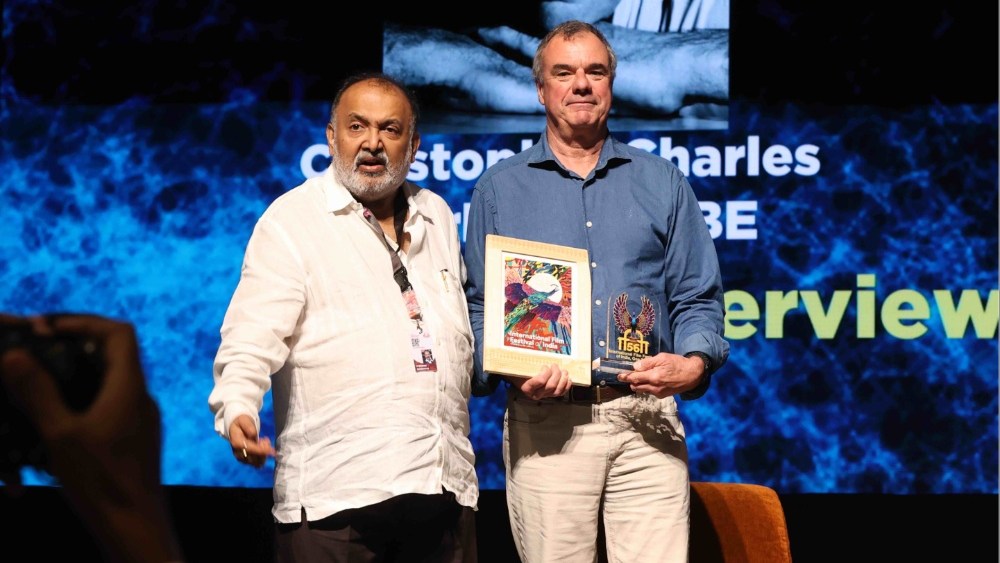
At the Indian International Film Festival, Oscar-winning special effects supervisor Chris Corbould pulled back the curtain on four decades of big-screen engineering, from tank chases and truck rollovers to house collapses and controlled explosions, and argued that the emotional power of spectacle still rests in what can be achieved physically, not digitally.
Speaking at a masterclass moderated by Variety’s Naman Ramachandran, Corbould reflected on his work on James Bond and Christopher Nolan films and emphasized that his guiding principles remain the same. It’s about shooting as much as possible on camera and letting the technology support the story rather than overpower it.
The discussion featured anecdotes and film clips spanning some of cinema’s most ambitious practical stunts. Corbould, who won an Oscar for Best Visual Effects for Inception, explained that his philosophy has remained consistent throughout his career. He argued that even as digital tools evolve, the most powerful results will come from collaboration rather than substitution. “Digital is a great tool, but when you rely on it for everything, you start to lose the emotional connection,” he said.
Corbould said the first step in any project was reading the script and thinking about how he could push his originality. In some cases, a fundamental overhaul may be necessary. The actor, who has worked on 15 Bond films, cited several examples, including GoldenEye, and explained how Corbould’s unconventional ideas transformed a routine bike chase into the now-iconic tank scene. Regarding No Time to Die, he recalls scaling back the car chase in an early version because it threatened to overshadow the emotional tension between Bond and Madeleine, saying, “What I’ve learned over the years is that I don’t want people to just be spectators.” “I don’t want people to come into the movie just to see some crazy effects. Everything has to fit together, the actors, the storyline, the locations. It’s a complete movie, and it’s not just me blowing something up.”
Christopher Nolan’s influence has had a huge impact on this debate. Their long-term collaboration is based on a shared belief that digital effects should only be used when physical effects are not possible. This thinking has led to some of modern film’s most daring sequences, such as the rotating hallway in Inception and the real-life truck rollover in The Dark Knight. Corbould admitted he initially had doubts whether flipping the truck could be accomplished safely, but Nolan rejected digital workarounds. “He pushes you to your absolute limits,” Colball said.
Many of Corbould’s accomplishments border on feats of engineering. The sinking house in Casino Royale required a huge interior set with a giant aquarium that could be tilted and lowered, as well as detailed miniatures for outdoor filming.
He also dispelled the myth that blowing things up is fun. He noted that explosions are the most stressful element of his job. It’s only after they’re done that he relaxes. “Spectre’s” record-breaking desert explosion, a one-take practical stunt performed in Morocco, “was never intended to be a world record,” he said, but it was a shot that needed to look right.
Underneath the show, Colbor highlighted the countless planning and safety checks that go into every stunt, as the comfort and safety of the actors and stuntmen is paramount. “The safety of stunt drivers and stunt staff is completely non-negotiable,” he said.
Looking to the future, Corbould said he believes new AI tools will find a place, just as digital effects once did. “I want directors to continue to value the physical craft,” he said. “Chris Nolan is a perfect example of that.”
