

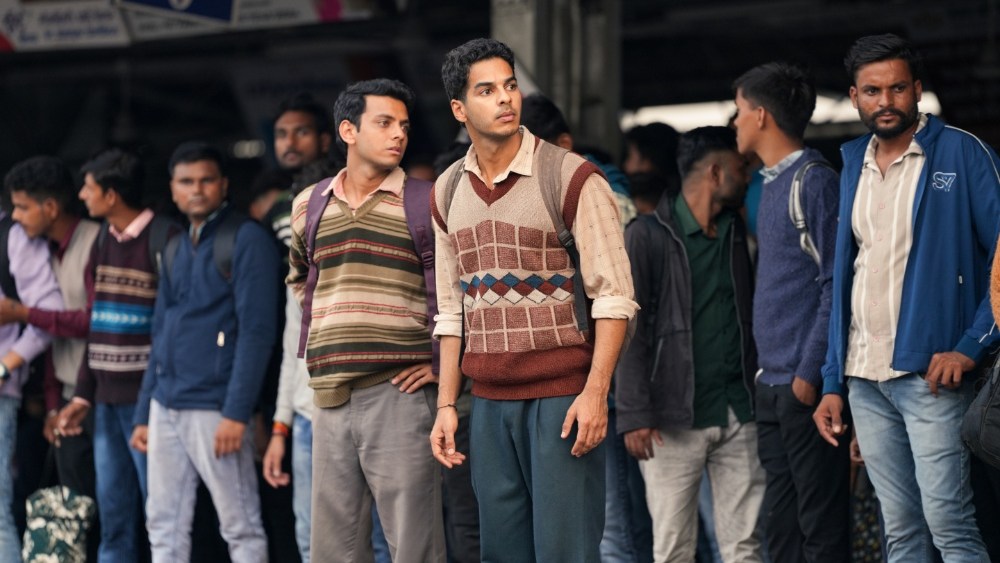
At the Variety Streaming Room hosted by Dharma Productions, director Neeraj Ghaiwan spoke about the origins and production of Homebound, the international feature film that was executive produced by Martin Scorsese and was nominated for an Oscar for India.
The film, inspired by a New York Times op-ed by Basharat Peer, tells the true story of two marginalized young people in India, one Muslim and one Dalit. They leave their villages in north India and seek government jobs in nearby cities. The journey reveals the reality of modern India. “When we talk about people from marginalized communities, we often talk about them in statistics,” Gaywan told Variety’s awards editor Clayton Davis. “We need to humanize their experience.”
Ghaiwan, who is Dalit, said the film was based on his own life, including the years he spent hiding his caste status. Making “Homebound” was a way to reject the shame attached to that experience, he said. “That shame is not something I should carry,” Gaiwan said, adding that the film centers on empathy across religious, ideological and social divides in a time of increasing polarization.
Translating that experience to the screen required intensive work with the film’s young leads, Ishaan Khatter and Vishal Jethwa. The actors took part in a two-month workshop where they lived in a north Indian village and immersed themselves in the reality of their characters. “Good craftsmanship alone is not enough,” he said. “You have to understand the philosophy, the politics, and the lived experience of the people you represent.” Gaywan encouraged the actors to bond off-screen as well, having them share personal stories and vulnerabilities to strengthen the friendships at the heart of the film.
This deep preparation proved essential for the film’s most challenging sequence, the emotionally intense bridge scene that Gaywan says was the most difficult to shoot. Cutter’s performance, in which his character screams into the horizon and loses his voice, was a “truly spiritual experience” that ultimately shaped the edit.
As the film awards attract increasing attention, Ghaywan said representing India comes with a great responsibility. “It’s not a question of expectations,” he said. “It’s about telling the stories of people who are made invisible by the powers that be,” he said, adding that he hopes audiences walk away from the film with empathy. “That’s the only way we move forward.”
