

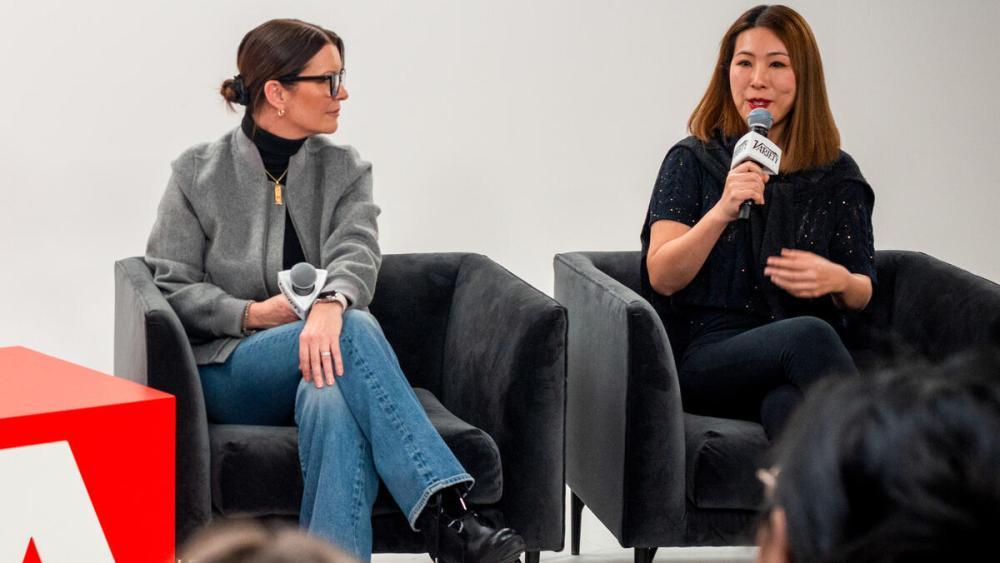
At Adobe’s Showtime! Park City: Gen AI Showcase at Sundance, two filmmakers demonstrated how generative AI tools are transforming the creative process and emphasized that human artistry remains at the heart of storytelling.
Taryn O’Neill and Momo Wang presented short films “MythOS” and “Wink,” respectively, created using Adobe Firefly in a significantly compressed time frame. A panel discussion moderated by Variety co-editor-in-chief Cynthia Littleton explored how filmmakers are experimenting with generative AI to expand creative expression.
O’Neill’s “MythOS,” a live-action hybrid featuring a distinctive whale sequence, was completed in a month. This is a timeline not possible with traditional animation techniques. Wang’s “Wink” was inspired by rescue cats and took 28 days to create, a five-minute 3D animation rendered in a 2D style. By comparison, her 2023 Oscar-nominated film took two years to complete, a traditional 10-minute 2D animation, Wang noted.
“I want to dispel the myth that someone goes out on their lunch break and makes a great AI movie,” O’Neill said. “The only way MythOS was created was through the collaboration of a lot of really talented and passionate people.”
Both filmmakers detailed the technical challenges that required extensive iteration. Wang pointed out that lip-syncing animal characters is particularly difficult, noting that some shots require hundreds of attempts to achieve the desired result. O’Neill explained that he uses Adobe Stock images as a starting point and then iterates through Firefly to create a specific framing and emotional resonance.
Filmmakers have adopted different workflows adapted to AI tools. O’Neill’s team used Firefly boards to pre-visualize the entire film before filming the actors on a green screen and composited them onto AI-generated backgrounds. We also created digital doubles of the actors, with full consent for extensive shots. O’Neill, a former actor, said both performers were hesitant at first, but became enthusiastic once they understood the process and the protections in place.
Wang, who was inducted into the Asian Animation Hall of Fame and whose AI films were collected by China’s National Film Museum, took a primarily visual approach. “I’m an artist. I’m not an engineer. I can’t write a perfect, great prompt,” she said. “So I just do image to image.”
They emphasized the importance of documenting prompts and maintaining consistency in style across a team of freelance AI artists. O’Neill explained that the prompts use cinematic language, specifying camera angles and lenses to achieve the desired visual effect.
The panel discussion highlighted how AI tools are democratizing certain aspects of filmmaking while raising new questions about copyright and attribution. Wang’s “Wink” is based on her personal experience dating over 300 people as material for a popular online comic series, ultimately telling a story about love and acceptance without pretense.
O’Neill, who has a degree in economics and spent 20 years as an actor, said his work aims to counter apocalyptic narratives with stories about a potentially positive future. “If people can’t understand our potential future, how will we create it?” she said.
Both filmmakers pushed back against concerns that AI would replace human creativity. “The tools are fixed, but guys, we are flexible,” Wang said. “We have the tools to make your dreams come true.”
O’Neill urged filmmakers to embrace collaboration in the age of AI. “Find your tribe and tell the story together,” she said. “Your personal story is great, but let’s do it together.”
