

Revolutionaries Never Die won the top prize at this year’s Cairo Film Connection, the industry program of the Cairo Film Festival. Variety interviewed Mohanad Yakubi, the Palestinian director who won the Best Post-Production Award.
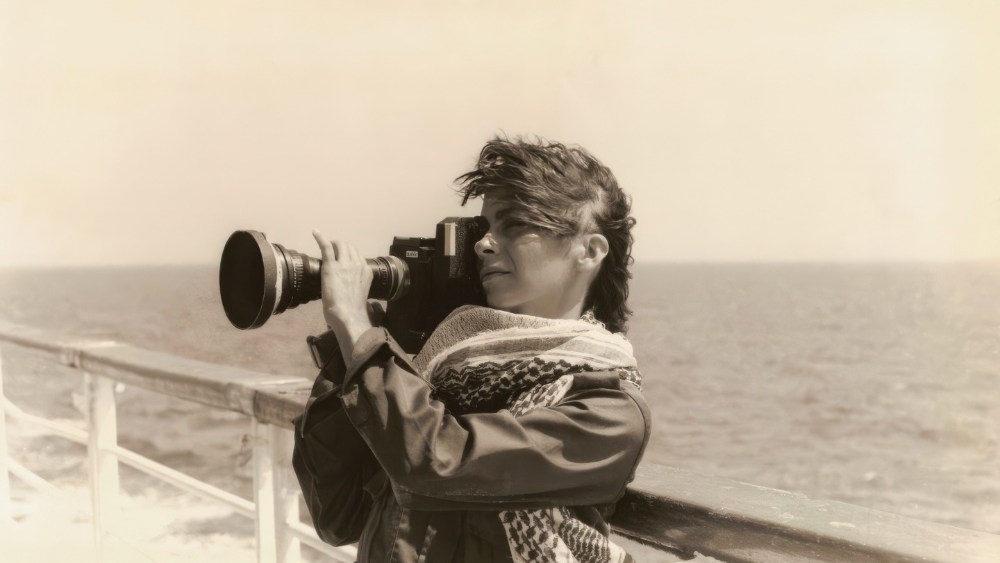
Revolutionary Never Dies, produced by Yakubi’s company Idioms Film, is the third film based on Yakubi’s archives. Explore Lebanese filmmaker Jocelyn Saab’s work from 1973 to 1983, the first decade of her filmmaking career.
Yakubi grew up in Kuwait, Amman, Egypt, Libya, Gaza and the West Bank, and after earning a master’s degree in film at London’s Goldsmiths University, returned to the West Bank and settled in Ghent, Belgium, eight years ago, where he is a resident research fellow at the Royal Academy of Arts (KASK).
On this project, she collaborates with researcher Mathilde Roussel, who served as Saab’s assistant during the last ten years of her life.
How did this project come about?
I had access to 115 reels directed by Jocelyn Saab from 1973 to 1983. The decisive turning point came in April 2024 when my family’s home was bombed in Gaza. There’s a scene in Jocelyn Saab’s 1982 film Beirut My City where she stands in front of a bombed-out house and talks about the situation, her feelings, and what the house means to her. I empathized completely with her, even though I never had the opportunity to stand in front of my own destroyed home. That was the moment when everything she made between 1973 and 1983 suddenly made sense to me – I think this is the price you pay as a politically engaged filmmaker trying to support the Palestinian struggle. When we place Jocelyne’s image on our timeline, it becomes magical and her voice begins to guide us. It’s like she’s making the movie and I’m the instrument to make it happen.
Do you think movies can change political reality?
I actually stopped believing in the power of images and filmmaking as I watched the genocide unfold and the entire destruction live 24 hours a day. The point isn’t the amount of images or telling people what’s going on. It is ultimately a question of geopolitical power.
Have you met Jocelyn Saab?
No, we communicated via email. She sent me one email, I didn’t reply, and she passed away 5 weeks later in 2019.
Why do you think her films from this period are interesting?
She’s not just thinking about the Palestinian issue. Her films offer hope for change. They are the Arab left. She has also made films in Western Sahara, Egypt, Iran, and Lebanon. Her 1973 film was about a romantically politicized revolutionary. But her perspective began to change due to the Lebanese civil war and the disbelief of seeing how the country she believed in and loved was destroyed.
Are there any similarities between what she photographed during this period and the current situation?
One of the great characteristics of the Arab mentality is that things are always repeated. What I’m trying to do is take a step back and show that the aggression never stops, and try to identify some of the underlying issues. This is exactly why I am interested in archives, because if you look at other films made in Gaza in the 1970s, it seems that nothing has changed. However, in the 1960s and 1970s there was a political ideology associated with left-wing parties that sought to understand the situation coherently. Now it’s just blatant violence.
Who is your film aimed at?
I am more interested in talking to Palestinians than anything else. People without sovereignty, without archives, without producing knowledge systems. There is no organized education system. Movies can be a vehicle for creating this kind of dialogue. At the moment, the main priority is not creating images. It’s about creating genuine dialogue.
Why is it important to have your project screened at Cairo Film Connection?
I think this is the first market to show this movie. I wanted to have an Arab base for that, so Cairo was the best option. I have been visiting Cairo for the past two years because my parents left Gaza and live there. There are still people who can discuss this project and present the film in a broader perspective to an Arab audience.
