

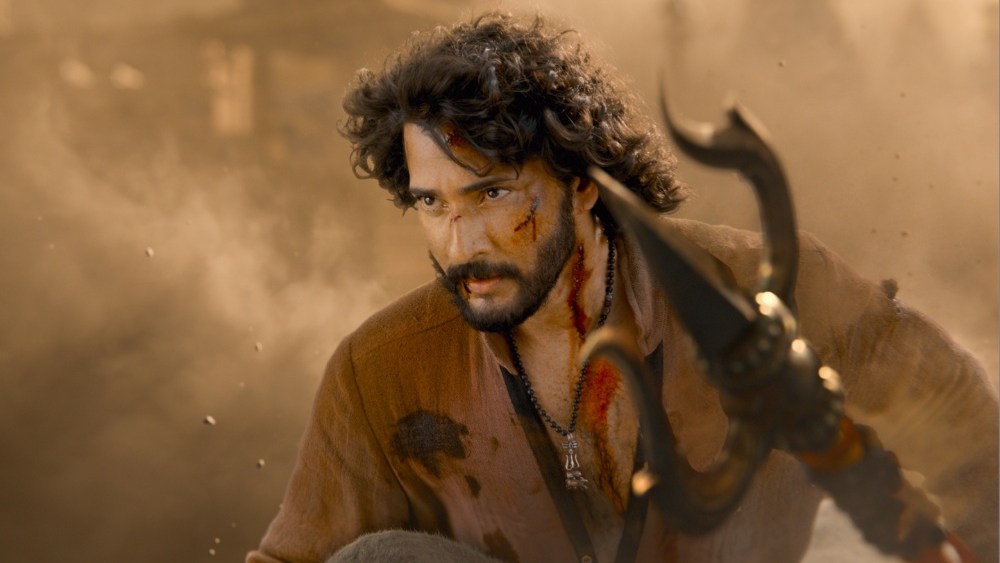
The cast of RRR director SS Rajamouli’s Varanasi have opened up about the grueling shoot of the ambitious film, from shooting with wild animals in Kenya’s Masai Mara to the physical changes required for their roles.
The film’s story spans thousands of years and locations traverse multiple continents, from Antarctica to Africa to storied cities in India. Mahesh Babu plays the dual roles of the protagonist Rudra and the Hindu god Rama, Priyanka Chopra Jonas plays the character Mandakini, and the main antagonist Kumbha is played by Prithviraj Sukumaran.
Babu, who spent a year preparing for the role, underwent three months of Kalari martial arts training just to adjust his posture to suit the era of the role. “I am playing the character of Lord Rama and it required posture… you can’t stand like a modern character,” he explains.
He also trained for several months with the track and field team to modify his running style. “When I saw the shot, I was really happy. It was worth training for six months for that shot, so it was worth it,” he says. “The way I walk has changed, the way I stand has changed, everything has changed.”
Sukumaran’s Kumbha is a character who is forced to sit in a wheelchair and can only move his face. “Everything you see here is practical. It’s not like a CGI image. The wheelchair and me in it and everything is practical,” he says. “The challenge was that only the face was movable, and everything this character had to convey had to be done with just the face, without any specific body language.”
He describes the character as having “a very interesting dichotomy, because he’s physically very limited, but at the same time mentally very dangerously unrestricted.”
The film’s African scenes, shot during the Great Wildebeest Migration in Kenya’s Masai Mara, proved particularly difficult. The filmmakers received extensive support from the Kenyan government to access the protected land.
“I don’t think many people, other than maybe poachers, have been given that kind of freedom or access to Maasai Mara land,” says Chopra Jonas. “It was scary and exhilarating to go in there and actually work with real animals.”
The production team adjusted the timing of filming to coincide with the migration. “Everything depended on the animals, so the crew got very little sleep,” she explains. “When the elephant family moved, we had to go and say our lines.”
Babu describes the first day of filming as surreal. “We had these vehicles and they took us there and dropped us off, but Sir (Rajamouli) was in another vehicle somewhere because he had to go around the wildebeest,” he recalls. “Then the car that dropped us off left and we realized we were just standing there with the wildebeest and all of a sudden we just heard the ground shaking because these animals were just (running).”
The actor recalled that Mr. Rajamouli was directing from a distance via walkie-talkie. “He was so excited. He was like, ‘So great, so great. Just keep moving.'” And we knew he was on board with his opinion. ”
After filming that day, the actors discussed the uniqueness of their experience. “I don’t think any other actor could have done what we did, and it was quite an accomplishment,” Babb says.
Rajamouli explains that visiting the African wilderness has been on his bucket list for a long time. “Once you land in Africa, you’re immune to it. But once you go into the wilderness, you’re not just attacked, you’re literally swept off your feet,” he says. “It’s an incredible feeling. I feel like I really get to know my size in the world.”
Even though the film relies heavily on visual effects, Rajamouli makes it a point to use practical elements as much as possible. “This movie is VFX-heavy, so he’s very particular that some of it is absolutely authentic,” says Chopra Jonas. “He’s very particular about making this movie a blend of real production design, real sets, real interactions, and VFX. So we only work on VFX for things that we can’t really achieve.”
For Chopra Jonas, Varanasi marks her return to Indian productions after focusing on Hollywood projects. The actress, who does not speak Telugu, had initially expressed concerns about the language barrier.
My first meeting with Rajamouli in Hyderabad helped allay those fears. “He took me into his office and it was just him and I, and he said, ‘Priyanka, this film will not be released to the world unless you have the best version of you in every frame. That’s my promise to you,'” she recalls.
She says her experience making the film was transformative. “If there was ever a way to come back to Indian cinema, it would be by making the biggest Indian film, and that project is this film,” she says. “I think Sir’s vision is unlike anyone else in this country or abroad. His peers are, so to speak, the Spielbergs of the world, the Nolans of the world, the Finchers of the world.”
Regarding the film’s title, director Rajamouli acknowledges the cultural and religious significance of naming the film after one of India’s holiest cities. “This is the name of an ancient (city), the first city, and it is deeply revered by millions of people,” he says. “I know it has weight. I know it has religious meaning. And of course that makes me more responsible for how I use it.”
He also became emotional during the final mixing session. “The moment I saw the title ‘Varanasi’ flashed on the screen, I got goosebumps and tears filled my eyes,” he says. “So I thought it was right to name the film Varanasi.”
Chopra Jonas, who grew up in Uttar Pradesh, also has a personal connection with the state. “I am a big Shiva bhakt (the Hindu god Shiva, the chief deity of Varanasi), so it was a surprise to hear the story and understand why it is called ‘Varanasi’,” she says. “There was no part of me that felt like this story didn’t do justice to the history and importance of this city.”
Sukumaran says the title is perfect for the material. “There is no better title for what this film is about and the plot of the film,” he says. “How this story plays out has a lot to do with Varanasi itself.”
For Rajamouli, this project represents a creative leap that he had long envisioned, but never expected to come to fruition so quickly. “All my films are inspired by (Indian epics) Ramayana and Mahabharata. But here, that is not the inspiration. In fact, this is a part of Ramayana that we are incorporating in this film,” he says. “I kept imagining that I would end up making these blockbusters at some point in my life, but I never thought it would happen so quickly.”
Varanasi will be released in theaters worldwide on April 7, 2027.
