

she’s alive! Finally.
When Maggie Gyllenhaal sat down to rewatch James Whale’s 1935 classic The Bride of Frankenstein, she wasn’t prepared for what she hadn’t seen. The bride’s appearance time is only 2 minutes. she doesn’t say anything. She saw the creature she was made to love, screamed once, and was blown up. She was created for men who were disgusted with her, in a world that didn’t give her a say in the matter. And then she was gone.
That’s how stories always end, more or less.
“She feels like she’s in this insane situation,” Gyllenhaal said at a press conference to promote the film. “I was brought back from the dead without her consent to become the wife of a man I had never met.” That absence, a character made to exist, denied everything, excluded, is reflected in the new film “The Bride!” starring Jessie Buckley and Christian Bale. ” gave the driving force. In Gyllenhaal’s words, the film’s ambitions are far-reaching and “celebrate all the parts of us all that don’t fit into the boxes we’ve been told we need to fit into.”
“The Bride!” It is no coincidence that this work arose amid a particular cultural desire for such stories. Guillermo del Toro’s recent “Frankenstein” reset the moral terms of the myth by constructing a film that never harms anyone except those who first try to harm it. All horrors trace back to Victor’s choices, not to the existence of Victor’s creations. In this context, “Poor Things” pushed Vera Baxter’s autonomy to comic extremes. “The Substance” turned female anger into a grotesque spectacle and called it empowerment. Together, these films do something that the Frankenstein myth rarely allowed. In other words, it is about centering the inner world of the created woman and asking what she actually wants.

Frankenstein. Jacob Elordi as Frankenstein’s Creature.
Ken Woroner/Netflix
Provided by Searchlight Pictures
Scholars who have made careers studying horror, feminist theory, and the history of synthetic women argue that this impulse is much deeper than a single cultural moment and far older than Hollywood.
The portrayal of Elsa Lanchester in the Whale film remains one of the most arresting images in film. Her hair standing upright, her white bandaged gown, the deafening hiss directed at the creature she was made to love. Not a word was spoken. Barbara Creed, professor emeritus at the University of Melbourne and author of The Monstrous Feminine, believes that silence is important. The female monsters on screen aren’t just female versions of male monsters. It is something more specific, rooted in the female body itself, including reproduction, sexuality, and generativity. The fear the bride causes is not what she might do. That’s who she is.
“She rejects any possibility of continuing the dominant social order,” Creed says. “She does not want to participate in the continuation of an order dominated by male power and science.” Screams, hisses, explosions – not the monster’s rampage. A woman who turned down the only role she was offered. And because she refuses, she is destroyed.
Bride of Frankenstein, from left, Elsa Lanchester, Boris Karloff, 1935.
Courtesy of Everett Collection
Her downfall is not a dramatic accident. Scholars say this is the logical endpoint of the structure in which women have always been imagined. Despina Kakoudaki, author of “Robot Anatomy” and professor at American University, points out that this pattern predates “Frankenstein” by centuries. In the cultural imagination, the artificial woman is always created as an adult and immediately assigned a purpose, but it is always defined by someone’s desires. Androids become soldiers and servants (a dead detective is rebuilt as RoboCop, Bucky Barnes is brainwashed to become the Winter Soldier, Anakin Skywalker is resurrected as Darth Vader). The artificial woman becomes a wife and an object. Their sexualization is not incidental to the fantasy. It’s an illusion.
Julie Wosk, author of My Fair Ladies: Female Robots, Androids, and Other Artificial Eves, follows a similar architecture in Pygmalion and beyond, stating, “Most of them are initially created to be submissive, obedient, perfect women. Men’s fantasies about women who had no ideas of their own.” The moment she acquires an idea – a desire, a refusal, a self – she becomes something the story needs to contain or destroy.
Mary Shelley understood exactly that when she wrote her original novel in 1818. She was 18 years old and had already become a mother twice, but her first child died two weeks after birth. She conceived the novel in the summer of 1816, when she and Percy Shelley and Lord Byron were stranded in Geneva, reading ghost stories and challenging each other to write their own. What she created was not a ghost story. It was a novel about the horrors of creation, written by a teenager who had already experienced the horrors of giving life and losing it.
Her mother, Mary Wollstonecraft (English’s first major feminist theorist), died giving birth to her, and in the following years her legacy was publicly destroyed and she was dismissed as a radical and a prostitute. Shelley grew up knowing exactly what happens to women who reject prescribed roles, and she hid her most devastating claims in a story that on the surface seemed like a cautionary tale about science.
Ann K. Mellor, professor emeritus at UCLA and author of Mary Shelley: Her Life, Her Fiction, Her Monster, interprets the novel’s most radical act not as the creature’s creation, but as Victor’s decision to destroy the female creature before it can live. He tears her apart before she takes her last breath because women with agency are a threat to civilization. Victor isn’t just afraid of his fellow creatures. He fears what she represents. It’s a woman who was never asked, never consulted, and who might have something to say about it. It is the most accurately feminist-coding act in the novel, the scene where she cries “Bride!” In a way, that’s the answer.
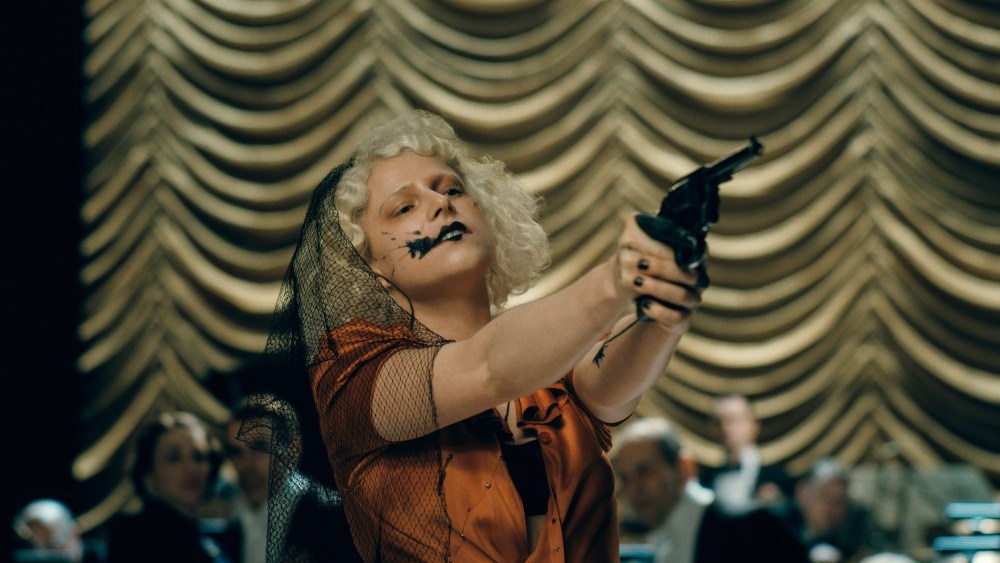
Gyllenhaal suspects that Shelley’s treatment is not finished. “I think Mary Shelley might have had a little more to say,” she told journalists. “Not only could it not have been published in 1820, it was unthinkable.” The black mark on Buckley’s face in the film was, in the producers’ visual concept, an ink smear from Shelley’s own manuscript, a woman who had been underground for two centuries, unable to finish her thoughts. The Bride is more than just a monster story. She is Shelley’s most repressed idea, finally given room to breathe. Every film adaptation to date has treated her as a plot feature, created, rejected, and destroyed, but “The Bride!” insists she is the subject.
The Bride (aka The Bride!), Jesse Buckley as the Bride.
©Warner Bros./Courtesy of Everett Collection
Creed sees the current wave of feminist horror as tradition finally catching up with the idea. In classic horror, female monsters were people to be wary of, terrifying precisely because they exceeded their assigned roles, and were punished accordingly. What she is observing now is different. These are the heroines who undertake what she calls katabasis, a journey into the darkness of ancient Greece, asserting rather than running away from their own monstrosity, and emerging transformed rather than destroyed. “Rather than being miserable, the heroine owns it,” says Creed. “She herself ends up becoming a villain in parts, but she accepts her monstrosity.”
Katherine Spooner, professor of Gothic culture at Lancaster University, sees the same energy in the Gothic tradition’s long history of giving women space to express what polite discourse rejects. “Sometimes I get angry and devastated,” she says. “And I think that really speaks to young women at this particular moment.”
The illusion that women are perfectly submissive has not disappeared. It stages a return to the aesthetics of the trade wife and a nostalgia for female subjugation, to which Reborn Woman is partly a direct cultural response. The two phenomena inform each other in real time.
Mellor argues that this myth extends to even the most pressing anxieties of our time. “Frankenstein is the classic myth of people who seek knowledge without paying attention to its consequences,” she says. “This is all happening now around AI, the latest Frankenstein invention that may create superhuman possibilities for humanity, or destroy it.” Two centuries later, Shelley’s warning remains the most accurate language for what it means to build something and refuse responsibility for it.
The deeper question, and one that scholars return to again and again, is whether the women at the center of these stories are truly masters of their own destinies, or whether even their rebellion is still being scripted by someone else. When Poor Things’ Vera Baxter steps into the world of her own volition, is it liberation, or a new fantasy of what a liberated woman might be like? As Wosk says, “Are we reliving old notions of strange and pathetic creatures?”
“THE BRIDE!”, from left: Christian Bale as Frankenstein’s monster and Jesse Buckley as the bride.
©Warner Bros./Courtesy of Everett Collection
The question is, “Bride!” It seems like it is made to stay inside rather than resolve. When Gyllenhaal was asked directly who the monster in the movie was, she completely resisted the premise. In her story, monsters live within all of us. The parts of us we’re told to suppress, the anger and weirdness that doesn’t fit into the approved human version. “Please turn around and shake hands with your monster,” she says. Not to defeat it. to claim it.
Mr Buckley, who also participated in the panel discussion, said the resuscitation of the bride was not so much horrifying as it was shocking. “Her mind and body are activated in a way that I never expected. It’s so alive and so monstrous in the wildest and brightest sense.”
For a story from centuries ago, it has aged surprisingly well. Of course, because it hasn’t aged much at all.
“It’s the idea of a male scientist trying to create the ideal woman and the woman refusing to be controlled by him,” Spooner says. “You can easily see why it keeps coming back.”
“Dear Bride!” or not. The answer to the deeper question of whether the title character is truly the master of her own destiny, or whether she is still somehow in the making, is something only a movie can resolve. But the very fact that that question is finally being asked in a full-length novel, with Bride of Frankenstein at the center of her own story, is itself an answer of sorts.
For 200 years, no one thought to question her. At least that has changed.
Jazz Tangcay contributed to this report.
