

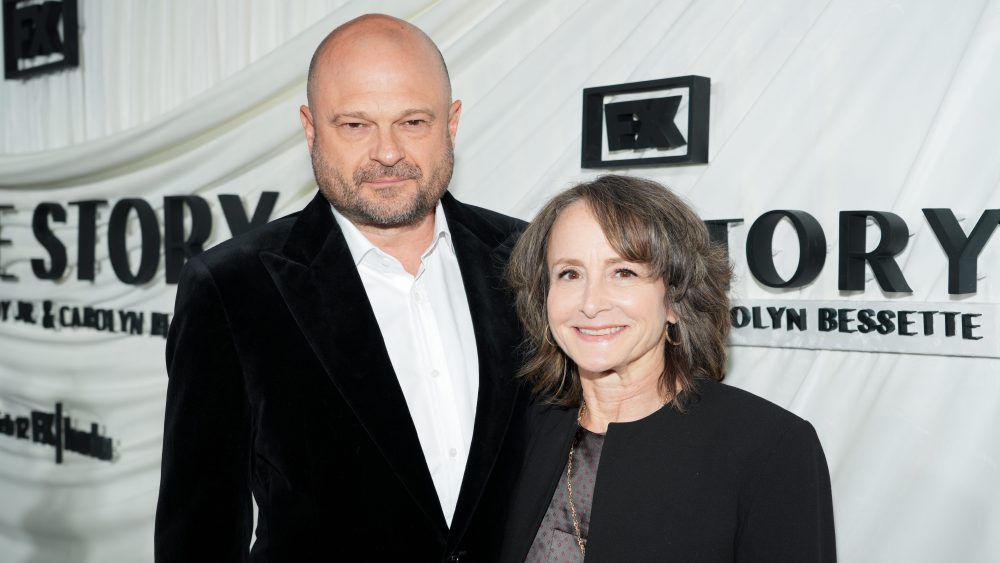
When veteran film producers Brad Simpson and Nina Jacobson decided to turn their lens to TV, their first effort turned out to be 2016’s “American Crime Story: The People v. O.J. Simpson” in partnership with Ryan Murphy and FX. A decade later, the pair are riding high on the success of another widely praised limited series, “Love Story: John F. Kennedy Jr. and Carolyn Bessette,” and they’re still in business with Murphy and FX.
On the heels of the powerful final episode of “Love Story,” which aired March 26, Jacobson and Simpson sat with Variety’s “Strictly Business” podcast for a wide-ranging conversation about revisiting the 1990s with the legend of JFK Jr. and his fairy tale romance with Carolyn Bessette.
The pair also addressed the state of the development marketplace in Hollywood, why their alliance with FX and Murphy has been so fruitful, and why they are active supporters of the Producers United effort. But mostly, the longtime collaborators who are partners in the Color Force production banner discuss the elements that made “Love Story” such a standout — the yearning for a look back at what seems a less frenetic time for pop culture. Simpson and Jacobson can’t say enough about Murphy’s instincts and the work of creator/executive producer Connor Hines, finale director Anthony Hemingway as well as “Love Story” stars Sarah Pidgeon and Paul Anthony Kelly and co-stars Grace Gummer, Constance Zimmer and Jessica Harper.
“Our cast is an embarrassment of riches, particularly for the women, who are left in the wake of these devastating losses,” Jacobson says.
We are talking coming off the heels of the conclusion of “Love Story: John F. Kennedy Jr. and Carolyn Bessette.” It is quite a journey and it is quite a journey for those of us who remember it firsthand. What was challenging about the finale to capture or shoot?
Brad Simpson: The plane ride (in which JFK Jr. and Bessette and her sister Lauren Bessette died) definitely was something that we talked about quite a bit. We always knew that we were going to have a structure where they passed away halfway through the first episode, and we would be left with the aftermath. But there was a lot of conversation about how to handle the plane, whether we should show the plane at all. We didn’t want to be gratuitous. We didn’t want to turn it into a crazy thrill ride. We spent so much time loving these characters and knowing that this was going to end the way it did.
We wanted to end in a way that honored them. And so really, it was about how do we tone that plane ride and show enough of what happened on the flight that people will understand without ending on some sort of crazy spectacle. And the thing that we learned along the way is that they didn’t know that they were about to crash into the water when they crashed. That they knew something was wrong and they were worried. But the way spatial disorientation works, that it wasn’t like they were going to be screaming and falling into the water, that actually they died instantly.
Nina, anything stand out to you in terms of in terms of the finale — getting it done, getting it just right?
Nina Jacobson: I think our cast is an embarrassment of riches, particularly for the women, who are left in the wake of these devastating losses, like unimaginable loss. I just really applaud our writers, Juli Weiner and Kim Rosenstock and obviously (creator) Connor Hines. I’m so moved by how dimensional all these women are in this impossible situation and how slowly they’ve built these relationships. I think the complexity of the performances from the women. It’s all of the things that you would hope for when it all comes together and you see people doing incredible work together. And it’s one of those moments where you just feel like they all just really revel in the acting in the episode.
So many great performances. Jessica Harper, who is a great character actor. She packs a lot into Ethel Kennedy and that relationship that we know from reportage on the Kennedys that she and Caroline Kennedy had a special bond. And just the anguish of Caroline Kennedy. And to know this is not fiction.
Simpson: We were very lucky to have these incredible actors, and because we knew that we were going to not have John and Caroline in the second half of the episode. In a lot of these shows we’ve done, “O.J.” or “Versace,” you know what’s going to happen. You know, in O.J., he’s going to get off, and in “Versace” that Andrew Cunanan’s going to kill himself in a houseboat. And everyone knows that this plane crash happens and you’re left in the aftermath. And we were just lucky that we had these incredible actresses to carry us through and to be living testaments for them. Ethel actually wasn’t originally scripted as being in the finale. Originally it was going to be Constance (Zimmer), who played the mother of Carolyn Bessette, and Grace Gummer’s Caroline (Kennedy) coming together and talking. And Ryan actually had fallen in love with Jessica Harper’s performance, as he’d seen more and more throughout. And he really wanted to bring her back to for the finale, to talk about what it was like to be a Kennedy woman and what they had been through. So we added that to the final script.
Sarah Pidgeon, over the course of this series, she just embodies this person full of conflicts and with the element that we know that she is going to meet an untimely death. It’s just incredible. And then Anthony Hemingway, just an incredible job in building the tension and the drama in this finale. I know Anthony is a reunion for you from “People v. O.J. Simpson.”
Simpson: We have a shorthand with Anthony because we’d worked with him extensively on “People v. O.J. Simpson.” He’s a really talented filmmaker. He came in and this was a script that was finished very close to when we were shooting it. He was getting it handed to him in pieces as he was prepping. And it was also like a lot of these episodes, you don’t really fully know how to end them. You have emotional ideas, you know that you’re going to be in the aftermath in some ways. But really the peak of most TV shows is the penultimate one. And the last episode we saw them almost break up. And so this is about them coming back together and then the tragedy that befalls them. It’s a bunch of things that people know. So it really has to ride purely on emotion. And I think Anthony is an emotional filmmaker first and foremost. He is a little bit more restrained in this series than he sometimes is in some of the other Ryan Murphy shows, because we had a much more restrained palette. And I thought it was fun for him to work within that restraint, but he really understands emotions. The actors loved him and felt really, really secure with him.
I would say one of the most emotional moments was when Grace walked out of (JFK Jr.’s) North Moore Street apartment (in Tribeca) into the crowds who had been waiting there with pictures of Caroline and John, and this was a real walk that had been taken. It was the real space. There was a hauntology about it. Just being there and watching Caroline walk through the space where you can feel almost the presence of people who’ve been there before, getting into the car and then watching her break down. She later told us that she didn’t feel like she was inhabiting or playing Caroline Kennedy; she was Caroline Kennedy in those moments.
Looking across the series and the goals, what would you say were some of the larger kind of cultural then and now themes that you tried to draw out?
Jacobson: It’s such an incredible experience to have a show that is being shared by so many people at the same time. It’s what you’re always dreaming of and rarely ever getting to experience when you’re in this line of work. And so to reflect on fame these parasocial relationships that we have now and that we had then, and how different it was though when it was mediated through both the monoculture and the tabloids. So the cruelty of the tabloids and the cost on real people’s lives, on the one hand. And yet the nostalgia of actually how much less exposed even the most exposed people seemed then. I think also our relationship to fame with the idea that I think obviously the show really explores both its allure. Carolyn was no rube. She was instrumental in publicity and marketing at Calvin Klein in the heyday at that time in her career. She was really very savvy. And it still burned her, right? And yet our relationship to fame has changed so much. Now everybody wants to be famous, and loads of people are famous. And there’s a lot of nostalgia for that time. Although there was a lot of cruelty that ran through the narrative, there was still a degree of agency that people had over their lives even then and we’re watching her lose that agency.
And now you take the way that we live now and how often people lose that agency, how often a person ends up famous without wanting to be famous for a minute. Like our relationship with fame is just so different. And it’s really been particularly how young people have consumed the show. And the way that the look back at a time that is so different, it’s almost feels like a fairy tale, right? And obviously we’re telling a romance. And so it is a bit of a fairy tale. We loved our characters and obviously it’s optimistic about them as a couple. And we rooted for them because we loved them. And it’s a bit optimistic about the time, maybe, but it’s been a joy to watch people enjoy that and be able to submerge themselves in it. It’s been incredible to watch people enjoy the show.
The show is performing very well for FX and Hulu. It’s been a cultural conversation. Every costume choice, every prop you’ve had has been discussed and debated. I’m guessing that when you see that you’re getting that kind of scrutiny, you know you’re connecting?
Simpson: We had such press attention on us last summer when people were worried we weren’t going to get it right. And you saw the depths of the fandom and concern, but really everyone who worked on this was mission driven. A lot of us had grown up in that New York of the 90s and we wanted to bring it back. But what I think is really interesting is it’s not just people who have nostalgia for that time, but people who have false nostalgia for that time. The show is doing really well among millennials and Gen X, and they’re looking back to the simplicity of that time, a time when you could go out and not be bothered by seeing where your friends were on Find My iPhone and were able to smoke in clubs and be silly and not be worried about being photographed. The carefree world that that was, I think is really appealing to a lot of younger people. We didn’t even do it intentionally. We talked about 1990s nostalgia. We wanted to get it right, but we just tried to recreate what we loved about it. We brought the music we loved in through (music supervisor) Jen Malone. It wasn’t calculating. It was just something where everybody was doing something about what they loved. And it really has touched a chord and it’s great to see it resonating. It’s great to see that it’s become cross-generational viewing.
Of course, you can’t produce a true-life story without having a lot of people weigh in and usually a lot of strong criticism. Daryl Hannah has spoken out — she’s not very happy with her portrayal in “Love Story.” How did you feel about what she had to say?
Simpson: You know, from the beginning of this, this was going to be John and Carolyn’s story, and we put a lot of research and rigor into all the people and moments in the series that ultimately shaped their relationship. We read a lot of biographies and journalistic accounts. Anytime you’re dealing with characters that are based on real people, there are big emotions and sensibilities, I think it’s tough for anybody to see themselves represented. For all of us in the show, we did approach every character with empathy and love. We love all our characters. So, obviously it’s difficult for some people to see themselves represented. We know this is a real tragedy that affected real people. But our intent was to celebrate the people around John and Caroline.
Is it becoming harder in any legal sense or production sense to tackle real-life characters, especially if they’re still alive? Are you finding hurdles in the world that we live in now where so many people can weigh in vocally very quickly?
Simpson: The legal team is very rigorous about fact checking us, even though it’s a dramatization. And even though these shows say from the beginning that we are trying to tell the emotional truth and we’re dramatizing events. There is a very vigorous fact checking that has only gotten more and more vigorous. I think that what’s actually interesting is that back during the age of ‘The People v. O.J.’ there were a lot more journalists out there. So they would do journalistic deep dives into our episodes and read all the books and be in conversation. And what’s different now is there’s just a lot of hot takes on Twitter and on Instagram. And so you don’t have as many journalists out there who are going back and debating, OK, this is what we think happened in real life. They’re competing narratives and this is what the show is presenting. How did they do that? And that happened a lot on ‘O.J.’ and it happens less on this. It just becomes a quick, ‘They got it wrong, they got it right’ based on somebody’s Wikipedia dive.
That is a sad sign of the times. Let me ask you about your larger partnership with Ryan Murphy and FX. It seems like it is a very fruitful partnership.
Jacobson: It makes me smile because of the fact that Ryan and I have known each other since we were both small children in the industry. I knew Ryan, when I was in my still in my 20s, he was in his and he was part of Act up, which Bruce Cohen and I started at the time. And so we’ve known each other forever. And even when the first time that we partnered on ‘People v. O.J.’ he’s so obviously so accomplished in television. And we had a resume of zero in television. And so we didn’t know what to expect, obviously. He was the big fish and we had our feature career, but we hadn’t really done television.
Well, you had a few features under your belt.
Jacobson: We did. We were not wankers, but still, we didn’t know what the relationship would be like. And it has been a really wonderful partnership. And it’s a very nimble partnership. We work differently on different shows together. And I think we challenge each other. I marvel honestly at how much I trust his instincts — his instincts on casting, his instincts on production design, on what a show should feel like. And bringing someone like Connor (Hines) into the fray and to have a young person like that with incredible voice emerging, who will have a huge career ahead of him as a writer, but to also have the guidance of like a director and filmmaker and showrunner like Ryan, it has been for us a real gift to be able to partner with somebody like Ryan. It’s just his instincts and knowledge of the medium.
He has really grown into not just being a very in-demand showrunner, but he has a company of actors and a team of artisans who work with him over and over. It’s no surprise why he gets the results he does.
Simpson: In general, Nina and I have a very simple approach to what we take on. If it’s a book and it’s a page turner and we finish it, don’t think of the reasons why it may not work, but think of the reasons why it might. Like we had both loved the book ‘The People v. O.J. Simpson,’ but we knew that wasn’t a movie. We just needed to wait for the rise of the big grand limited series and classy TV to catch up with us. And I think with Ryan, it’s been pretty organic.
In terms of the FX of it all, what do they particularly bring to the table?
Simpson: Twelve or 13 years ago, Nina and I decided to get into TV and we were driven by creative jealousy and survival instincts. And we just saw what was coming. And we saw the “House of Cards” and all these things. And we went to meet with every studio. And “The Hunger Games” had just come out. And so we were surprised. People wanted to do deals with us, even though we had no TV experience. And Joe Cohen, our agent, pushed us towards FX. We watched their shows and liked their shows. We sat with John Landgraf, Eric Schrier and Nick Grad. And it was just the three of them in the room, and they were brilliant. And Joe said, “They’re gonna offer you the least amount of money, and everybody wants to go to HBO right now, but you should be with them. They don’t have anybody like you, and your sensibilities will match.”
And so we took the lowest amount of money from them and it paid off. It paid off in a big way. “O.J.” was our first show and we were soon exclusive with them. And basically since then, we’ve only worked with them. They believe in literary pulp. They believe in a pulpy poster, but then a Shakespearean spine. You want to be able to reference Chekhov when you’re talking to John Landgraf. They push for quality and they don’t stop. They don’t stop giving you notes in a way that sometimes for some writers can be annoying, but we are also the same way. We believe that a great TV show or movie is just finally abandoned, never finished. And they listen to their creators and they believe in their creators. There’s something different when you see one of their shows, you can just tell. And it’s that they have confidence in the vision of the people who are making it.
Jacobson: I will echo that. I think FX, we were intuitively drawn to them. I was just feeling like these feel like our people. They’re interested in the same things we’re interested in. And they’re as ambitious and hopeful about the reach of storytelling. It means as much to them as it does to us. It’s a gift to have a relationship like that over all these years, and especially at a time where there’s not a lot that most people can count on and to say, I believe if something’s really good, they’ll make it that what they have to add to it is almost always pretty smart. And when it isn’t, we argue.
Tell me about “The Shards”?
Simpson: It’s based on a book by Bret Easton Ellis, who is a touchstone for us, between (novels) “Less Than Zero” and “American Psycho.” He’d written a book called “The Shards,” set in 1981. It’s sort of like “Less than Zero” but if there were serial killers and murders happening, a coming-of-age piece. It’s a piece that, like many of these things, is defined by a mood, by the music of the time, by the clothes of the time, and by teenagers who feel like adults and are acting like adults but aren’t yet adults yet. And it was a book that HBO had originally optioned. (Ellis) had done it as a podcast, and we were incredibly jealous of it. And when it became free, we pounced on it. Ryan got it and knew how much we loved it and so brought us on to it. And it’s got an incredible young cast and is, I think, going to be something that, when it comes on later in the summer, is surprising to everybody, but it has all the great elements of people who’ve been looking for that sort of Giorgio Moroder, “American Gigolo” vibe of the teenagers of the early ‘80s. It delivers on all of those things.
Jacobson: One of the things about the current moment that I think people love is discovering a new generation of stars and not just being told who the star is, but being able to be part of making of stars and getting to have these communal events – that is the dream. It’s what you always hope for is the shared cultural experience. The freedom of being able to see people fall in love with your cast and have Ryan’s brand behind you. To have that freedom is really a gift.
My last question for you. It’s a big one. How do you feel about the marketplace right now? 2025 was a tough year. A lot of retrenching. There’s still a lot of turmoil in the general marketplace. What would you say in terms of your optimism, your sense of the selling marketplace for TV and film right now?
Jacobson: It’s no day at the beach. Obviously there was a course correction that had to happen, you know, as John Landgraf, too much TV. It’s true. Right? It was too much. There had to be less. Ultimately, the hope is always to have the shared experience. And when there’s so much out there and everybody’s watching it in different ways at different times, it’s very hard. We have a nostalgia as well for the time that we used to all everybody was watching “Roots.” Everybody was seeing “Jaws,” whatever it was. We had these shared cultural experiences, and it brought us together and made us hate each other less, I think. And so we have a lot of longing always to try to achieve that. And it’s hard to be able to take shots and you need to be able to take some risks, certainly in development in order to get have any chance of getting to that and having a home run, you got to be able to swing the bat. Right. I think the retrenchment on development feels like it’s loosening up a little bit because I think with the too much TV realization came the too little development realization, or at least it felt that way. I do think it’s starting to lift a bit, but it’s definitely the fear factor and how do you make a peep in a saturated market? That pervades everything and that’s still there.
Simpson: One of the things that Nina is hitting on right now as there’s a realignment is that people have forgotten how to develop. They’ve forgotten that you have to take chances on things and that you have to develop internally. And I think a lot of the studios right now are just becoming reliant on these big packages that come out prepackaged, and then they complain about how they’re having to overpay for these packages. And we came up during a time in which you would have a whole bunch of producers developing and trying to take shots to get it. It’s always unexpected stuff that pops through. and I do hope, as Nina says, people realize that you need a development incubator in some way in order to continue to make good stuff.
Jacobson: You need producers to keep interrogating the material and keep trying to make it better. At the most basic level, that’s our job is just to keep trying to make it better and to keep asking how it could possibly be better and let better be the best version, hopefully, of each person who’s contributing. And obviously Brad and I have been involved as well in Producers United. Just the sustainability of this as a line of work development contracts. Even though the paltry fee that Producers United has also talked about as really, trapped in the ‘70s at times. There’s no way to grow new producers if there’s hardly any production companies left. We’re very lucky to have the relationship with FX where they recognize and that we have value because there are a lot of producers who have a lot of value who don’t have a home. And then the question of like, how do you actually make a living doing this? The economy has to also feed and sustain itself so that you have people who just do nothing but stand around trying to figure out how to find something that hopefully resonates, how to make it as good as it possibly can be and put together as talented of a team of people as you possibly can and then desperately hope that you can get it made and have partners who support you. But you have to have an economy that supports people doing that for a living.
And that’s part of why we’ve gotten involved in Producers United is because we’re aware that having the backbone of FX, having a partner like Ryan keeps us in the game on television side in a way that allows them when we go to make movies, which are so much more infrequent. I mean, we used to make our living as feature producers. That was how we made a living and TV was the side hustle. I mean, I love features, but they don’t come around as often. And so having to balance our business and do both, it’s been a gift creatively.
“Strictly Business” is Variety’s weekly podcast featuring conversations with industry leaders about the business of media and entertainment. (Please click here to subscribe to our free newsletter.) New episodes debut every Wednesday and can be downloaded at Apple Podcasts, Amazon Music, Spotify, Google Play, SoundCloud and more.
