

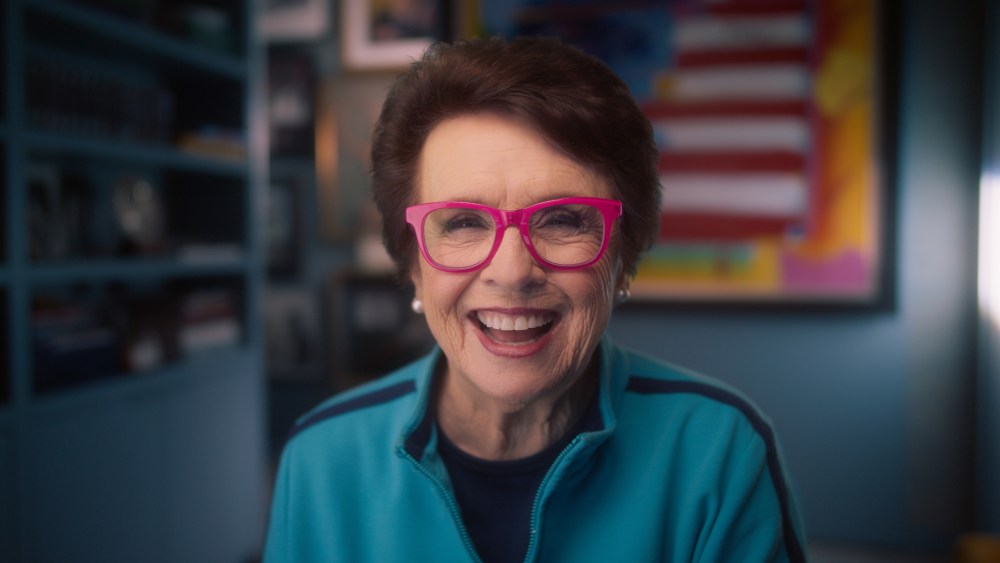
Tennis icon and legend Billie Jean King tells her story in documentaries, articles, and even the movie Battle of the Sexes.
“Give Me the Ball,” which premieres at the Sundance Film Festival on Monday, may be the best documentary about Billie Jean King ever.
Directors Liz Garbus and Elizabeth Wolfe tell the story of King’s struggles and triumphs through candid interviews and archival footage, celebrating his impact and fight for change not only in tennis but in culture.
Ahead of its Sundance premiere, King, Garbus and Wolfe sat down to discuss their unrestricted access to telling the ultimate Billie Jean King story.
The documentary is an ESPN 30 for 30 documentary with a premiere date to be announced later this year. “Give Me the Ball” is produced by Ridley Scott Associates and Story Syndicate in association with Elton John’s Rocket Sports.
Billy, your story has been told many times in many different ways, but “Give Me the Ball” is incredibly honest and raw. Why did you say yes when Liz and Elizabeth approached you?
Billie Jean King: I’ve never seen a proper documentary. I thought, “I’m going to be gone soon so people can see me and hear my own voice,” which I think was really important. Elizabeth thought we should start with 1973 as our center and then move backwards and forwards and whatever we want from there. And it worked really well. They are the right people to do it.
Liz, I know you love tennis, but what made you want to tell the story of Billie Jean King?
Liz Garbus: When we think about storytelling, we’re always looking for something that speaks to our moment. There has to be a reason? Why are you making this movie now? Thinking about Billie as a person, her career, the generational changes that spanned her career, and where we are today as a nation and a culture, that kind of work and spirit is what we need at this time. The story of Billy, a selfless warrior who risked everything for his community, is an incredible story. No matter what community you lift up, you do it, you do it all, and that’s what Billy did.
Elizabeth, Billie touched on that, but could you talk about the frame you had in mind given her career?
ELIZABETH WOLF: I knew about Billie’s story, but I knew it from the perspective of having studied the women’s movement, and I knew a little bit about the “battle of the sexes.” The first thing I did was buy and read Billy’s memoir, “All In.” As a filmmaker, being able to commission someone to write a memoir and use that as a guide for how to approach storytelling is a great research tool. What struck me, both when I read this book and when I met Billy, was the lesson that you can change the world by changing your world.
There was also a lot of Billy archives, especially in the late 60s and 70s.
We remembered 1973. Billy has won many titles and is about to compete in the Battle of the Sexes. It is the pinnacle of the women’s movement. A lot of things come together. If you do a little research, you’ll find that she’s on every TV show and in every newspaper. And it seemed like now was the moment.
When you spend time with Billy, you feel like you have the best life coach around.
I remember saying to Liz after we first met: “We as humans have to feel it.” That was the motivating factor in deciding to have Billie as the main interviewer to speak to the audience and really make these life lessons feel through her story.
How do you find the balance between wanting people to “feel Billie” but also needing to tell a great story of one woman’s fight for equality and change?
KING: Liz is the one who comes in and asks questions. She kept asking me good questions. There are many vulnerabilities there. what do you say? How do you say exactly? How do you reach people? How can we touch their hearts and minds? How can we help them? It has always been important to me since childhood.
Garbus: I think one of the reasons Billie has been able to make a difference in society, change her sport, and impact so many people and society as a whole is that she’s relentlessly optimistic and moving forward. she is a fighter. She put one foot in front of the other and that spirit is what made her this great warrior. It was also difficult, as a filmmaker, to ask her to stop and think about what that was like. Billie had to hold back all sorts of mental turmoil as the entire tour rested on her shoulders. She couldn’t skate. She couldn’t be human. The reason we sometimes ask her the same questions or push her is because that’s Billie’s nature. Now that I’ve spent time with her, I think moving forward, we should focus on the positives, and we both know that it comes at a personal cost. In other words, he was asking Billy to pause in that moment and notice how that weight felt. But it was precisely Billie’s forward movement, drive, and optimism that made her so incredibly powerful and effective.
KING: Knowing history is important. It is important to know the history of women’s sports. No one really knows anything about women or women’s sports. There’s a reason why this happened. It was because of Title IX. It was because of what happened in history. And it won’t happen overnight. I think sometimes people don’t stop and think about these things. I think they need to understand that it’s been a long and difficult road. What about the generations before me? I don’t know how they did it, but it took many generations for these players to realize their dreams. A lot of what my generation did was prepare things, and we had different dreams, but we knew we couldn’t do it, but we wanted future generations to do it. I want players to understand this business and I hope this educates and helps people.
Garbus: I’ll tell you that you’ve seen more “battle of the sexes” in our docs than ever before. Isn’t that so?
KING: You found something.
This traditional style is still conveyed today. Did you know where it ends?
Garbus: I think it started with the idea of the 1973 frame. When you start making a movie as multi-chapter and as impactful as Billy, you need a frame. You also need to be flexible when entering the editing room. The best part of documentary filmmaking is throwing all the spaghetti against the wall and rearranging it.
One thing that’s really important is that you feel like you know Billy.
It’s a huge responsibility when you think about your responsibility as a filmmaker and that this piece of American history or this film is going to be part of her legacy. So we worked incredibly hard to get it right and also to make it feel like we got to know this person.
Wolf: We spent a lot of time with Billy in the edit, and we were like, “Wow, this story is so important.” There are a lot of downer stories in the documentary world, but this one was uplifting and optimistic.
Originally when we were thinking about the 1973 frame, it was like, “Okay, it’s a battle of the sexes, and she wins.” But we realized almost immediately that there was more to tell. Her personal journey through dealing with an eating disorder, meeting (my wife) Ilana, and coming to terms with herself, her needs, and her sexuality. There are so many things I want to tell you.
Going back to what you said earlier, what does it mean to tell Billy’s story to the world?
Garbus: We need heroes. We need people who fight the tough battles, come through the other side, make sacrifices, and take great pride in their sacrifices. We need people who put the needs of their communities above their own.
This interview has been edited and condensed.
