

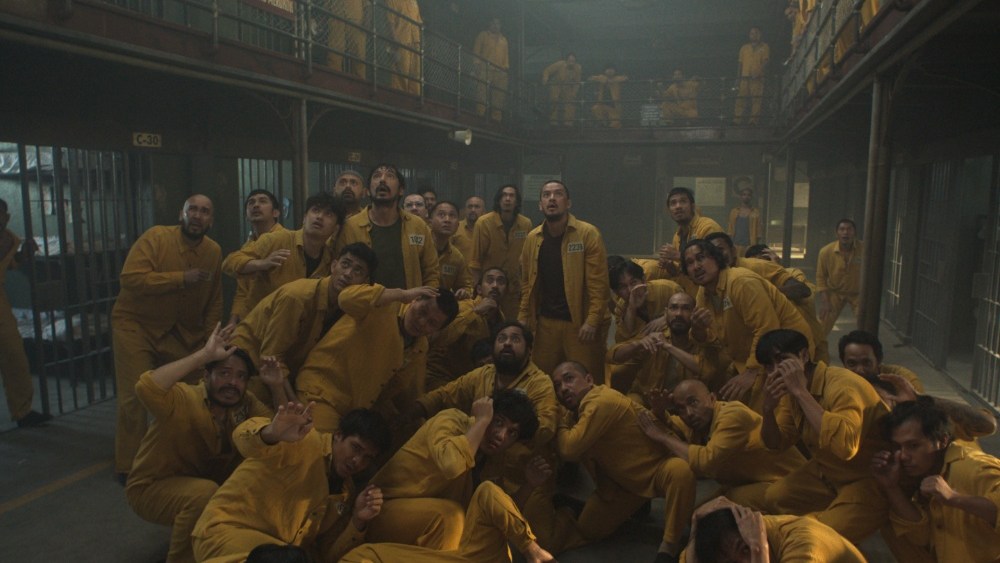
The ghosts in Joko Anwar’s Ghost in the Cell aren’t haunted, they’re in charge.
With his Berlinale Forum entry Ghost in the Cell, Indonesian filmmaker Anwar has created a prison-set thriller that conveys social anxiety over systemic corruption and environmental destruction through supernatural horror, treating its genre elements as political tools rather than escapist entertainment.
The film centers on prisoners in an Indonesian correctional facility whose fragile power structure collapses when a new inmate arrives with a vengeful supernatural being who hunts those with the darkest auras. As the body count rises, survival depends on the collective action of those incarcerated.
For Anwar, the prison environment became an intensive laboratory for exploring social hierarchy. “Prisons are like a microcosm of society, where class, power relations, fear, violence, and morality are all compressed into one confined space, where civility is removed,” the director explains. “In prison, the consequences are immediate. But while everyone is trapped in the same system, not everyone faces equal consequences, including punishment.”
The filmmaker deliberately wove environmental destruction and judicial inequality into the fabric of the story, rather than treating it as background decoration. “Horror has always been rooted in environmental and political realities, rather than just entertainment,” Anwar says. “I let ghosts tell me truths that human-made systems refuse to articulate.”
Central to the film’s approach is treating supernatural beings as active substances rather than pure metaphors. “Ghosts never represent ideas. They have intentions, they have intelligence, and they have limits. Ghosts choose their victims,” Anwar points out. “In other words, ghosts are not metaphors, but real people, shaped by trauma and injustice. Ghosts do not bring moral comfort; they bring consequences.”
Managing a large ensemble within a volatile prison environment required extensive preparation. Anwar created detailed backstories for all the characters, including the day players, and conducted group rehearsals that reflected the film’s factional dynamics. “We had all the actors have sheets of other characters in their group, and we kept other characters from different groups a mystery so that you could feel the danger and suspicion that comes from other groups of prisoners,” he explains.
It turned out to be important to balance the tone, mixing violence, satire, and unpleasant humor. “Humor in movies sharpens the tension rather than defusing it,” says Anwar. “Laughter should be accompanied by discomfort. If the audience laughs and immediately wonders why, the tone is working.”
Landing in Forum, known for championing formally ambitious and politically challenging films, is in keeping with Anwar’s intentions. “The Forum is a section where films are allowed to be uncomfortable and unresolved,” he says, hoping that the system depicted will be perceived by international audiences as uncomfortably familiar rather than exotic.
The director wants viewers to stop questioning the organization’s complicity. “I want people to ask themselves who this system is actually designed to protect,” he says. “This film isn’t asking whether corruption and destruction exist. We all know that they exist. It’s asking why we are so comfortable allowing them to become normalized.”
The film represents a new collaboration between Jakarta-based Come & Sea Pictures, Anwar and producer Tia Hasibuan through Rapi Films, South Korea’s Barunson E&A (the studio behind Bong Joon-ho’s Oscar-winning Parasite), and Legacy Pictures. The ensemble cast includes Abhimana Aryasathiya, Lukman Sardi, Bronto Paralae, Aming, Rio Dewanto, Morgan Ooi, and Tora Sudiro.
Barunson E&A is handling worldwide sales for the project as part of a two-year agreement with Come and See Pictures.
