

 7 minute read
In 2023, Jessica Alba and CAA Co-Head of Film Talent Tracy Brennan founded the group Culture Makers over a shared concern that Latinx representation in film and television continues to lag. They have come together to recruit, network and promote more opportunities for Latinos in all areas of entertainment. Since its inception, new relationships, film projects and collaborations have emerged through Culture Makers.
On Monday, co-hosts Alba, Brennan, ELLE Editor-in-Chief Nina Garcia and Sofia Vergara hosted the third annual Culture Makers event, hosted by Tequila Don Julio and ELLE. The party honored designer Willy Chavarria and included guests Becky G, Natalia and Vanessa Bryant, Edward James Olmos, Andy Garcia, Robert Rodriguez, and Miguel. “I am so honored to be hosting this event with Jessica, Nina, and Tracy this year,” says Vergara. “Having an event that creates community and promotes the idea of collaboration, creation, and supporting each other was something that I of course wanted to be a part of. It’s an opportunity to celebrate who we are and where we come from.”

Willy Chavarria and Jessica Alba.
How have Culture Makers changed in 2026 compared to 2023?
Tracy Brennan: Our community just came together. When Jessica and I started this, we only knew each other a little bit. Although we ran in the same circles and met at events, we never really spent time together or had any meaningful conversations. Our group has become closer together and our communication has become deeper. People are coming out for each other, celebrating each other, letting each other know when projects they’re working on or movies are coming out and how we can all come together and support or repost something for people. Our community didn’t really have a cultural hub where we could all come.
People are like, “Hey, this movie is happening.” That way people can get information and get in the ring, not just from the representatives.
Jessica Alba: I think[we were]hungry for a community like Culture Makers and a group chat and a space where we could really support each other and be each other’s sounding board. People are always very active in it.
TB: Every time there’s an event like this, Jessica is great at putting out these statistics quickly, eloquently, and clearly. Education is key because you don’t realize your power unless you connect with others. But because of the purchasing power of Latinos, we have real power. I hope people care about the Latinx community and are excited about it and want to support it, but people also care about the bottom line.

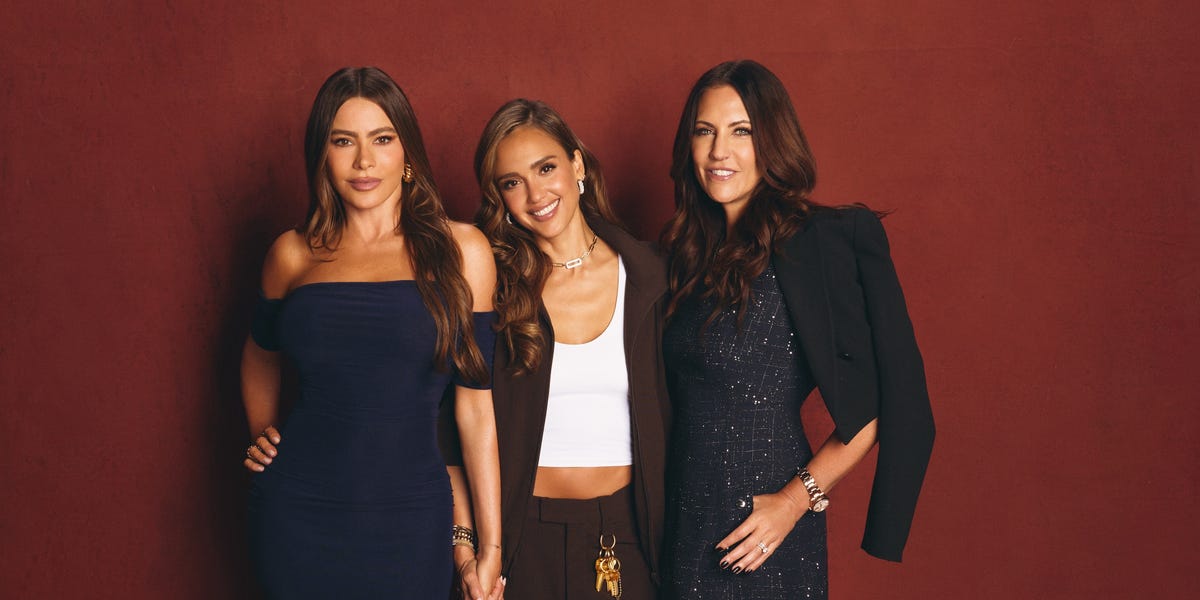
Vergara, Brennan, Alba.
What projects and collaborations have come about as a result of the relationships built through Culture Maker?
JA: When we put it together, Culture Makers was really about creating a backyard cookout-like atmosphere where we could have deep, meaningful conversations and connect with each other. What emerges from this is a project and a collaborative effort.[I talked to Michael Peña]and he was like, “Michael, what do you want to do?” He said, “It would be cool to do a family movie. It would be cool to do an action movie or a heist movie.” So I asked, “Why don’t you do a Robert Rodriguez, fun action, family, heist movie?” So Robert joined us.
James Cameron obviously introduced me to the world as an actress, but it was Robert Rodriguez early in my career that made me a darling of the indie world. There is a movie called “Incognito” that was sold at Cannes. Danny Ramirez and Victoria Alonso joined[Culture Makers]to make a movie called Baton, and the cast is almost entirely Latino.
TB: It also means connecting the dots because I think a lot of people in our community didn’t know about the accomplishments of other Latinos. Enrique Melendez, Jenna Ortega’s stylist and one of the few Latina stylists, participated in the Culture Maker event for the second year. I promoted him because I was working with Jenna and I was telling everyone, “You should know this guy.” Suddenly he started receiving calls from people.

Natalia and Vanessa Bryant.
What are the biggest challenges facing Latinas in creative fields today?
JA: I think the biggest challenge, frankly, is expressiveness. A lot of gatekeepers often feel really strangled because, frankly, they don’t know anyone who looks like you, and they don’t know that you work with people who look like you. Many people are risk-averse, trying to hang on to their jobs, and don’t want to rock the boat. They feel it’s a big risk, even if you’re highly qualified, talented, and right for the job.
There is rhetoric that we all must confront if we are to truly change the narratives that are untrue about our communities and drown out so much good work and progress that we have made. What’s so important about this group and what we do every day is to continue to show up and express who we are and to show little boys and girls that no matter who you are or where you come from, all kinds of people can be leaders and be in positions of power.
TB: Unfortunately, a lot of the roles created for Latinos are very stereotypical. I represent Demián Bichir, the third Latino ever nominated for Best Actor. After he was nominated for an Oscar in the same year as many prominent movie stars, the only casting nomination he received was for a cartel leader, and he really didn’t want to continue perpetuating that stereotype.
The fact that people weren’t thinking of him outside of those roles, which is unfortunate, but he just received an Oscar nomination for his beautiful performance, was very eye-opening and enlightening. It is our duty to promote new voices, new writers, and new directors, and to help identify and support them.
I don’t think anyone would say, “I need a straight offer,” but everyone would at least like to have the opportunity to put their art to the forefront, have other people see it, see new ideas, and be on a bit of a level playing field.

Are we seeing any progress in these areas?
TB: To be honest, I think it’s still tough.
JA: It’s still difficult.
What are the future goals for Culture Makers?
TB: In my dream world, I would love to continue to grow Culture Makers. I want to hold an event in New York. We started it here (Los Angeles), but it would be great to have a presence on the East Coast as well and really unite our groups across the country. We would like to expand overseas as well.
The other day, a Guatemalan filmmaker sent a film to my client. I had never heard of this director before, but I sat down and watched the movie and thought, “Wow, this is very impressive.” Therefore, we want to continue to grow, unite, and make our presence felt on a global level.
JA: It would be incredible to have an endowment that could actually put money and resources into developing these great projects. In many cases, a check of $10,000 to $50,000 can make a big difference in whether something actually gets written.
TB: I have to say that while the statistics aren’t looking good in film and television, music has come a long way. The Latin music scene is huge and all sorts of records have been broken in the last few years, making it really exciting and exciting.
JA: Another big part of the story about spaces that don’t always see us is definitely fashion. Vogue Mexico editors Carla Martinez de Salas and Nina Garcia have always been champions and supporters of our community and others. Nina is amazing. She is the Fairy Godmother who creates space for Latinas in the fashion world. What an impact it has on culture and expression.
Willie (Chavarria) is definitely leveraging his platform and his show to tell real, really beautiful stories. they feel at home. For me, when I watch Willie’s show on my phone, iPad, or computer, I watch it over and over again, like a telenovela, like a Broadway show. There’s a story. It’s romantic, tragic, and beautiful. It’s celebrating. It’s really about what’s going on in the world. I believe he is so inspired by what’s going on in the world and how our communities can stand up beautifully with dignity and pride. We’ll do it on stage in Paris.
Even the silhouettes he uses, it’s all kind of a callback to Chicano culture and that’s what I grew up watching. I have a great affinity for Willie, his storytelling, and his courage to be able to love the person he loves and not have any barriers to it. Because certainly there is still a big masculinity in our culture that he stands up against. I’ve been a fan of his for years now. It’s truly incredible to be able to honor and feature him on Culture Makers. Hopefully, we’ll all be wearing more willies on the red carpet.
TB: Another fun thing that Jessica takes the lead on is celebrating someone, whether it’s a famous celebrity, a great chef, cook or baker. Jessica made sure that all of the vendors attending the event were Latinx from Los Angeles.
It was a great opportunity to showcase local vendors within Los Angeles. There were so many different new foods, shops, restaurants, and different things that I wasn’t even aware of that she was brought to the table and given a platform to shine.
This interview has been edited and condensed.
