

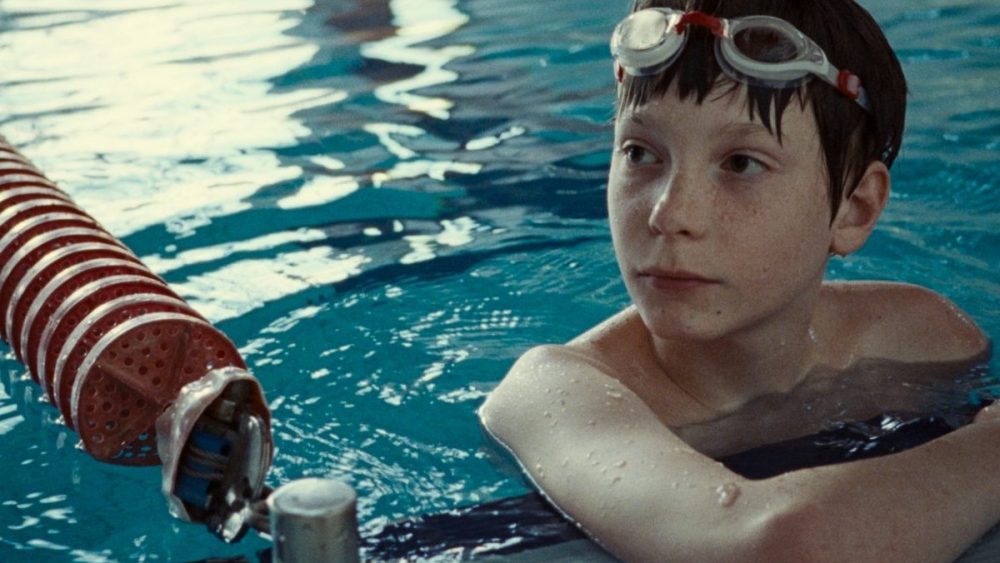
Creepy title aside, one might start watching Charlie Pollinger’s The Plague and think it’s a YA coming-of-age drama, a modern-day version of The 400 Blows, or a men’s version of Welcome to the Dollhouse, about a group of teenage boys spending the summer at an overnight water polo camp. But as the film progresses, not only does its story become increasingly sinister, but the look and feel of the film subtly lures the audience away from its cheerful safety and into the darkest psychological realm of early adolescence.
The film is set at a water polo camp, so much of it takes place in and around an indoor pool. Anyone who has been to the YMCA early in the morning knows the harsh fluorescence of this environment. The first two acts of the film thus appear brightly lit and almost sterile at times.
The opening shot introduces the first of many underwater shots, with the camera fully submerged in the pool and showing the boys diving into the water and flapping their feet, disturbing the underwater calm. The chlorine-washed blue of a swimming pool is unmistakable, but cinematographer Stephen Brecon says he and Pollinger tried to avoid typical underwater shots. “The classic underwater shot is a perfume commercial where you see a woman in a flowing, draped outfit with what looks like a divine ray shining through it,” Brecon told Variety. “It was nowhere near what we wanted the material to look like, and was actually more like a painting, inspired by a deeper focus.”
To achieve the underwater shots, the cameraman was underwater and received instructions through speakers, Brecon said. “Basically, I was able to talk to him through a giant megaphone speaker that was placed underwater, so it was like garbled instructions and he would just nod ‘yes’ to the camera or nod ‘no’ to the camera to make sure he could hear me.”
The camera was no longer stationary, circling around the swimming children and bobbing up and down as if by chance, but Brecon said it was more carefully calibrated than it appeared. He said the camera was “on a flotation rig that allows you to let the air out to a perfect level where it’s half in, half out. And then you push it to the surface between the boys and there’s a lot of splashing going on, so it has a very chaotic energy.” But “it was very diagrammed. It had to be very safe for the boys, so there wasn’t really a lot of moment-to-moment spotting of it. You know, we had lifeguards in every corner of the frame.”
The handheld look of the sequence is complemented by sound and score that cut in and out in sync each time the camera submerged and surfaced. “I’m sure the actual ducking of the sound of the music was done by Damien[Volpe]and Dave[Patterson]in the sound department. But I was there. I participated in those sessions,” composer Johann Lennox told Variety.
Although the film’s cinematography slowly shifts over the course of its running time from the deceptive brightness of a Bildungsroman to the darkness of a horror film, the music is consistently eerie from the beginning, letting the audience know that not all is well for this group of children. “The music is scary, but it’s also super weird,” Lennox says. “We wanted to send a telegram early that something goofy and insane was going to happen.”
The eerie energy is accentuated by the music’s surreal and sometimes marginal nature. “You just hear me crying into this microphone,” Lennox continued, noting that the music is strange throughout, but there are subtle escalations as the film progresses. “I don’t think there are any strings in the first third or half of the movie, and then the gritty, noisy sound of the strings starts to creep in over the vocals and eventually replace the vocals the moment the happy music stops,” Lennox explains. “Then there’s also this tense, swelling drone sound that crowds the hallways and stuff. There’s a short sound early on in the movie, and I think it’s about three or four minutes long at the end.”
The sights and sounds of “The Plague” are a notable break from that sinister mold. Of note is the scene in the middle of the film where the children sneak out at night, and a handheld long take of the children partying in an alley.
“This is probably the most extreme version of what I call a ‘sandbox’ scene,” Breckon says. “There are broad strokes that are very well set and diagrammed, but within that, it’s just chaos, going in all directions. In terms of actually approaching it, we were trying our best to commit to a 180-plus area, flipping around and trying to get the other side, but the kids did everything in a circle, so right away we were 36 It became a 0 degree area and that posed some challenges. As a cinematographer, you want everyone to be in it.” You don’t want too many backlit, frontlit moments, so you were trying to keep up with the scene that was unfolding in front of you, but there wasn’t a version where you were like, “Hey, hey, this isn’t what I want.” It was more like, ‘No, this is what our kids are telling us we should be.’ ”
The scene culminates when one of the boys puts a CD into a boom box and an Italian pop song plays. This song could easily be mistaken for an anonymous but fitting needle drop, but it is nonetheless an original piece of music that Lennox composed for the film. “Why don’t we just write something ourselves?” Lennox reflects, praising the film’s “sound world, which is 90% one thing and then something else comes in. That’s intentional. It couldn’t be more opposite of everything else. I really like it as a structure and a shape.”
The song is titled “Corsa Notturna” and features Italian child vocals. This is the only vocal part on the soundtrack that isn’t Lennox’s own. The song reappears at the end of the film, with a dance sequence that once again showcases innovative camera techniques.
As the protagonist dances freely, we spin with him until a unique effect takes hold, cutting seamlessly between the boy and his spinning future, which seems to continue spinning. But Breckon explains that the shot never made the cut. The researchers created a rotating six-sided mirror in which the actor remained stationary, allowing him to intermittently appear in reverse shots while maintaining an outward circular motion.
“As he becomes part of the image and it moves from people looking at him to just him, he’s actually slowing down. He’s not spinning himself anymore and he’s starting to take stock of the situation at that moment, as opposed to the fact that this mirror is spinning faster and faster,” Breckon says. It’s a riveting effect that concludes the film, and effectively sums up this story’s dizzying approach to self-acceptance.
The influences on The Plague are wide-ranging. Breckon and Lennox say they draw inspiration from “Low,” “Carrie,” and “The Shining,” as well as “Full Metal Jacket,” “8 1/2,” “The Dark Knight,” and “Superbad,” to shape their look and sound. The result is something completely unique. This is a youth horror film that explores the social, psychological, and physical instincts that come with growing up.
“The Plague” premiered at the Cannes Film Festival in May. IFC acquired distribution rights in August and will release the film in theaters on December 24th.
