

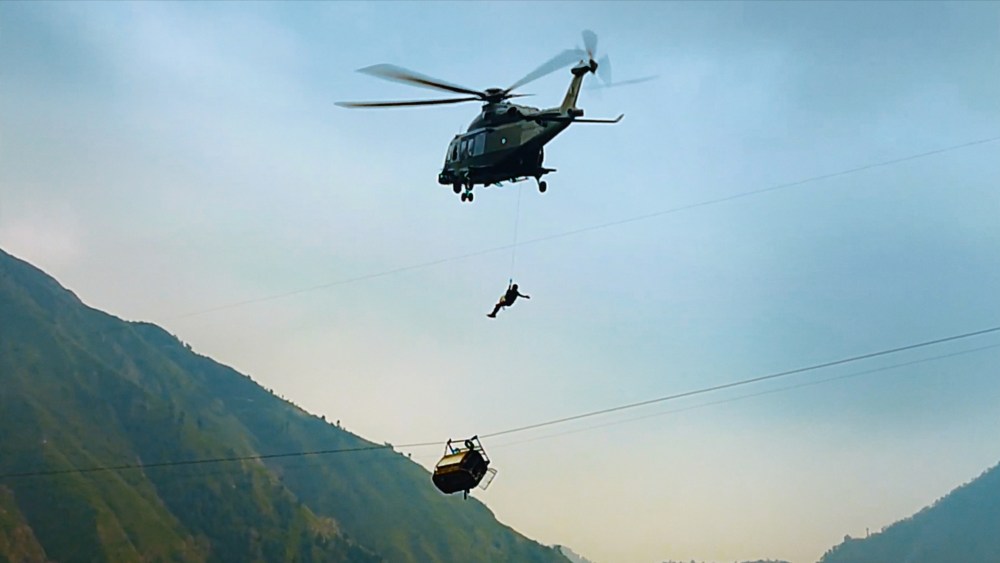
In remote parts of Pakistan, villagers routinely ride rickety cable cars across canyons that cut through the Himalayan foothills. But in August 2023, the unthinkable happened: the wire snapped, leaving six children and two adults dangling 900 feet into a ravine.
Pakistani film director Mohammad Ali Naqvi, along with the rest of the world, watched as authorities and volunteers rushed to rescue stranded passengers. But the dramatic rescue operation, which involved a military helicopter, a makeshift chairlift and a zipline, might not have been possible without some social media-savvy community members using cellphones and drones to capture the harrowing ordeal and urge the government to take action.
“TikTok has changed that,” Naqvi says. “They knew: ‘Don’t call the police. Post these stories on Instagram.'”
After 14 hours of life and death, all passengers were rescued. More than two years later, their ordeal and the rescuers’ heroic race against time inspired a new film, “Hanging by a Wire,” which premiered on opening night at the Sundance Film Festival. Naqvi combed through hours of archival footage to direct this propulsive documentary, which he likens to The Goonies or a cliffhanger.
“This is like a complete Hollywood-style action thriller,” says Naqvi.
Hanging on a Wire not only follows children and adults desperately waiting for help to arrive, but it also follows government officials and good Samaritans as they scramble to find a way to reach the trapped villagers. Among them was Sahib Khan, a local cable car expert known as the “Pirate of the Sky,” who worked with zipline expert Muhammad Ali Swati to install a pulley system to help rescue passengers. and Sonia Shamroz Khan, a district police officer who helped oversee the operation. All of them share their thoughts on dramatic events that often put their lives at risk.
“Many films made in this region are portrayed through the lens of victimhood, powerlessness, poverty and poverty porn,” says Naqvi. “I didn’t want to do that. I wanted to be intentionally destructive with this one. I wanted to show that these guys had resilience and agency. I wanted to show them as heroes.”
“Hanging By a Wire” includes several reenactments, as some of the rescues took place at night, making it difficult to find suitable archival material. However, it was the actual rescuers and the rescued villagers who acted out the ordeal in front of the cameras.
“I know some documentary filmmakers shy away from reenactments, but for me they showed me what happened to them,” Naqvi says. “They were bridging the gap. In a sense, they were co-writing their own story.”
Naqvi hopes the film will draw attention to Battagram district, where the accident took place. The region lacks well-maintained roads and is in dire need of better infrastructure. That was something Naqvi experienced firsthand when he visited the area to interview those involved in the rescue efforts.
“This is the craziest, bumpiest ride,” Naqvi says. “You’re climbing the Himalayas. It’s very narrow, and you’re riding in this jeep. If you make a mistake, you’ll fall to your death.”
At one point he decided to ride one of the cable cars.
“When I was location scouting, I told myself it would be okay,” Naqvi says. “It was a horrifying sight. About halfway through, I thought I’d never do it again.”
