

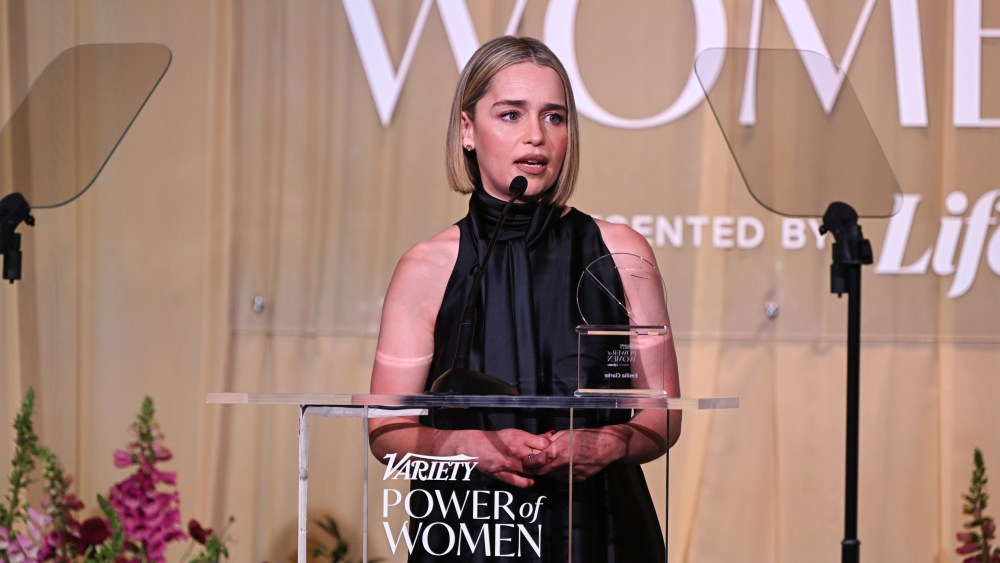
Game of Thrones star Emilia Clarke was honored at Lifetime’s Power of Women London, where she gave a moving speech about surviving two brain haemorrhages in her 20s.
Clark detailed her survival from the massive hemorrhage in last week’s cover story, but she maintained a sense of humor even 15 years after her health scare.
“For years I felt like I was cheating death. Death was coming for me,” she said. “I really felt like I had done something wrong. I shouldn’t have been here. I also thought it messed up my ability to function. Some people may agree with this.”
Ms Clark and her mother founded the charity SameYou in 2019, where she publicly revealed what she had gone through and whose goal was to help fellow survivors suffering from brain hemorrhages. “When we finally shared our story in 2019, we were overwhelmed by the response,” she told Power of Women London. “Most young people have contacted us to tell their stories. Today, tens of thousands of survivors in our communities are saying essentially the same thing: The journey to healing is like falling off the edge of a cliff with no one to catch you.”
The Game of Thrones star was honored alongside Emma Corrin, Hannah Waddingham, Suki Waterhouse and Cynthia Erivo. Read her full speech below and watch the video above.
Hello everyone,
Thank you, Thea, for the wonderful introduction, and to Variety for celebrating this wonderful group of winners. It’s an honor to be in a room full of people using their platforms to highlight such important causes near and dear to their hearts.
I’m personally here to talk about shocking health disparities that affect millions of people but are largely invisible. In Hollywood, that’s usually a superpower. In medicine, that’s the problem. It’s my story and why I founded the charity SameYou.
This is true. One in three people will suffer a brain injury at some point in their lives, and if you survive your brain injury, you may be able to heal and return to a normal life. But that’s wrong.
When it comes to aftercare after brain injury, we face a universal crisis. In the UK and US alone, over 15 million people are currently living with the life-changing effects of stroke or traumatic brain injury. But our health system still lacks a clear path out of this crisis or the ability to help those in need.
That’s why we founded SameYou with our mother Jenny. Because finding the help you need to get back to life is often a matter of winning the lottery. Because of social inequality, they receive little attention, funding, or even airtime. This is one of the biggest gaps in health and social security systems, no matter where you live.
I was 22 years old when I had my first brain hemorrhage. I was 24 years old when I gave birth to my second child. He was also 22 when he filmed the first season of Game of Thrones and 24 when he made his Broadway debut. I’d like to blame the bad reviews on my brain hemorrhage, which happened in the early hours after closing…
It’s been 15 years since my first bleed and I look back on it now and realize how difficult it was. I never had a chance to think about how my two brain injuries affected me. Because I was able to walk, talk, be myself, learn my lines, and get back on camera within weeks of both brain injuries.
I was okay, right?
Did I ignore what was going on with my hormones, or rather my hormone deficiency, my extreme fatigue that no one I knew in my 20s suffered from? What about my anxiety? Is that a normal job in an image-focused industry? Broken ribs after filming a sex scene? Well, maybe that’s his fault. But do you sometimes experience a power outage after a long night shoot? Does your whole body hurt? I didn’t think I needed to know why. I wrote it off as stress and a non-stop work schedule that I wasn’t very good at dealing with. I thought it was fixed. So did my doctor. I blamed myself because no one could see the pattern.
It never occurred to me that maybe the problem was with me…because brain injuries are so complex and we are only beginning to understand how they can affect you, long after you have recovered.
If you are rushed to the emergency room with a brain injury, doctors will usually do everything they can to save your life. They will stop the bleeding, remove the blood clot, find the cause, cut it out, stitch you up, and send you home. But what many people don’t realize is that no matter what symptoms remain, whether physical, cognitive, emotional, or verbal, the result is unresolved trauma. And there are too few neuropsychologists and specialized rehabilitation services to change that reality without a major shift in priorities.
When everyone around you thinks you look fine, they treat you as if you are fine. Eventually, you’ll start to think you should too. I often compare today’s brain injuries to the situation with cancer 100 years ago, when it was misunderstood, stigmatized, and hidden from view.
When rehabilitation is available, its duration is usually measured in weeks rather than years, and it focuses only on the most visible symptoms. Brain injury recovery is still in its early stages, leading to lost potential, lost livelihoods, and setbacks for too many people.
SameYou’s mission is to help people rethink recovery.
In 2011, I didn’t want anyone to know about my brain hemorrhage. I was embarrassed and overwhelmed by a diagnosis I didn’t understand. I didn’t even tell HBO until I knew I wasn’t going to die. In TV terms, that’s usually when they get killed off anyway. After my second bleed in 2014, I started thinking that speaking publicly might help. But it still took many years for me to grapple with my truth.
When I finally shared my story in 2019, we were overwhelmed by the response. Most young people contacted us to tell their stories. Today, tens of thousands of survivors in our community are saying essentially the same thing. The journey to healing feels like falling off the edge of a cliff with no one to catch you.
I knew I had to do something. It all started when I wanted to buy a new sofa for my hospital’s ICU family room. Then the nurses came to support me, holding my hands, cleaning me, and talking to me while I tried to understand what was going on. Then I started imagining what my recovery would have been like without my family. If I wasn’t financially stable. If there was no job waiting for me. In the end, it all became SameYou.
Recovery is just as important as survival.
People need guidance. they need answers. They need support both physically and mentally.
Because when you think about who you are, your personality, your intelligence, your humor, your memory, your good taste, etc., where do they live? Your heart.
And when that fails, our faith in ourselves can be shaken. It may scare you and convince you that you’ll never be the same again.
But we know that it is possible to pick ourselves back up. Hence the name “Same You”.
Fifteen years after my first brain hemorrhage, I have recently embarked on my very belated journey of recovery. Thanks to the guidance and help of the extraordinary David Putrino at Mount Sinai in New York, I now have the energy and positivity I had in my 20s.
This was not a miracle cure, it was a journey.
One in three of us will experience a brain injury in our lifetime. There are so many people living with life-altering consequences.
So if it happened to you or your loved one, they have the right to come forward.
Thank you for giving me this platform to tell my story. Thank you to the tens of thousands of SameYou survivors who continue to inspire us every day.
And thank you for listening.
