

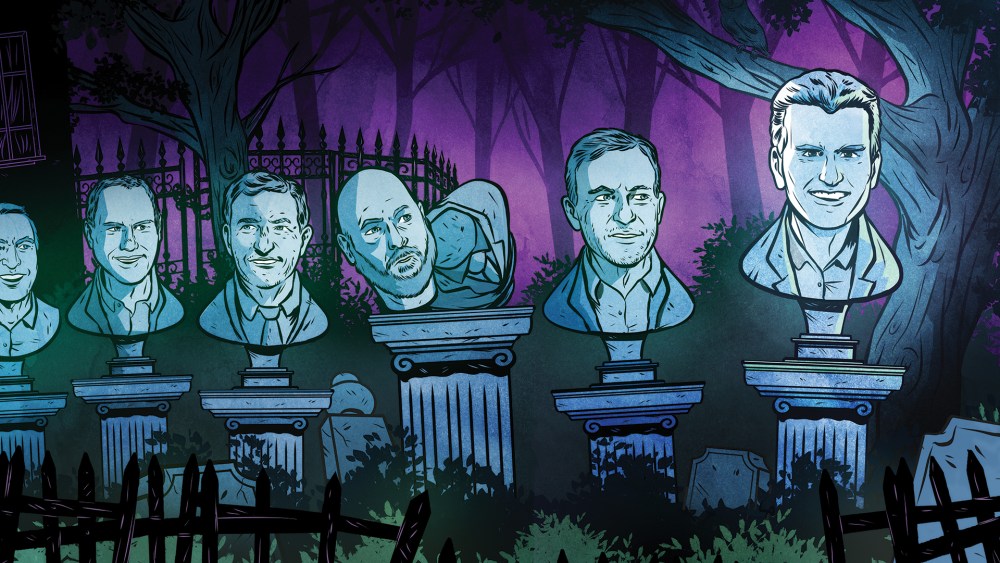
It was around five in the morning on Disneyland’s 70th birthday in the summer of 2025, and tens of thousands of staffers and guests had arrived early to watch Josh D’Amaro and Bob Iger ring in the anniversary in the park’s esplanade.
D’Amaro, then the chairman of Disney Experiences — and soon to be named the company’s CEO — was set to deliver welcoming remarks onstage in front of the iconic garden boasting 5,900 flowers planted in the shape of Mickey Mouse’s face. A marching band was on hand to welcome the executives; Minnie and Goofy were waiting in the wings; Snow White, Chip ’n’ Dale and other beloved characters were packed into a train car ready to be rolled along the tracks of the Disneyland Railroad; and a parade was scheduled to glide down Main Street. Cameras were set up to record the celebration for a gauzy special on ABC.

Zohar Lazar for Variety
There was only one problem: D’Amaro was nowhere to be found.
Handlers scrambled to find the chairman of the parks as fans pushed against the gates. The executives were set to ring the New York Stock Exchange bell and take a photo with 36,000 cast members, and the clock was ticking.
Finally, the handlers located D’Amaro. He had slipped under the ropes and gone to the back of the crowd, and was walking among clusters of employees shaking hands and chatting. “That’s a custom of his — to always go to the people furthest from the stage and do his Josh thing,” says Marcus Buckingham, a leadership expert who shadowed D’Amaro for his upcoming book, “Design Love In: How to Unleash the Most Powerful Force in Business.”
There’s a phrase that’s used around the Magic Kingdom to describe this phenomenon: “the Josh Effect.” D’Amaro — tall, slender and silver-haired — has a politician’s ability to make anyone he encounters feel seen and heard.
“He’s so relatable,” says Joe Gavigan, a 25-year veteran of the parks division. “He looks people in the eye. He’s extremely confident but not cocky.”
D’Amaro is also fiercely competitive. When Gavigan and D’Amaro worked for Disney in Hong Kong, they played tennis almost weekly. Despite his aura of affability, D’Amaro fought to win every match.
The 55-year-old executive will need to show that same drive as he takes on the biggest challenge of his career; Iger, who became CEO in 2005, will hand him the keys to the Mouse House on March 18. Though The Walt Disney Co. remains the most storied brand in Hollywood, the entertainment landscape it once dominated is shifting dramatically, forcing D’Amaro and the company he will lead to adapt with it.
Disney’s rivals not only include traditional media conglomerates like Comcast that make their money by producing and distributing films and TV shows, but streaming giants such as Netflix that have transformed the way that people watch them. That’s to say nothing of tech players like Apple and Amazon, which have muscled their way into the business by launching their own streaming services. And then there’s YouTube and TikTok, which are siphoning off younger viewers at a dizzying rate with user-generated content.
“Disney and Josh have to get Hollywood back in the center of gravity of our culture,” says Kevin Mayer, former head of Disney’s global streaming business and co-CEO of Candle Media.
But viral videos may not have the same tsunamic impact as artificial intelligence, which Disney is still trying to navigate, engaging in legal battles over copyright with some startups in the space while investing $1 billion in OpenAI. Animation is synonymous with Disney’s brand, and AI is reducing the cost of producing those movies. However, it is also flattening the playing field, allowing users to create animated work without the backing of a major studio. It will take a deft hand to navigate AI, an inevitable force and yet a major point of sensitivity in the creative community. Iger has described D’Amaro as someone who views technology as an opportunity rather than a threat.
“You’re seeing it supercharge these creatives in amazing ways,” D’Amaro, who declined to be interviewed for this story, told Disney-owned ABC News. “If you were to walk over to their studios today and see them using AI, harnessing 70 years of history, this is when The Walt Disney Co. thrives — when technology intersects with brilliant people and creativity.”
Disney has long maintained that its library of animated characters, from Cinderella to Stitch — as well as the brands that Iger snapped up during his tenure as CEO, such as Marvel and “Star Wars” — enabled the company to overpower the competition. That may be true. However, they can’t alter the fact that the shift to streaming is leading to the collapse of the cable business, depriving Disney of a major source of its profits.
Cable is uniquely valuable and thus nearly impossible to replace. Disney not only brings in subscription and ad revenue from its cable channels, but also pockets retransmission fees from operators paying to broadcast its programming. Viewers may be signing up for Disney+ and the company’s other streaming services in greater numbers, but that business barely breaks even, and the money that Disney is generating pales in comparison with what it once made from cable.
“The problem Josh faces is the one we’re all struggling to solve: How do you manage the decline of cable and replace those earnings with streaming?” says one rival entertainment company chief. “You have to oversee that transition while simultaneously finding ways to grow your business.”
D’Amaro, who joined Disney in 1998 as a sales and marketing exec, was tapped to lead the company because his part of the Magic Kingdom is growing. Last quarter, Disney Experiences, which includes the parks, cruise ships, hotels and consumer products, topped $10 billion in revenue for the first time in its history. Even more impressive, under D’Amaro, that division was responsible for 71% of Disney’s operating income. In contrast, D’Amaro’s rivals for the CEO job — Dana Walden and Alan Bergman — came from the entertainment division, which saw profits decline by 35%, and the operating income of ESPN, led by Jimmy Pitaro, another challenger, dropped by 23%.
“For a lot of folks on Wall Street, there’s a degree of comfort in Josh taking over the role,” says Kutgun Maral, media analyst at Evercore ISI.
During the first of his two terms as CEO, Iger opted to deploy Disney’s treasury to buy Pixar, Marvel and Lucasfilm, believing that the company with the greatest stockpile of intellectual property wins. How will D’Amaro make his mark now that he’s calling the shots? It may not be the kind of transformative $71.3 billion deal that Iger signed to buy 20th Century Fox, given that Disney is carrying more than $45 billion in debt.
D’Amaro is a self-proclaimed risk-taker, and his moves as parks chief offer some clues. Disney is breaking ground on a theme park in Abu Dhabi, its first attraction in the Middle East. At the same time, D’Amaro successfully pushed for the company to buy a stake in Epic Games, believing that partnering with the “Fortnite” creator would introduce a new sandbox for Disney’s iconic IP. During a Q&A with Disney fan bloggers, D’Amaro teased how he hoped to lean into the gaming universe. “It could be a new film premiering (on ‘Fortnite’). It could be the place that you decide to book your next cruise vacation,” he said of Disney’s plans for the platform. “You could participate in the Super Bowl in some way there.”
Even as Disney moves more aggressively into gaming, it needs to get the Magic Kingdom in order. Analysts and rival companies believe that some of Disney’s most durable franchises suddenly look shaky. In partnership with Walden, who was promoted to the newly created role of president and chief content officer, D’Amaro will have to focus on reviving everything from the superheroes to the sci-fi series. Overall, the company needs to develop new franchises to maintain the flywheel effect that feeds into streaming and the theme parks. “Marvel is definitely in a rut,” Doug Creutz, an analyst with TD Cowen, says. “They haven’t had a ‘Star Wars’ movie in more than six years,” he says, while noting that “The Mandalorian & Grogu” is slated for a May release.
Internally, there are concerns that an unconventional 36-second Super Bowl spot for “The Mandalorian & Grogu” that featured the title characters riding a wagon pulled by Tauntauns failed to generate the kind of excitement the marketing team was hoping to spark. The film itself is something of a question mark, given that it’s based on a streaming series and, consequently, may not seem like a big-screen proposition for any but the most die-hard Baby Yoda lovers. There’s a sense that “Star Wars: Starfighter,” a spinoff from “Deadpool & Wolverine” director Shawn Levy, is more likely to satisfy fans when it hits theaters next spring, with sources who have seen footage praising Ryan Gosling’s performance and suggesting Levy has recaptured the franchise’s spirit of fun.
“Star Wars” isn’t the only franchise facing questions. Walden and D’Amaro will also have to determine if Disney should continue to fund James Cameron’s cinematic journeys to Pandora. The most recent “Avatar” film, last year’s “Fire and Ash,” brought in more than $1.4 billion globally. That’s nearly $1 billion less than the previous installment earned. Given the cost of these films, every “Avatar” installment needs to be massive to break even. “If you make $1 billion on the next movie, you still lose hundreds of millions,” notes one insider.
Rafa Alvarez
Then there’s Marvel, a crown jewel of the Disney empire. When Disney+ launched, the division was tasked with producing streaming shows that tied in with the “Avengers” movies. Some, such as “WandaVision,” were watercooler hits; others, like “She-Hulk,” struggled. The result was oversaturation, leading to audience fatigue. Recent Marvel films “Thunderbolts*” and “Captain America: Brave New World” fell far short at the box office. Some pundits argue the future of the superhero franchise may ride on the hotly anticipated “Avengers: Doomsday,” although sources inside the company’s film division believe the health of the MCU does not hinge on an individual title. Executives are pleased with what they’ve seen for the December release, and rival studio heads privately predict “Doomsday” will be the year’s highest-grossing film.
If D’Amaro is going to revitalize Disney’s franchises, he must maintain a healthy relationship with Walden, considered to be one of the industry’s strongest creative executives. After all, D’Amaro lacks any film or TV experience, something that bedeviled Bob Chapek when he was CEO for less than three years. Unlike Chapek, who alienated Disney’s creative divisions by having the media chiefs report to his handpicked ally, Kareem Daniel, there’s a sense that D’Amaro will approach the task with more delicacy, giving Walden a level of autonomy. “Josh is not afraid to surround himself with people who know more about something than he does,” says Spencer Neumann, a former Disney executive who now is Netflix’s chief financial officer.
Tom Staggs, co-CEO of Candle Media and a former head of Disney’s parks, says while D’Amaro hasn’t greenlit movies or TV shows, he has an intimate understanding of what audiences want to see. “There’s not much difference between what a guest at the parks wants and what the audience wants,” he says. “It’s all part of the same equation.”
Chapek failed to make inroads with the agents and filmmakers who are vital to the production of Disney’s movies and shows. His legal battle with Scarlett Johansson over the company’s decision to send “Black Widow” to streaming during the pandemic did nothing to endear him to the artistic community. Disney’s board, looking to avoid another blunder, opted to promote Walden so she could serve as a cultural ambassador for D’Amaro. That has reassured many of the showrunners who forged deep bonds with Walden during her stint as the company’s TV chief, where she established herself as a talent whisperer.
“When you’re working on a project and it isn’t gelling, panic sets in and you throw shit against the wall,” Dan Fogelman, creator of the Hulu series “Paradise,” says. “Dana steps back, takes a breath and calls you into her office. She has this unique ability to zoom out and look at the big picture. And it can be as simple as ‘This drama is not dramatic enough’ or ‘This comedy isn’t funny.’”
Walden, who was a top TV executive at Fox, which maintained a Darwinian style of corporate governance, has adapted to the Disney way, which embraces a more collegial ethos. Most of the top Fox executives who tried to make the transition flamed out, but Walden thrived.
“The two cultures could not be more different,” says Bryan Lourd, CEO of Creative Artists Agency. “But Dana bothered to get to know the people at Disney and find out what their challenges were. She didn’t bring any assumptions. She brought her curiosity.”
She also ensured a smooth transition for the hundreds of shows moving under the Disney umbrella.
“Will Peter Griffin suddenly have to wear a pair of mouse ears? That was the concern, and it just never materialized,” says “Family Guy” creator Seth MacFarlane, who praises Walden’s “self-assuredness” and ability to “socialize as a friend” with creative people. “She’s like the ship’s captain who is able to be a leader and, at the same time, the big sister to the crew.”
Succession fights often end with bruised egos, but Walden has told confidants she’s excited about her new role, which includes overseeing film. But that means Bergman, who used to have a direct line to the CEO as movie chief, will report to Walden. It’s unclear if he embraces the new relationship; however, Bergman has not indicated he plans to leave.
As for D’Amaro, he’s already made overtures to Hollywood, stopping by a recent luncheon for Academy Award nominees, where he mingled with the likes of Steven Spielberg and Timothée Chalamet. “When you watched Chapek at these things, it was painful,” one observer notes. “Josh seemed completely at ease.”
D’Amaro has managed to steer clear of the controversies and culture wars that perennially plague the Mouse House. He avoided Chapek’s disastrous “Don’t Say Gay” battle against Florida Gov. Ron DeSantis, and he didn’t have to play bad cop during the strikes or muddy himself in the ugly free speech drama between Jimmy Kimmel and the FCC, unlike Walden and Iger. But as CEO, D’Amaro will have to get his hands dirty.
On Sept. 29, 2020, a few months after D’Amaro was named chairman of Experiences, he showed how he might handle a crisis. When mass layoffs struck Disney’s theme park business, D’Amaro was tasked with telling thousands of cast members they were being evicted from the happiest place on Earth.
He didn’t just send a memo; instead, he visited Downtown Disney to comfort crying employees. He listened to them as they vented and shared their fears. But he also made it clear that the COVID crisis had decimated tourism, leaving Disney with little choice but to make painful cuts.
“Josh was both being a good corporate soldier by handling the furloughs due to the reality of the COVID shutdown and also giving the frontline cast members the time to grieve over a very difficult situation,” says Gavin Doyle, founder of the news site Mickey Visit.
The central objection about Disney’s parks over the past few years has been affordability. As their leader, D’Amaro has overseen price hikes that have seen one-day passes at Disneyland and Disney World top $200 and annual passes reach upwards of $1,628. That’s stirred up complaints that what was once a family destination has become a getaway for the rich.
“There is a hope among Disney fans that Josh D’Amaro will lower prices,” says AJ Wolfe, author of “Disney Adults: Exploring (and Falling in Love With) a Magical Subculture.” “I don’t think he’s going to do that. Why would he?”
Despite the blowback on pricing, Disney enthusiasts revere D’Amaro. He’s a celebrity among employees and parkgoers, who see him as the executive most loyal to Walt Disney’s original vision. When Buckingham followed D’Amaro across Disneyland, he says, “it took us half an hour to get 30 yards. He is constantly accosted by guests who want to hug him and take pictures with him. I’ve walked the park with dozens of Disney execs over the years, and this mobbing has never happened before.”
One morning last year, before the gates opened, D’Amaro spent time in the sprawling “Star Wars” land with a Make-a-Wish recipient. “For half an hour, he’s just on his haunches with this 12-year-old girl chatting about the stupid robots that have walked up,” Buckingham says. “And no one’s watching; there are no cameras.”
While D’Amaro made tough decisions during COVID, he was also an empathetic leader as the pandemic upended the business. With all meetings relegated to Zoom, D’Amaro would cover his name tag with masking tape and scribble his emotional state with a blue pen. One day it was “Pain.” Another, “Fear.”
He’s also known to get in the weeds. At Disneyland, he has a reputation for being obsessed with everything from the color of the trash cans to the taste of the popcorn. He recently spent nearly three hours in a meeting with 30 operators and Imagineers to brainstorm a potential redesign of the Millennium Falcon ride. “He even designs his own PowerPoint presentations, which is kind of weird,” Buckingham says.
D’Amaro’s hands-on approach doesn’t just apply to the attractions. In 2022, shortly after Mattel announced a deal to make Disney Princess and “Frozen” dolls and other products, D’Amaro drove himself to the toy maker’s headquarters in El Segundo.
“Josh wanted to meet the people who actually do the work, the product designers and developers,” says Mattel CEO Ynon Kreiz, a former Disney digital exec. “That was very telling about his approach: It was about the people and the work.”
When he ran the Experiences division, D’Amaro had thousands of employees under him. Yet he maintained personal relationships with the security guards, cooks and princesses scattered across the park. He once went viral for picking up trash on Main Street. And on one Halloween, he served as a costume contest judge and chased down the losers to convey how much he admired their outfits.
D’Amaro lives in Orange County with his wife, Susan, and two children. He’s two hours from the klieg lights of Hollywood, but he’s relocating to L.A. to be closer to Disney’s Burbank headquarters. Having won the succession battle, D’Amaro is poised to become one of the most recognizable figures in corporate America. His every public utterance will be dissected for clues about the direction he wants to take the Magic Kingdom. Friends and former colleagues think he will have no trouble adjusting to the higher profile, along with the new zip code.
“Josh lives, eats and breathes the brand,” says Mayer. “I don’t think he’ll shrink from the spotlight. He’s a perfect ambassador for Disney, because he embodies its ethos.”
D’Amaro is fond of telling his children, “Just say yes.” It’s a mantra he’s relied on when facing choices and challenges in his career. “There’s so much serendipity in life — you’ve got to open yourself up and explore,” D’Amaro told students at Georgetown University, his alma mater, last April. “Everything is never lined up perfectly. Sometimes you just have to hold your breath and go for it.”
This month, another one of those life-altering opportunities came D’Amaro’s way. On Feb. 2, the day the board voted unanimously in his favor, D’Amaro was invited into a room with Iger and board chairman James Gorman, where he was asked to be the next CEO of The Walt Disney Co.
“It’s surreal,” D’Amaro confessed at a global town hall a couple days later. “A lot goes through your head in that moment. I got a little embarrassed. I got a little choked up. Because it’s a big responsibility.”
D’Amaro took his own advice. He held his breath and went for it.
Todd Spangler and Matt Donnelly contributed to this story.
