

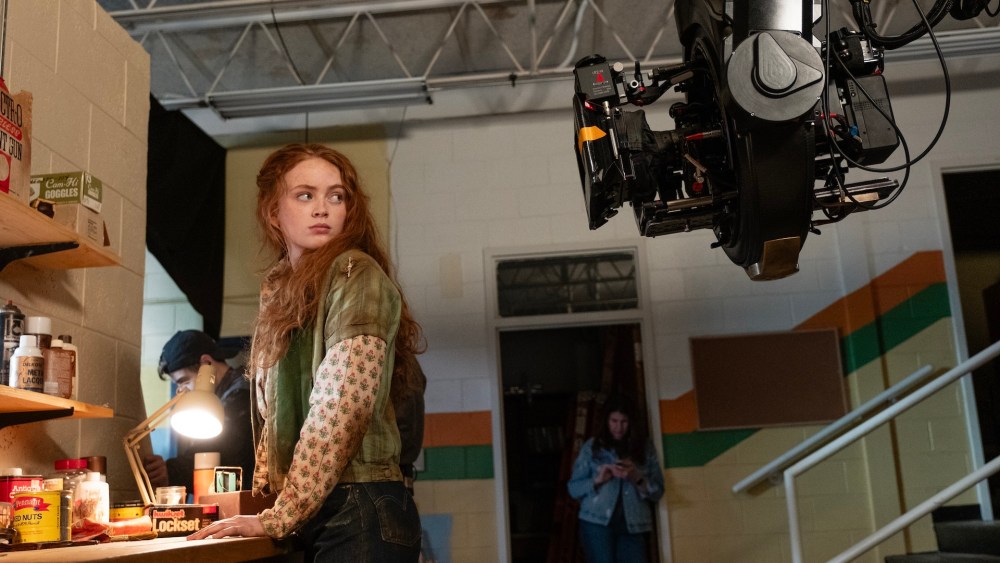
When Martina Radwan, director of the documentary One Last Adventure: The Making of Stranger Things 5, first met the show’s creators Matt and Ross Duffer, she told them she wanted to celebrate the series by showing how the final season was made. But she also wanted to delve into the brothers’ creative process and how it evolved as “Stranger Things” grew into an era-defining hit in the Netflix era.
“Because that’s often left out, especially for shows this big,” Radwan says. “It’s still a very creative process, and it’s still a very collaborative process.”
Radwan immigrated to New York City from Germany in the mid-1990s and has worked as a cinematographer for most of her work. She won an Emmy Award in 2024 as the cinematographer for the documentary “Girls State” and directed her first documentary feature “Tomorrow, Tomorrow, Tomorrow” in 2023. She was hired to direct “One Last Adventure” in the summer of 2023, months before production began on “Stranger Things 5,” and began work on the documentary that fall. The dual strike was finally over and we were finally able to start production.
Radwan was already a fan of the show, but to prepare, she watched it again and read everything she could about the Duffer brothers. “And that’s when it became clear that the scope was very wide,” she says. “But at the heart of it all, it’s still Stranger Things.”
By the end of 2023, Radwan had moved to Atlanta to participate in production on the show’s final season, and was on set every day.

Nico Tavernise/Courtesy of Netflix
“One Last Adventure,” which premieres on Netflix on January 12, follows the production of “Stranger Things 5” from the first table read to the final day on set. It details the filming of the season’s big set pieces, including the end of Volume 1, where Will (Noah Schnapp) accesses powers he didn’t know he had to fight the Demogorgon, and the series finale’s battle in the Abyss. Reflecting on the show in an interview, Radwan said he thought the ending of Stranger Things was “the end of an era,” and he felt that was true. Not only is “Stranger Things” so culturally dominant that entire conspiracy theories can be fabricated, as the “Conformity Gate” rumors that went viral this week demonstrate, but in the future, most shows of this scale will be computer-generated.
Matt and Ross Duffer are the focus of the documentary, but cast members Millie Bobby Brown, Sadie Sink, Finn Wolfhard, and Schnapp also share their experiences on the show and reflect on its ending. Here, Radwan talks about how he directed One Last Adventure: The Making of Stranger Things 5.
This project is very different from your previous work. What was it about Stranger Things that made you want to make this documentary?
It goes back to the creativity aspect and what kind of filmmakers Matt and Ross are. Because I wanted to celebrate the movie. I also teach, so I see kids not knowing old movies. I love Matt and Ross. They always come back to older films that are much more homemade than what we see now, especially ones that are seen at that level and size. I really love that they kept mentioning the old movies with such respect and admiration.
While filming, did you have any idea what kind of story it would be?
Something has emerged. Because it was clear from the beginning that this was a coming-of-age story for everyone, not just the cast. My brothers, all my collaborators, and the times in which we live.
Others appeared as well. The real thing about Stranger Things, what’s really great about Matt and Ross is that they always want to live in the real world, so they build everything. “Stranger Things” was the end of an era. No one will ever build the Pain Tree again, a set the size of a soccer field.
Nico Tavernise/Courtesy of Netflix
When we wrote our Stranger Things cover story, we interviewed Shawn Levy. He was talking about the “twin bubble” between Matt and Ross and how it’s hard to understand, how they are essentially a hive mind. Are there any differences between them as creative people in terms of their duties on set and in the writers’ room?
I really don’t think they are that different. Matt is more of a set guy, while Ross is more of a writer. They say so, but in reality they are so intertwined that it’s fascinating.
We all think “Stranger Things” happened overnight. No, I feel like that wasn’t the case. They started when they were eight years old. It became clear that they were really a hive mind. They rarely disagree.
There are no interviews with people outside of the show. It’s the Duffer family, it’s the cast, it’s the department heads. Did you consider voices from outside the program?
There’s so much information out there about Stranger Things that we wanted to keep it in a bubble. Everything you need to know outside of the show is there.
Did Winona Ryder or David Harbor sit with you? They don’t appear in the movie.
No, it’s not. I just didn’t have time. They were busy with other projects so we didn’t have time to sit down.
Wasn’t it also available as a set? Millie Bobby Brown gives an interview with a bloody nose.
It was Millie’s idea! She was like, “This is my last day. I’m playing a character.”
Unfortunately, David and Winona couldn’t find time. I tried it.
Was it Millie’s idea to do the interview with a nosebleed?
Well, we waited until her last day and she just wanted to be eleven. And Millie is Millie, giving nosebleeds to many others as a wrapped gift.
Ross Duffer and Jamie Campbell Bower
Nico Tavernise/Courtesy of Netflix
Did you just guess which scene will be the most interesting for fans later on? Now you know what the epic scene is that people will be talking about forever, but you just didn’t see it.
Well, of course it became clear after reading the script. And of course, talking to Matt and Ross and hearing their stories. Matt and Ross wanted to make a behind-the-scenes film that would give young filmmakers an idea of how the film was made. Obviously, the MAC-Z attack in Episode 4 was something literally no one knew how to do. Still, they did it.
What interested me was the writer’s room scene where Mike talks about wanting a gun but not believing he should have one.
The beauty of this spectacle is that they always return to the characters. And actually, I think in the writers’ room, that becomes very clear. Matt and Ross are really good at that. Yes, MAC-Z took 6 weeks. But at the end of the day, it’s about the characters.
I don’t want to give Mike a gun — that made sense to me, because once he gets the gun, he’s no longer innocent. He’s not some nerdy kid who plays D&D.
There’s also a scene in the writers’ room where they discuss how the Demogorgon should be present in the final battle in the Abyss, but that didn’t happen, so people were fixated on it. Was it resolved in some way that is invisible to us?
I like that moment and I like the conversation because obviously it’s changed, right? So let them sit there and really explore that. For me, the writer’s room is so fascinating. Because you can see what they’re thinking.
I love how sure they were about the Demogorgon in the Abyss at the end. Except Ross said, “Hmm, maybe there’s fatigue, Demogorgon fatigue.” And Kate (Trefry) agreed. And you say, “Oh, okay, this isn’t the last conversation. They have different opinions and they’ll work it out someday.” We left the document open. Because everyone knows that there is no demo in the pain tree at the time the documentation is published.
Nico Tavernise/Courtesy of Netflix
What did you think about the final episode?
I love the finale. It really was. Of course, I saw it here in New York at a theater in Union Square. And it was so cool to see everyone join in and follow and applaud. It was really cool to see it in a collaborative environment.
And how are you responding to the reaction to the final episode? I still don’t know what the average person thinks about that, but forget about the people who are extremely online.
I think people liked it, but I think they were surprised. They don’t know what to make of it because it’s an ambivalent ending that I love. I think most movies these days tell you what to think and feel. You’re on your own here a little bit. And it has to be resolved. Because when I look back at my first impressions, I think they change over time. I think that’s the reaction the Duffers were hoping for: a question mark.
Do you think Eleven is alive?
I like the idea that magic is dead, or that magic should have died. But again, the magic lives on within us. So I don’t know.
Provided by: Jun Nishijima/Netflix
Can you talk about filming everyone’s series rap?
Yeah, it was tough because there was a lot, and it was very emotional. For all of them, half or a quarter of their lives will be over. For the Duffers, there will never be another “Stranger Things.” For me, it was important to have a really unified ending. Matt and Ross had to make a final decision. I wanted it to be a one-time farewell. We didn’t want to separate all the goodbyes because it’s a common experience for everyone, including the crew.
I think the biggest surprise for me was Matt and Ross.
Does that mean they cried? They end up suffocating. Do you think it’s especially matte?
Yes, Matt, that’s one thing that makes them different. Matt is more openly emotional. I think Ross is just as emotional, but he also makes a lot of jokes like, “Don’t worry, I won’t give you a hug.” And that’s very intentional. He’s not a big hugger. So when Matt came and just wanted to do a group hug on the last day, that’s when I realized, “Oh, this is going to be really emotional.”
I thought they would try to wrap it up. But how do you maintain it after 10 years?
This interview has been edited and condensed.
