

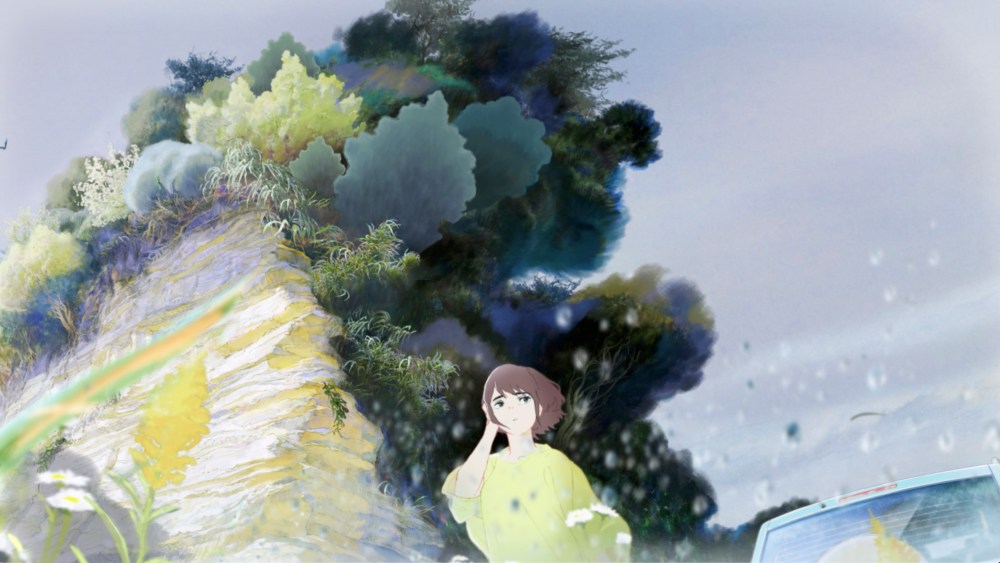
It all starts with a line. In director Yoshitoshi Shinomiya’s debut feature A New Dawn, which had its world premiere at Bernale as part of this competition, animation is born from its essence, with swift lines and bold brush strokes leaping across the screen, echoing the fireworks that Obinata Fireworks Factory has been producing for decades.
An administrative closure is scheduled for tomorrow due to plans for a main road to run directly through the site. This house, located in a lush forest, is the main setting for the story of the youth of three childhood friends. A story deeply rooted in Japanese culture with universal appeal that tackles themes such as family heritage, childhood bonds, the effects of climate change, and the development of untouched cities over nature and culture.
Ahead of the film’s premiere, Variety spoke with Shinomiya about what it means to attend this global event.
Shinomiya, who trained as a traditional Japanese painter, worked on director Makoto Shinkai’s “Your Name.” He started his animation career with films such as “In This Corner of the World” directed by Sunao Katabuchi, as well as the anime project “Tokino Crossing” and the music video “Boukentai: The Hero of the Forest.”
All these experiences are brought to life in this first feature, which marks the return of animation to the Berlinale competition. “To be honest, I wasn’t sure if the movie would be ready in time,” confesses Shinomiya. “However, I am happy to be able to come to Berlin and screen this film at the festival. I was told that it is very rare for an animated work to be selected here (the last time was the Chinese animation film Art College 1994 directed by Liu Jian in 2023). I would be very happy if in some way we could lay the foundation for more animation creators.”
Created by a (very) small team of artists, A New Dawn is also unique as one of the few French-Japanese animation co-productions created by French independent animation giant Studio Miyu, which is responsible for many of Europe’s greatest animations.
“It was an interesting collaboration, because the French team has a very different way of working and approach to animation than the Japanese team.” Miyu worked on the stop-motion animation scenes and emphasized that although there were some differences, the French side had a very good or deep understanding of Japanese culture and was able to cleverly insert that into the characters’ actions in certain sequences. “Of course, working on a collaboration like this comes with a certain degree of loss of control. But I would say that through this loss of control, we were also able to expand our horizons.”
Expanding your horizons is also at the heart of Shinomiya’s stories, which are set in a picturesque town that bears no resemblance to the town in which the author grew up. “My hometown in Kanagawa Prefecture was very close to the sea, but land improvement work destroyed part of the sea. Traditional fireworks displays were held in my hometown, but these too were canceled at some point due to economic reasons. Finally, I was no longer able to continue the profession and work that my parents and previous generations had maintained.”

Yoshitoshi Shinomiya
Provided by: Yoji Shimizu
Now that the artist (who has been painting since he was a child and holds a doctorate in Japanese painting from the Tokyo Graduate School of Fine Arts) has become a father himself, he decided it was time to face this past and work on this story. “It seemed like the right time for me to focus on the past and focus on the people who are still trying to pass on their traditions and unique craftsmanship today, but are prevented from doing so. The main characters in this film are quite young, but I wanted to address these topics through their stories because I think future generations need to deal more with those issues. Not just the energy crisis and the environmental crisis, but also the loss of community.”
In a lush landscape, the Shinomiya trio (voiced by Riku Hagiwara, Kotone Furukawa, and Miyu Irino) throw lines at each other with powerful alchemy. “It was my first experience directing a voice cast, so I was a little nervous about how it would turn out. But I’m glad to hear that the results were appreciated and their relationships were well represented on screen. Two of the actors in the trio were also making their voice acting debuts, but they were very professional and learned very quickly.”
“A New Dawn” is a delicate, grounded film, bursting with visual splendor, from the scenery to the lighting, as the three main characters, Keitaro, Chichi, and Kaoru, navigate with swift, poetic, and stylish movements. “For the animation, we took a unique approach by making the main character and characters as simple as possible,” Shinomiya explained. “Through very simple lines and colors. No matter where you’re from, you can understand the emotions that are conveyed in a very universal way. This choice also references traditional East Asian art, allowing our small team to focus on more detailed context.”
The director, who blends animation and live action before creating commissioned works, also emphasized the importance of blending techniques in his artistic practice. “For me, it’s like painting using a variety of materials.As an artist who is not originally an animator, I feel that being able to bring in external elements that are not directly related to animation is a strength.”
One of the key elements that blends visual technique with deeper meaning is the spectacular and almost legendary fireworks “Shuhaari” that Keitaro seeks to create as a swan song for the fireworks factory. “In Japanese, ‘Shuhari’ refers to human growth and reflects the very philosophy of life and death. The three main characters go through these steps in order to move forward: protect, destroy, and then decide to transcend and start something new. However, this small town… It’s also about people who stayed behind or moved to the city. All of these different paths are symbolized by the fireworks in ‘Shuhari,’ and I think everyone can relate to that.”
