

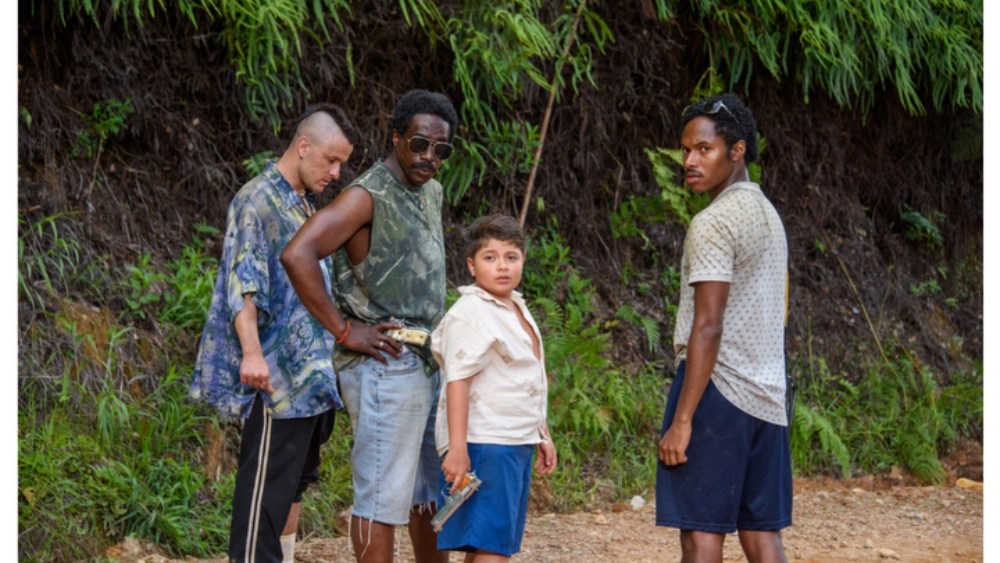
Disney+ and Hulu’s series “Dear Killer Nannies,” inspired by the story of Pablo Escobar’s son Sebastian Marroquin, is not another “Narcos,” insists Sebastian Ortega (“El Marginal”), who co-created the show with Marroquin and Pablo Farina.
“There have been so many stories about drugs. Too many. But when I met Sebastian, I thought, ‘This is completely different.’ You won’t see a hunk of cocaine in the entire show. ”
“Our focus was not on drug trafficking, but on this boy. It’s not about Pablo Escobar, it’s about his son. He’s slowly starting to realize that what he thinks is normal isn’t, and that his father is one of the worst criminals in the world. Imagine finding out that your father is Pablo Escobar. So weird!”
Ortega said Marroquin has tried to make amends throughout his life.
“He was the last person to talk to him (Escobar) minutes before he was shot. It was a very difficult process for him to figure out what was right and what was wrong. He had to bear the weight of it and think about all the victims left behind. He tried to meet his family and said he was really sorry.”
Marroquin also wrote about his experiences in a book called “The Sins of My Father.”
“This project gave me the opportunity to meet a great human being who was able to turn his life around. He has come a long way. In many dramas and movies about fathers, fathers were not portrayed correctly. It was natural for him to tell his side of the story,” Ortega told Variety at Series Mania.
“Dear Killer Nannies” was written by Alejandro Quesada, Ana María Parra, Martín Méndez and Ortega, and directed by Pablo Fendrick (“The Bronze Garden,” “Among Men”) and Felipe Cano Ibáñez. Produced by Walt Disney Company Latin America, Telemundo Studios, TIS Productions, and distributed by Walt Disney Company.
The cast includes Janelle Villarreal, Miguel Tamayo, Miguel Ángel “Orion” Garcia, Laura Rodriguez, Juanita Molina, Julián Zuluaga, Rafael Zea, Danharry Colorado, and Julián Bustamante, with John Leguizamo cast as Pablo Escobar.
Living in his shadow was not easy and his son was “unjustly judged.”
“Sebastian was only 16 years old when his father died and he had to take care of his mother and sister. He was a prisoner of his father’s crimes. I grew up in Miami in the 80s and 90s and went to school with many kids whose fathers were involved in drug trafficking. They probably all worked for Escobar! Many of them had a cocky attitude even after his father was killed. He is very ashamed of what his father did, but at the same time he still loves his father.
This contradiction also exists in a show that goes from “love to pure horror” within minutes.
“I’m a fan of ‘The Sopranos,’ and I like this combination of brutality and tragicomedy. There’s a scene where you’re having fun in your car and you’re ambushed. You’re always warned of danger,” Ortega says.
“The point is, you’re not watching it from the outside, you’re right there, witnessing a horrible crime, and getting a big hug. It’s all in the title. It’s about being surrounded by people who took care of you, but who also took people’s lives. It’s very hard to grow up and be okay in an environment like that.”
By producing this program, he was able to demonstrate that “nothing good can come from violence.”
“I remember the story about Escobar, because the whole world was talking about this guy. I was scared at the time, and I can’t imagine how his son felt. This is a great opportunity to see Escobar through the eyes of a child.”
Adding, “Sebastian spent years in therapy and took time to let go of material things, but he eventually realized what he really wanted, and that was to live a life of peace, away from violence, because Sebastian had never truly known peace.”
“I remember my dad telling me stories about sleeping in a different place every night, or how he was surrounded by a lot of money but couldn’t go out and buy food and was still hungry. That’s when you start to wonder, ‘Is it worth it? It’s certainly not.'”
