

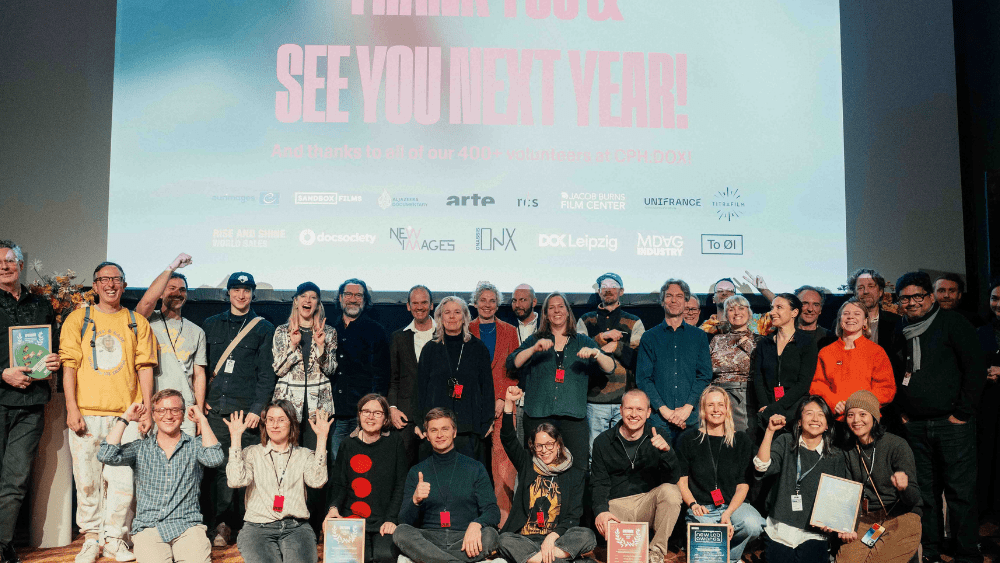
A total of more than €110,000 ($127,000) in prize money was awarded tonight in Copenhagen as another edition of the CPH:DOX industry sector concluded. The documentary Everything Is Red and Grey, executive produced by Laura Poitras and directed by Shurideh C. Moravy and Shurouk Alaira, won both the Al Jazeera Documentary Channel Co-Production Award and the Arte Award, and the winners also included new projects from festival favorites like Nothing Compares director Kathryn Ferguson and De Humani Corporis Fabrica director Verena Paravel.
“Everything is Red and Gray” will be about a group of young Palestinian filmmakers who overcome the tragic murder of a friend in Gaza. Ferguson’s Matresence, based on the novel of the same name by Lucy Jones, has been described as a “genre-bending cinematic documentary” that explores the changes that occur during pregnancy and early motherhood, while Paravel’s Cosmophonia features a soundtrack made up almost entirely of “sounds never before heard by the human ear.”
In addition, films such as “My School Is Seized” directed by Halina Lavrinets were also winners. The film tells the story of an 18-year-old boy who flees Russian occupation and exposes a school system designed to prepare children for war. My Father the Iceman, directed by Łukasz Kowalski, follows the journey of a documentarian who confronts his father after joining Poland’s far-right movement. And “Don’t Let the Sun Go Up on Me,” a new project by Asmae El Moudir, director of “The Mother of All Lies,” about Morocco’s “Children of the Moon.” A complete list of winners can be found below.

“The mother of all lies”
marrakech film festival
CPH: Industrial temperature check: AI and journalism in focus
This year’s CPH:INDUSTRY was marked by in-depth conversations on a wide range of topics, but two things stand out as being of major concern to the industry. It’s about the threats and opportunities of artificial intelligence, and how documentaries can learn from the collapse of modern journalism. In her opening remarks at this year’s CPH:SUMMIT, Beadie Finzi, co-director of the Doc Society, warned her colleagues: “If you don’t look forward and look ahead, you won’t be ready for what’s coming next.”
Both CPH:SUMMIT and CPH:CONFERENCE run counter to this trend of provoking questions rather than seeking direct answers to the big existential questions plaguing the documentary format in 2026. Inside the crowded hallways of Kunsthal Charlottenborg Museum, an imposing industrial home, attendees heard praise for the festival’s handling of AI in particular. By bringing together an AI-themed panel with a range of experts, including policymakers and prominent executives, and framing it through more lyrical concepts of truth and agency, CPH:INDUSTRY has found a nifty way to tackle the theme head-on while avoiding the AI fatigue that plagues such festival forums.
When it comes to AI, the conversations on the ground avoided cataclysmic perceptions about the new technology, but still provided valuable and useful insights into the dangers of a technocratic future. Bill Thompson, the BBC’s research and development expert, pointed out how we have “been complicit in the activities of organizations that do not have our interests at heart” and how “the technology we thought would help us turns out to have been designed in a way that could never give us what we wanted.”
One burning question, of course, was how artificially generated videos and images might affect the public’s trust in documentaries, and even the idea of truth itself. Tabitha Jackson, a former Sundance Film Festival director and recently appointed president of the Film Forum, gave a poignant opening speech at a session on truth, asking, “If what we see is no longer believed, how will audiences decide what is true? What will happen to the values of accuracy, verification, and public service in a post-truth world? And how should documentaries reimagine relevance, ethics, and technology in an AI-enhanced media ecosystem?”
The festival’s industry sessions primarily stimulated this very media ecosystem, especially journalism. While fiction filmmaking often looks at television and online content to try to predict upcoming trends, documentary can find more important synergies with its cousin, reportage. Throughout the festival, experts spoke about the impact of the conglomerate and power convergence of the ultra-wealthy few, and how grassroots movements in journalism can inspire documentary makers to survive in the near future.
“Journalism has always been part of the festival’s DNA,” Mara Gould Mercado, CPH:DOX’s head of industry and training, told Variety. “We understand there are big differences between reportage and documentary, but they feed into each other. It was very natural for us to look at journalism and what happened to it to think of solutions on how to rebuild the industry.”
“Hell’s Army” director Richard Lowry was one of several journalists and slasher documentarians to screen new investigative films at the festival. Asked about how the state of journalism has influenced his work, the filmmaker warned that the rise of totalitarianism and authoritarianism is leading to a world “stripped of rules and guardrails.” “The attacks and destruction of journalism is part of this whole kind of degeneration of the world we’ve been living in.”
But there is hope. Carol Cadwallader, a former Observer reporter and co-founder of The Nerve, told festival attendees that the unique number of clicks to journalist-owned media platforms rivaled, and even exceeded, the traditional media she previously worked for. “No one is coming to save us,” she said. “We have to build our own life rafts here. If you build it, they will come. People want to understand what the heck is going on in this world right now.”
“Hell’s Army”
Provided by Evergreen Productions
Complete list of CPH:INDUSTRY winners:
Sandbox Film Science Pitch Award (Sponsored by Sandbox Film)
“Matrescence” Written by Kathryn Ferguson, Produced by Rosie Creral and Elanora Emptage
Millennium Document Against Gravity Award
“My School Is Seized” Written by Halina Lavrinets, Produced by Oleksandr Ivanov
Rise and Shine Award
“My Father the Iceman” Director/Producer: Łukasz Kowalski, Producer: Anna Magellanto
Uni France Doctoral Award
“Children of the Moon” Director: Romain Duris, Producer: Richard Simecek
Jacob Burns Film Center Award
“The Calling” Director Beniamino Varese, Producer Harry Vo
Eurimages New Lab Outreach Award
“Don’t Let the Sun Go Up On Me” (written by Asmae El Moudir, produced by Emma Lepers)
Eurimages New Lab Innovation Award
“Cosmophonia” Written by Verena Paravel, Produced by Florence Cohen
Al Jazeera Documentary Channel Co-Production Award
“Everything is Red and Gray” by Shuride C. Molavi and Shruk Alaira
ARTE Award
“Everything Is Red and Grey” by Suride C. Molavi and Shurouk Alaila and “We Are Volcanoes” by Sharon Yong and Natalie Chao
Jacob Burns Film Center Award
“The Calling” by Beniamino Varese
Uni France & Titra Film Doctor Award
“Children of the Moonland” by Romain Jurisch
Onassis ONX Award 2026
“Still Point, Turning World” Lead Artist Ben Joseph Andrews, Produced by Emma Roberts
New Images Festival Award
“Mourning Glory” Written by Matius Sibor (Oh Matt), Produced by Pepe Le Puc
DOK Leipzig Prize
“Mourning Glory” Written by Matius Sibor (Oh Matt), Produced by Pepe Le Puc
