

After making her feature film debut with Sisters in Arms, a thriller about a battalion of female Kurdish warriors, celebrated French journalist-turned-director Caroline Forest embarked on her boldest venture yet with her next project, Broken Truth.
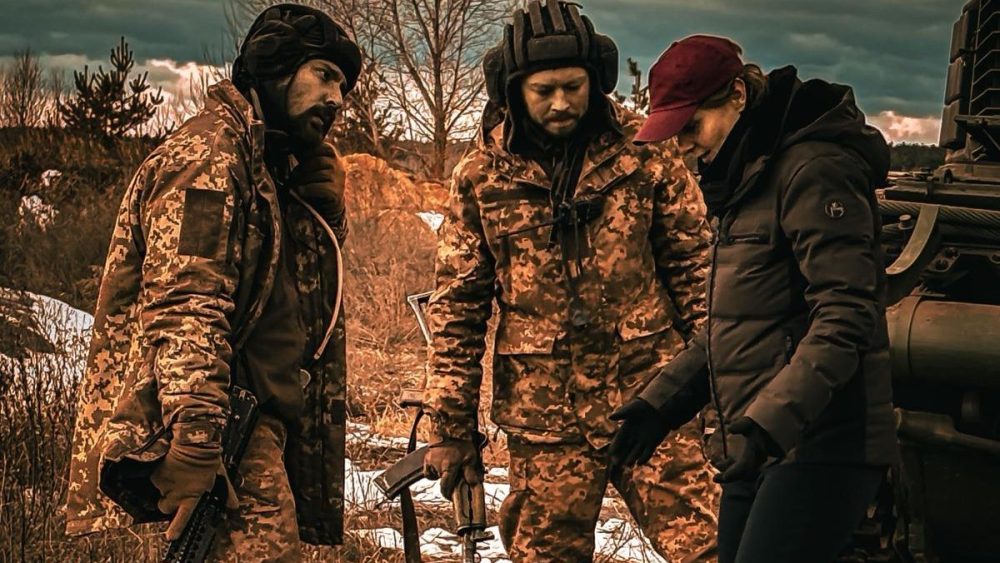
The English love story and road movie “Broken Truth” is set in the first weeks of Russia’s invasion of Ukraine. Director Forrest shot the film with an almost entirely Ukrainian cast and crew over seven weeks in Kiev and across the war-torn country in the dead of winter, when missile and drone alerts continued to plague the Kiev region. There were only a handful of French collaborators on set, including acclaimed cinematographer Thierry Arbogast, whose credits include Luc Besson’s Léon: The Professional and The Fifth Element.

Copyright: Anna Konik
“I’ve been trying to make this movie for three years since the war started,” Forest said in an interview after filming in Kiev, adding that he plans to take a night train out of the country as commercial flights remain suspended.
“Broken Truth,” written by Alain Loeb (“Colternate Beauty”), centers on Julien, a cynical French disinformation strategist based in Kiev. Julian works at a bot farm and is in the process of selling his startup when war breaks out. He unexpectedly falls in love with Katarina, a Ukrainian museum curator and single mother, but Katarina is distrustful of him and the shadowy business he is involved in. When the invasion begins, the two and Katarina’s 10-year-old daughter flee together and embark on a journey to survive the chaos of war.
Forest, a top counter-propaganda specialist and a regular guest on French political talk shows, said he was immediately drawn to the project when he was approached by producer Jean-Charles Lévy. Levy had deep ties to Ukraine after working on several films there over the years, most notably “Revenge of the Shiny Shrimps.”
Levy introduced the script to Forest after American producer Robert Stein, who had originally been looking for an American director, realized there were no American filmmakers willing to shoot a feature film in wartime Ukraine.
Copyright: Fiammetta Venner
“I have been deeply involved in Ukraine for over 10 years,” she says. “When American producer Robert Stein brought this script to my attention, I couldn’t help but fight to direct it. This was exactly the film I had dreamed of making about Ukraine and the propaganda scourge through a beautiful love story torn apart by mistrust and lies,” she says.
Forest has indeed been involved with Ukraine for more than a decade, dating back to 2011, when she made a documentary about Ukrainian feminists for France 2, a few years before the Maidan uprising. She then returned to cover the Maidan for a French cultural magazine and served as a foreign observer for the first post-Maidan elections in Odessa.
She says the script appealed to her because it is “at the heart of what’s going on in the United States, what’s going on here, and what Russia has been doing to Ukraine. The reality is that all of these factories are churning out fake profiles, fake stories, pushing false narratives, flooding the web and social media with false narratives to cause chaos and sometimes to serve authoritarian states like Russia.”
Despite Levy and Forest’s experience and knowledge of Ukraine, “Broken Truth” proved to be a near-impossible mission to work together. The film was originally conceived with an American lead, but the actors balked at filming in Ukraine. She eventually set her sights on Sisley, who had previously starred in the action series “Largo Winch.”
“We needed a French actor who could speak good English and fit the role,” she says. “Tomer Sisley was the perfect choice for Julien.”
Forest said audiences may be surprised by Sisley’s performance because “he’s not playing a savior at all.” “This is not an action movie. It’s really a love story.”
Katarina is played by Ukrainian actress Pustvit, whose real-life story is very similar to her character. Ms. Forrest said that after casting her, she learned that the actress had volunteered extensively during the war to the point of burnout, had a boyfriend fighting on the front lines in Zaporizhzhia, and had even been held captive by the Russian military for several days.
“She’s actually going through a similar experience to Katarina in the movie,” Forest says.
Forest and the producers also decided to take the risk of filming the entire film in Ukraine, despite the ongoing war, and were able to enlist the help of an intrepid French insurance broker, Ugo Roubini. “If it wasn’t for him, if he had to pay for insurance like you do when you shoot in a conflict zone, we definitely wouldn’t have been able to make this movie,” Forrest says.
Copyright: Mitya Borodin
Operations in Kiev meant dealing with power outages, missile attacks and drone alerts. Forest said the production relies on military advisers equipped with software that can distinguish between alerts that pose a real threat to their own location and those that affect the wider Kiev region. This allowed the team to eliminate many alarms and only evacuate if absolutely necessary. It happened at least once during filming. The cast and crew spent an hour in the shelter listening to the sounds of drones exploding overhead.
“Jean-Charles and I are stubborn. For us, it did not make sense to shoot this film in Latvia or elsewhere, as proposed, because, first of all, the entire beginning of the film takes place in Kiev, and we are shooting in Kiev, Khreshchatyk, Maidan, St. Sophia and St. Andrews,” she says.
“As you know, the Russians hit very hard this winter, taking advantage of sub-zero temperatures, only to greatly increase the losses and consequences. There were a lot of power outages, but the Ukrainians know how to make ends meet no matter what. You have to think for yourself, but they know how,” she recalls.
“There was no other place we could have filmed this important film,” Levy said. “Our staff has become a family. It was very important to us to show that even during the war, the industry still exists in Ukraine and that it is possible to shoot high-class, international-level English-speaking feature films,” he continued.
Forest pursued authenticity even in the war scenes. “All Ukrainian soldiers are real military actors. They are all actors who have joined the army and are fighting,” she says.
For example, one of the lead actors came to film in between expeditions at the front, and immediately returned to combat after filming, but one of the crew members stepped on a landmine and lost his leg. Some had metal plates stuck in their heads after surviving explosions on the front lines.
“It just felt like that. Everyone has a story to relate to. We all have family members who died in war or who are on the front lines,” she says.
Ultimately, Forrest said the work became such a source of collective purpose that the production staff said it helped them “look forward again.”
The film was supported by the National Foundation of Ukraine, as well as the French pay-TV channel Canal + and the broadcaster France Télévision. Levy’s Forecast Pictures co-produced with France’s Wild Tribe & Ethic Scenarii, Ukraine’s Pronto, Italy’s Be Cool Produzioni, Romania’s Saga Films, and co-produced with Ourobouros in the US and Lightrunners in the UK.
Forest hopes to complete the first cuts by September. She said “Broken Truth” will first premiere in Ukraine, then travel internationally and possibly include festivals.
“We didn’t just make a movie. We proved something. That movie can still be here, and that’s what matters,” Forest says.
Copyright: Fiammetta Venner
