

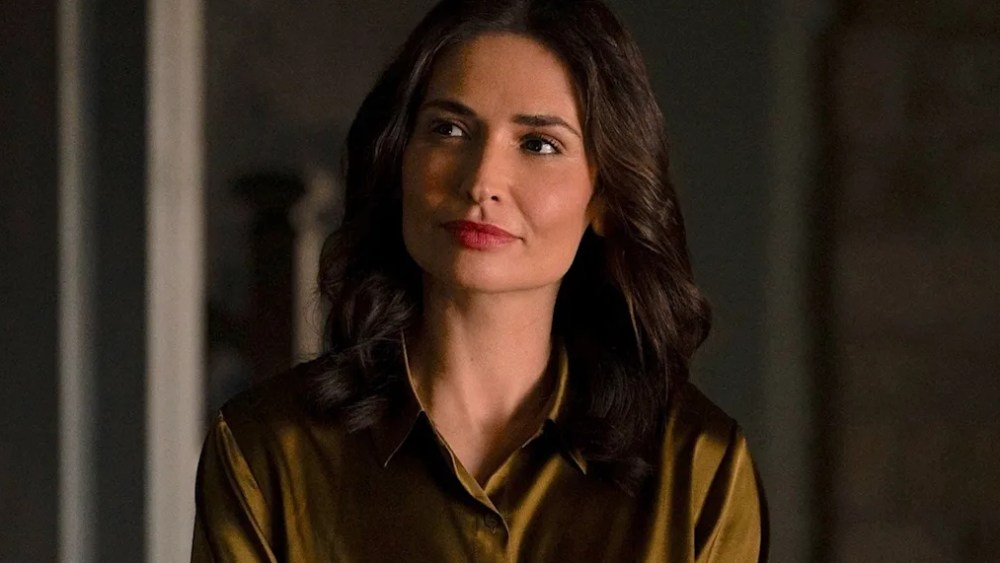
The casting team for Vince Gilligan’s Pluribus searched all over the world for an actor to play the main character of Zosia. The alien “hive mind” sends Zosia to work with the resister and rebel Carol (Rhea Seehorn), but she must be beautiful, smart, gentle and patient. That was a tall order, so when they couldn’t find her, they returned to the cabinet.
The casting teams behind all of Gilligan’s series, from Breaking Bad to Better Call Saul, keep a physical archive of handwritten notes on every actor they’ve ever auditioned for. Months into the hunt and with other resources exhausted, casting director Russell Scott pulled out an old folder and began flipping through it, and he stopped at Carolina Wydra. “He looked at my picture and said, ‘Let’s go see her. What happened to her?'” Wydra recalled. The Polish-born actress, known to genre fans for her roles in HBO’s “True Blood” and Marvel’s “Agents of S.H.I.E.L.D.,” left home to become a stay-at-home mom after giving birth to her son Atticus during the pandemic. Her agent fired her and she had a second son. When she felt ready to go back to work at age 42, she had no agent, no manager, and no idea how she was going to get back in the room. Then an audition request came through her old commercial agency, which still had her on its roster. “I just watched Vince Gilligan on Apple TV and it literally went into complete shock,” Wydra said. “That wasn’t my intention. But there was another voice inside me that said, ‘Just give it a try. You have nothing to lose.'”
Spoiler alert, she got the role. And after more than a decade of battling Hollywood’s perception of her as a femme fatale, Wydra emerged as the breakout star of Gilligan’s sci-fi drama Pluribus. In the show, Wydra’s mysterious Zosia serves as the only point of contact between Seehorn’s Carol and the rest of humanity, who are connected by a single consciousness. Carol is one of only 13 people on Earth who has not been infected by the hive mind. “I always wanted to be good at acting, and it wasn’t about fame,” Wydra says. And now, she is one of the celebrities vying for the Emmy Award for Best Supporting Actress in a Drama.
Even after she won the role, the impostor syndrome lingered. Wydra remembers being nervous on set, trying to land the role, and Gilligan staring at her between takes. “He said, ‘You belong here.'” That was the affirmation that all artists seek, especially when they feel like they don’t necessarily belong.

Apple TV+; HBO; Mitch Herseth/ABC via Getty Images
Wydra was born in Poland and immigrated to the United States at age 11 in 1992 after the fall of communism. Her family settled in Costa Mesa, far from Hollywood despite being relatively close. “My parents wanted me to have a stable job,” she says. “Being an actor wasn’t something I was brought up to do.” After years of secretly nurturing his ambitions, drawing inspiration from European writers such as Andrei Tarkovsky, Luis Buñuel and Federico Fellini, modeling came first and acting later. She immersed herself in New York’s independent film scene, appearing at theaters like Angelica and Film Forum, and only pursued acting professionally in her mid-20s. Still, breaking out of typecasting has proven difficult. “It’s so easy to get stuck in a box,” she explains. “People say, ‘You’re too beautiful for the role.'”
The exception, she remembers, was David Lynch, who cast her in the 2017 revival of Twin Peaks. “It was the first time someone took me and I was really arrested,” Wydra says. “He painted my teeth, turned me into a drug addict, and stripped me of everything that made me look good all the time.”
On the set of “Pluribus,” she found a similar creative outlet in Seehorn. She says Seehorn is one of the hardest-working performers she’s ever met. The two rehearsed scenes together on weekends, and bonded over the ritual of sharing plain donuts each day on set. “She doesn’t like anything that’s inside,” Wydra says with a laugh. “She refuses.” Eventually, Seehorn told Gilligan that she wanted the other half as well. “So next year we’ll be fighting over donuts,” Wydra says.
The bigger point is work ethic. “She takes this very seriously. She knows all the nuances of her character,” Wydra says of Seehorn. “Vince gives her notes, and sometimes I don’t understand them, but she does it that way.”
The series also proves that Wydra’s long, non-linear journey was worth it. “I’m living beyond my dreams,” she says. “I had the pleasure of working with Vince Gilligan, who is not only a great artist, but also a great human being.”
But she also continues to reflect deeply on this time in the United States, especially as an immigrant who grew up believing in the promise of her country. “My parents were living the American dream,” she says. “They came here, bought a house, built a great life. It’s heartbreaking to see what’s happening in this country right now.”
She remembers being in New York City the night Barack Obama was elected president in 2008. “When Obama spoke, the whole city went silent. It felt like everyone was united and united. It felt like the American Dream was alive,” she says. She misses those times.
But for now, Wydra is focused on the job. She recently returned to acting classes as season two is currently being written. She hasn’t read a word of it. She is taking an improvisation course and hopes to pursue theater in the future.
“Impostor syndrome? Maybe I have a gift for never compromising.”
