

For four seasons, “Bridgerton” fans have obsessed over every detail of the costumes, including Daphne’s debut white outfit, Penelope’s transformation into an emerald, and the Queen’s increasingly outrageous wigs. The show’s costume designers have built a reputation for creating unforgettable costumes that viewers screenshot, analyze, and admire.
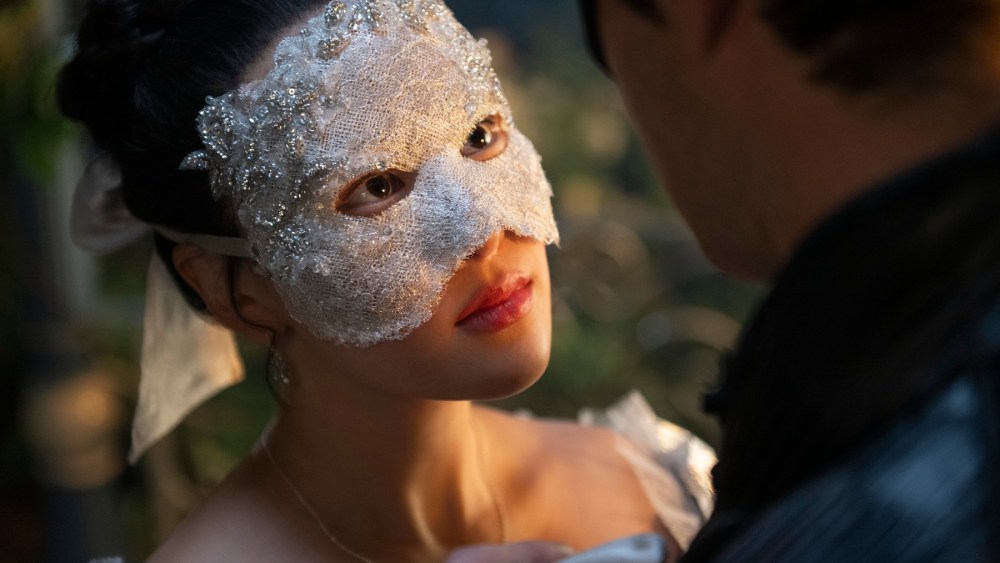
So when it came to Sophie Baek’s (Yerin Ha) silver masquerade dress in Season 4 (arguably the most narratively significant costume in the show’s history), the team made a counterintuitive choice and purposefully kept the design subtle. Probably forgettable.
When Sophie appears at the masquerade ball, she wears a borrowed silver dress that matches the chandelier in the Bridgerton family’s ballroom. It’s the dress that begins the season’s central romance, which haunts Benedict Bridgerton’s (Luke Thompson) dreams and sketches. But costume designers John Glaser, George Thayer and Dougie Hawkes say the memories were always more important than the dress itself.
“What’s interesting is, if you think about the silver dress, you see it when she wears it, you see it at the ball, but then it’s no longer an important costume,” Glaser explains. “It’s the image that matters, because he painted it. It’s the memory of the shoelace, the memory of the glove. We never see that costume again. It’s all just a memory.”

Yerin Ha (left) who plays Sophie Baek in “Bridgerton” and Luke Thompson who plays Benedict Bridgerton.
Provided by Netflix
Rather than create something sharp and penetrating, Glaser and co-designers Thayer and Hawkes constructed what they describe as an illusion. The team deliberately avoided doing anything that would leave a vivid memory in Benedict’s mind. “His memory would have been more vivid if it had been a red dress, a stiff red mask, and a stiff dress with a shape,” Glaser says of the alternative. “But it was a ghostly hallucination.”
The fabric itself was chosen so as not to be a focal point. Thayer explains that the light silver base is layered with silver lace, sequins and crystals, all done subtly so that the dress only reveals itself when Sophie moves. “When she moves, you can get this kind of change and maybe a shimmer of pattern,” she says.
The mask was also intentionally blurred. “We don’t really know where it started and where it ended,” Glaser added.
While Sophie floated in silver anxiety, other characters also appeared in bold, unmistakable costumes, including Lady Danbury (Adjoa Andoh) as Zeus and Heloise Bridgerton (Claudia Jessie) as Joan of Arc with her signature bob. “It’s a simple look,” Glaser said. “You remember Cleopatra’s mask. You remember Joan of Arc, right? But can you explain what Sophie’s silver dress looked like? It’s not. Silver. And that’s the idea. She’s a little blurry. You can’t really see what’s over there.”
Adjoa Andoh (left) as Lady Danbury and Ruth Gemmell as Lady Violet Bridgerton in “Bridgerton.”
Liam Daniel/Netflix
Showrunner Jess Brownell acknowledged the challenge of making Benedict’s failure to recognize Sophie believable. This plot point leaves viewers perplexed, wondering why such minimal disguises are not seen through. She acknowledges that this requires a voluntary suspension of disbelief.
“We certainly talked about putting Sophie in a full-face mask or a wig or something, but at the end of the day, the encounter between the woman wearing the mask and Benedict is so important that Sophie needed to be able to express emotion,” Brownell told Variety. “But I think what we’re really banking on is the fact that class was very divided in that era. Even someone as progressive as Benedict would never have expected that the woman he was looking for at a ball would turn out to be a maid. In that era, the staff were basically invisible.”
That ambiguity carried over to the balls, which had no unified theme and no unified color palette other than one rule. It was to “avoid silver.” In a cacophony of colors and characters, guests arrived as historical, fantasy, or literary figures. The designer ensured that each bold outfit blended with the others, intentionally contrasting with Sophie’s silver simplicity. “We wanted her to be the center of attention,” Thayer says. “But in the most modest way possible.”
Beyond the grand spectacle of the masquerade ball, the costume team surprisingly also embedded quiet details that even the show’s most ardent fans aren’t aware of. This includes Benedict’s leather bracelet. This is a signature accessory he wears throughout the season that many fans may have overlooked.
“It’s the first time the guy in ‘Bridgerton’ has worn a bracelet or something like that on his wrist, and no one noticed it,” Glaser said. “I think it’s great that no one thinks, ‘Oh my god, he has a bracelet. What does this mean?'”
Luke Thompson (left) who plays Benedict Bridgerton and Yerin Ha who plays Sophie Baek in “Bridgerton.”
Liam Daniel/Netflix
Bridgerton’s maid outfit was also changed, with the team subtly changing the neckline to make it a little sexier to fit Sophie’s storyline. Thayer explained that the adjustments were subtle because viewers have seen these uniforms for three seasons. “All you need to do is change the neckline a little bit and make it look a little bit more sexy.”
For Cavender’s domestic scenes, Thayer made sure the neckline was open for practical reasons. When Benedict saw Sophie’s clothes in the rain, the water had to penetrate the thin fabric against her skin. “It’s a big deal to me, but no one else notices it,” Glazer said of the overall uniform change.
Yerin Ha played the role of Sophie Baek in “Bridgerton.”
Liam Daniel/Netflix
Oli Higginson (left) as Footman John, Sophie Lamont as Celia, and Geraldine Alexander as Mrs. Wilson in Bridgerton.
Liam Daniel/Netflix
It’s clear that a well-oiled machine is essential to creating such a detailed costume. From research to fabric sourcing, sketching and decoration, it takes four to five people working at the same time and four to six weeks to make one dress. Queen’s dresses, with their elaborate decoration and grandiose nature, can take months to make.
With just a few days to complete, the silver dress required a manual approach, with many people sitting around the gown and hand-applying the crystals, sequins and lace. “There were about five to seven people sitting around the dress decorating it,” Thayer recalled. This timeline prompted Glazer to joke, “Let’s change that number to four to six years.”
But what makes Sophie’s gown particularly poignant is its origin. Unlike other costumed guests who wear costumes on purpose, Sophie doesn’t wear a fancy dress at all. “She wasn’t wearing a fancy dress; she was just wearing a borrowed evening dress,” says Sayer. Alfie, sister-in-law Rosamund’s maid, finds it in the attic. “I thought that was fascinating,” Hawks says of the story choice. “The fact that it was a borrowed dress dictated the colors and created a lovely, soft story.”
Season 4 features a stripped-down Cinderella story, with a borrowed dress, a masquerade ball, and a woman falling out of her depth. The gown looks stunning on screen, but when you try to explain it afterwards, the details disappear, just like Sophie did when the clock struck twelve. The gown remains in Benedict’s perception and, by extension, in the audience’s perception, not as an object of catalogue, but as an impression. It’s silvery, shiny, and elusive.
“It’s a little vague,” Glaser said. “I don’t understand. It’s not sharp enough.”
Exactly as designed.
