

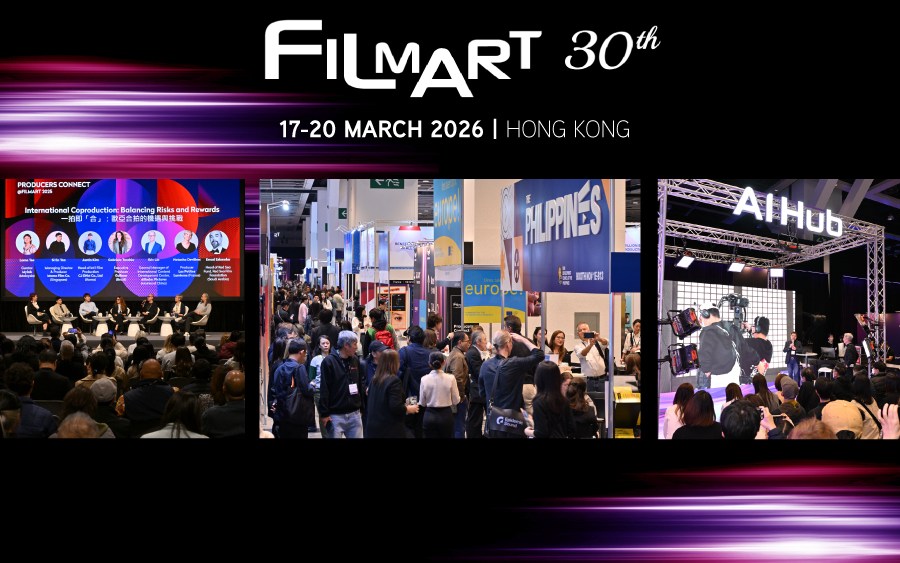
AI and its rapidly expanding role in film and television production took center stage at Filmart, where five technology, directing, and production industry veterans came together to discuss the topic.
At the beginning of the session, Oscar-winning filmmaker Ruby Yang, dean of the School of Future Media at the University of Hong Kong, announced the launch of a new master’s program in Creative AI and Film Production, signaling a growing movement to bridge academia and industry as AI tools become more prevalent across the production pipeline.
Yang emphasized that close cooperation between education and industry is essential for AI applications to evolve in line with professional standards and creative needs. She emphasized the importance of going beyond technical training and establishing an ethical framework to guide the use of AI in filmmaking.
“The mission is not only to develop talent, but also to ensure that the use of AI tools is based on strong ethical principles,” she said.
Among the panelists was Jie Yang, a former Google engineer and founder of California-based AI production company Utopai Studios, who reflected on the transition from software development to content creation and highlighted how AI continues to disrupt across sectors.
“As one of the early adopters of AI tools, I have seen how they challenge not only users but also filmmakers themselves,” Yang said. “When we showed Hollywood directors and crews a trailer that had been created before the movie was finished, they couldn’t believe what AI could already accomplish. And that was before AI was widely available.”
He added that this experience was a turning point and inspired him to move beyond engineering and into the market side of an industry where the demand for AI-driven workflows continues to accelerate.
Director Yun-Sung Kang pointed to a deeper structural tension between traditional filmmaking practices and emerging AI technologies, suggesting that the challenges extend beyond the tools to the underlying logic of production itself.
“Traditional filmmaking and AI technology are inherently incompatible,” Kang said. “What we need to translate is not just the technology, but the very language of the industry.”
That divide across creative processes, industrial workflows, and professional cultures has been repeatedly cited as a key obstacle, but also as an opportunity for new forms of collaboration. Panelists agreed that training environments and interdisciplinary education play an important role in reconciling these disparate systems.
Legal concerns about copyright and image rights of performers also came up during the discussion, especially as AI-generated content becomes more sophisticated. In response to questions from the audience, Hansl Kwon, CEO and director of Studio Freewillusion, said South Korea is already moving towards a clearer regulatory framework.
Kwon said, “AI-related intellectual property rights are being actively discussed in South Korea, and the portrait rights of performers are protected by law.” “We hope to see clearer legislation regarding AI applications, not only for protection, but to support the growth of the industry.”
As the conversation turned to the broader implications of AI adoption, the panel ultimately converged on a common understanding that this technology is no longer speculative, but is already reshaping the foundations of global filmmaking.
Reflecting that sense of transition, award-winning filmmaker and AI creative director Uli Gaulke described this change as both inevitable and transformative.
“I come from a traditional filmmaking background and started out in 16mm,” says Gohlke. “AI is a powerful tool and an unstoppable trend. If we can’t stop the technology, then as filmmakers we should ask what we can get out of it.”
