

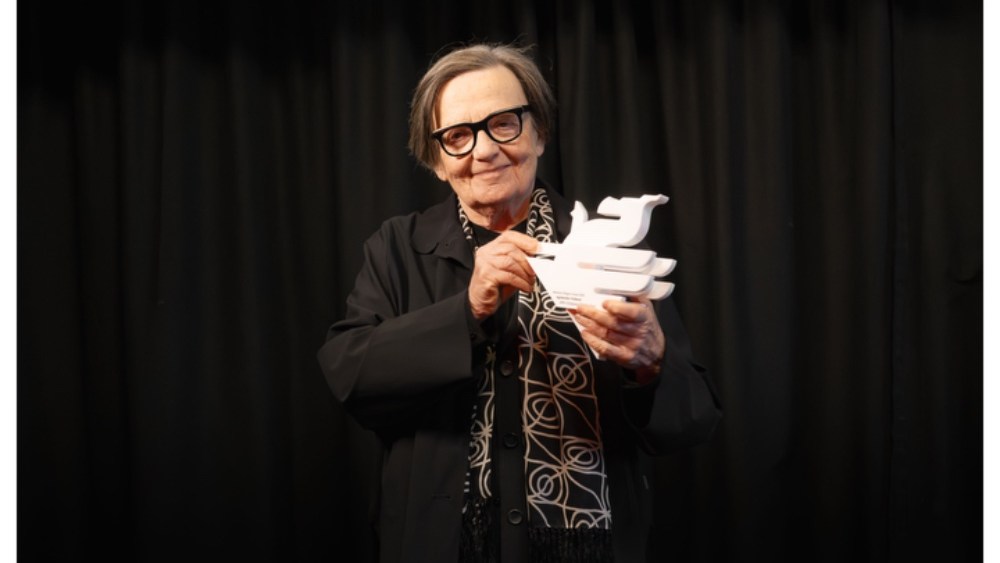
According to Oscar-nominated director and Gothenburg Honorary Dragon Award winner Agnieszka Holland, truth still matters in today’s world. But it’s easy to twist.
“It happened between Stalin’s propaganda and Goebbels’s propaganda. It showed how easy it is to change the meaning of words and how fragile they are. Sometimes, like when we hear what American propaganda is saying about the victims of the Minneapolis shootings, it feels like words are becoming less and less important.”
Her 2019 film “Mr. Jones” reflects that sentiment. The film is based on the true story of journalist Gareth Jones, who wrote about the Holodomor famine in Ukraine, which killed millions of people.
“He tried to tell the truth about what was going on, but no one was interested. Democracy dies when the media becomes corrupt and toys with the truth around political and ideological agendas. We are at that moment right now,” she said.
“Facts are not abstract. It happens. When you see a dead person, it’s a fact. We have to be humble now and (recognize) that ‘truth’ is different for everyone. So let’s stick to the facts.”
Holland, whose unconventional Kafka biopic “Franz” was an Oscar nominee for Poland, is known for being politically outspoken. Whether she’s discussing the women’s strike against abortion law reform or the border crisis between Poland and Belarus. She portrayed the latter in “Green Border,” which caused a huge controversy in her home country and threatened her own safety.
“It sparked an incredibly violent attack from the Polish authorities and some far-right members of the Polish population. There were a lot of threats. I had to travel with a bodyguard in Poland, which was one of the funniest experiences I’ve had,” she recalled.
“Their first job was to protect me during the premiere in Warsaw. But so many people were hugging me and grabbing my hand. It seemed like the worst thing that could have happened to the bodyguards. By the end of the evening, they were drenched in sweat. They said it was the worst experience of their professional lives.”
At the Swedish festival, Holland, known for films such as Europa, The Secret Garden, Washington Square and Total Eclipse with Leonardo DiCaprio, spoke about the difficult post-war childhood that shaped her.
“My parents’ experiences were very intense. The trauma they went through left a permanent mark on them. It also left a mark on me in some way,” she said.
“I was a witness to their weaknesses and strengths, their vitality and melancholy, and it definitely made me more mature and tolerant. I realized that you can’t expect people to be perfect and strong all the time, and you can’t really rely on them.”
Growing up in the midst of Warsaw’s destruction made her sensitive to her surroundings, as “the ruins were my playground.” Then her father died under mysterious circumstances.
“When the truth of Stalin’s crimes became public, he was so disappointed that he became a dissident in the party. He was arrested in 1961 and committed suicide during the investigation.”
Holland’s international career began when he left Poland to promote the film Local Actor. She was in Sweden when martial law was imposed in 1981. She was initially reluctant to talk about the situation, which is the focus of her daughter Kasia Adamik’s film Winter of the Crow, but later changed her mind.
“I was worried that the price would be too high. Then a Swedish journalist I knew hugged me and said: “Our poor Poland.” I thought: “He’s crying, and I’m Polish! I have to fight for my country.”
Still, Holland doesn’t dwell too much on the past or past successes. Which movie gave her the most satisfaction?
“It’s always the last one.”
Although the power of cinema has been “evaporating” since the 1980s, she hasn’t given up yet.
“Now that the world has become complex and dangerous again, perhaps it’s time for a new generation of filmmakers to emerge and get people back to the theaters for a collective experience of receiving important images and important messages,” she said.
“Perhaps we will reach some kind of wall or abyss, and if we survive, a new world with new values will emerge. After every disaster in human history, something good has come out of it. If we survive as a planet, the next step will be new progress. That’s my optimism.”
