

What you need to know
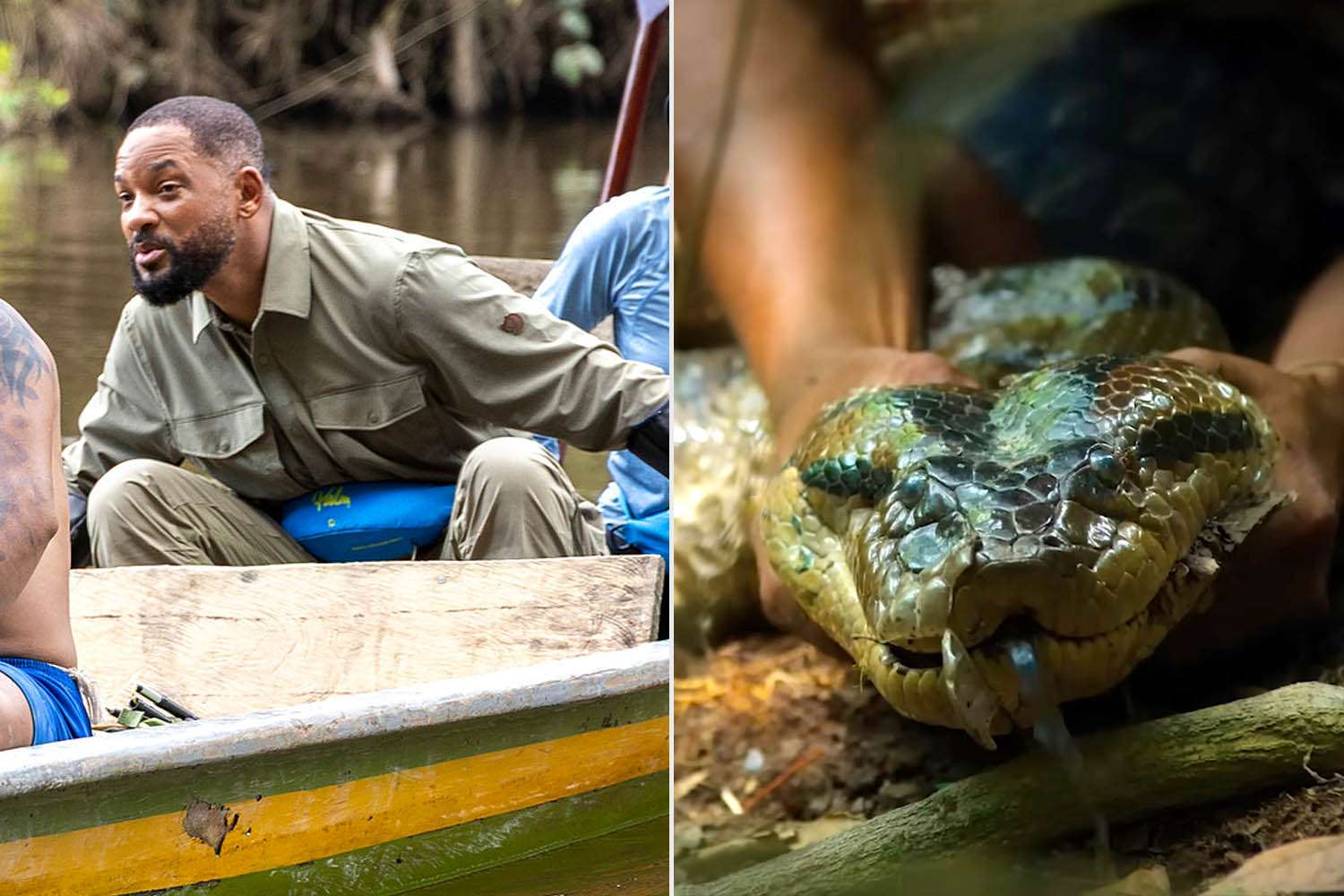
New footage has been released of a giant anaconda species discovered during the filming of Will Smith’s National Geographic travel series.
Footage of Pole to Pole with Will Smith, obtained by LiveScience, shows the 57-year-old actor, along with venom expert Brian Fry, expedition leader Carla Perez, and an indigenous Huaorani guide, taking a boat down an Ecuadorian river when the group notices a giant anaconda on the shore.
National Geographic/Kyle Christie
Local guides quickly intervened, getting out of the boat and attempting to immobilize the snake so Fry and Smith could collect one of its scales to study the snake’s genetics.
“Let them try to control this,” Frye was seen advising Smith, with the actor looking surprised.
“That’s amazing. Wow!” Smith exclaimed about the snake, which Fry estimated was up to 17 feet long.
National Geographic/YouTube
Once the guide had the snake under control, Smith and Fry could be seen getting out of the boat to get a closer look at the snake. “It was scary even from the boat,” the Bad Boys star said. I then asked the guide in his native language if it was “safe” and he confirmed that it was.
Fry then explained to Smith that he wanted to “take some” of the snake’s scales to “measure the accumulation of contaminants in the water.” But he said he needed to collect scales from its “belly” and asked Smith to “help,” but the actor balked.
“Yeah, I’m a little nervous,” Smith told Frye, who encouraged him, “You can do it.”
He then instructed one of his guides to lift the snake’s belly and asked the Oscar winner to “wipe up all the little dirt and debris” there. Frye got a pair of scissors and pointed out that he would just “cut” along the spot that Smith had wiped clean. He then neatly cut off a piece and inserted it into a vial for later study.
When Fry said, “Look, we have a sample. With that one little piece, we can study everything about this animal,” and the actor could be seen blowing air out of his mouth with a look of relief on his face.
“It’s great,” Smith said, holding up the sample.
Fry shared in a release from the University of Queensland that this sample, along with others collected, helped scientists discover that the northern and southern anacondas, previously thought to be the same species, are actually two genetically distinct species.
The northern and southern green anacondas diverged about 10 million years ago and are genetically 5.5 percent different, Fry said. “This is very important,” he added. “To put it into perspective, there is only about a 2 percent difference between humans and chimpanzees.”
National Geographic/YouTube
Never miss a news. Sign up for PEOPLE’s free daily newsletter to stay up to date on the best of what PEOPLE has to offer, from celebrity news to human interest stories.
The northern green anaconda, the species Frye’s team documented and identified, appears to reach a larger size and have a different and narrower geographic range than the southern blue anaconda in the Amazon.
According to National Geographic, the green anaconda is a nonvenomous constrictor snake native to South America and a member of the boa family. The reptile is considered the heaviest snake in the world. On average, they live up to 10 years in the wild.
Pole to Pole, starring Will Smith, will premiere on Disney+ on January 13th.
