

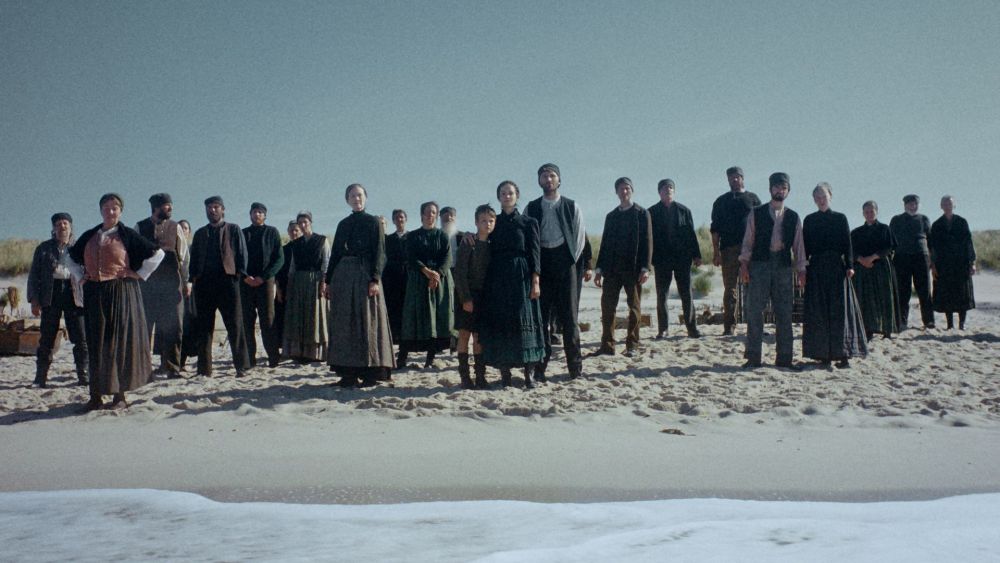
The Las Palmas de Gran Canaria International Film Festival enters its 25th edition with a line-up that draws on its long-established strengths: the discovery of writers, the rigor of cinephiles, and a programming vision that keeps new works in dialogue with the history of cinema and gives originality to the Canary Islands Film Festival.
Running from April 23 to May 3, the Canary Islands event returns with more than 100 titles, including competitions, retrospectives, live score screenings and special focuses.
That underlying idea is also how director Luis Miranda describes the festival.
“We’re recognized as having a great instinct for spotlighting films and filmmakers, often from certain peripheries, that define cutting-edge art in some way,” he says. “And increasingly, what motivates us is to approach it from a film history standpoint.”
Essentially, he says, “More than the editorial content itself, it is cinephilia that moves us,” and that impulse runs through the entire edition.
Programming as an argument
Las Palmas does not treat film history as a secondary layer added to new works. We use restorations, retrospectives, silent films with live accompaniment, and current festival titles as part of a single program proposal.
The official section remains central to its design. This year, with 10 features and 15 short stories, all Spanish premieres, the festival organizes its selections around identity and belonging.
Still, Miranda’s description of the lineup is more intuitive than thematic.
“What we’re interested in isn’t really the presentation of topics or styles or genres,” he says. “What drives us to choose certain films is the sense that there’s a real sincere effort in them.”
This difference also helps explain how Las Palmas views its modern festival scene.
Miranda spoke candidly about what he sees as the increasing standardization of prestige films. There, funding patterns and festival expectations can steer filmmakers toward recognized and already sanctioned formats.
“We’ve been concerned for years that creativity is being domesticated,” he says. “Too many festival school films have become too model-based and too repetitive, films that seem to have been made with too much respect for an already prestigious format.”
As a result, the selection strategy was built on the power and specificity of each film rather than on well-known festival metrics.
vigan focus
The most notable special focus of the commemorative edition is on Chinese filmmaker Bi Gan, winner of the Lady Harimaguada de Honor.
The accompanying “Vegan Blues” sidebar includes 2016 Las Palmas top prize winner “Kairi Blues,” “Long Day’s Journey into the Night,” and the latest feature, “Resurrection,” which will be performed in person by Vegan starting April 29th.
“If there’s one movie that represents what movies can do today, it’s ‘Resurrection,'” says Miranda. “This is truly a love song to the movie.”
Bee Gan’s celebration also includes two titles of his choice: “Spring in a Small Town” by Fei Mu and “The World” by Jia Zhangke.
Rethinking Panorama España
One of the most concrete changes this year is the “Panorama España” section. This section already existed within the festival, but has been reorganized for 2026. We also opened the door to titles that have already been shown in Spain or abroad, provided they have not been shown in the Canary Islands. It will also be judged by a young jury.
These two changes suggest that the festival will focus less on premier status and more on access, locality and audience building.
“Simply put, the goal is to be able to see them here,” Miranda says.
This effort has practical results. This widens the range of selection in this section and allows the festival to bring important recent Spanish films to audiences on the island, even if those titles are no longer new based on a strict premiere logic.
A similar effort toward audience renewal forms one of this edition’s most visible efforts. It’s a free screening for people who are or will be 25 this year.
While the move is partially symbolic, it reflects the real difficulties many festivals face in engaging young audiences.
“It was an idea that came out of a kind of self-defense,” he says. “We are concerned about the participation of younger generations.”
Miranda believes that although young viewers consume vast amounts of audiovisual material, they often feel far removed from the cinephiles and historical narratives that shaped 20th century film culture.
This idea hints at broader concerns about audience renewal and the need to engage younger viewers.
Other sidebars deepen that conversation. Camera Obscura opens the festival with FW Murnau’s Faust, accompanied live by the psychedelic band GAF y La Estrella de la Muerte. This section also incorporates Japanese silent titles with benshi performances and newly composed music by Ichiro Kataoka.
Held this year as a restored treasures program in collaboration with the Film Heritage Foundation, ‘Déjà Vu’ focuses on South Asian classics, including works by Satyajit Ray, Bimal Roy and Shyam Benegal.
Banda Aparte, historically the most extreme section of the festival, has also been rebuilt. No longer competitive, this year will combine a retrospective dedicated to Chilean filmmaker Ignacio Aguero with an experimental body of work under the banner “Presente Indómito”, including the Spanish premiere of Michal Kosakowski’s “Holofiction” and Isabel Pagliai’s “Fantasy.”
Panorama continues to serve as a current viewing window into the filmmaker circuit, with Canaries Cinema returning with four features and 14 shorts related to the islands.
The first day of the festival will also make room for direct conversations in the industry, as the Hornadas del Officio Cinematografico returns for its sixth edition with conversations and panels featuring prominent filmmakers and actors such as Oliver Lacse, Javier Cámara, Laia Costa, Asiel Echeandía, Alberto Rodríguez and Alberto Serra.
For Miranda, the essence of festivals lies in the “desire to talk about film.”
The 25-year-old Las Palmas is honing the traits that have long defined him. Current works, restored films, and repertoire titles illuminate each other, building a program in which the selection itself is treated as a form of montage.
“What we want is for everything to interact with everything else,” he says. “The festival is a kind of montage of films.”
If the festival’s broader identity is constructed through the interplay of retrospectives and sidebars, the official section remains its most distilled statement. Below are details of the 10 competing features.

“17” (Kosala Mitic, North Macedonia, Serbia, Slovenia)
“17,” published by Paris-based Totem Films, is about a teenage girl with a secret who witnesses a sexual assault on a classmate during a school trip. A player in Berlinale Perspectives, the film centers on silence, complicity, and post-event survival. The project had already attracted industry attention at CineLink Work in Progress in Sarajevo.
“Everything Else Is Noise” (“Todo lo demás es ruido”, Nicolas Pereda, Mexico, Germany, Canada)
The film revolves around a composer who secretly gives a TV interview at a friend’s house, and unfolds through blackouts, blackouts, and unexpected presences. Similar to Pereda’s long-standing work between fiction and documentary, it focuses on honor, marriage, and female friendships. It was composed as a co-production between the three countries and premiered at the Berlinale Forum.
“Forest on the Mountain” (“Bosque arriba en la montaña”, Sofia Bordenabe, Argentina)
The documentary, which premiered in Berlin, revisits the 2017 murder of Mapuche youth Rafael Nahuel by the Argentine Naval Prefecture, using archival materials to place the case within a long history of violence against indigenous communities. Bordenave’s previous works include “The Good Night” and “Red Star.”
“How to get a divorce during the war” (“Skyrybos karo metu” by Andrius Blajevicius, Lithuania, Czech Republic, Luxembourg, Ireland)
Blazevicius’ third feature film, which won Sundance’s World Cinema Dramatic Director Award, is set in a world where daily life is forever changed by Russia’s invasion of Ukraine. The film depicts a couple trying to separate as their private situations change due to the pressures of war. The film is a European multinational co-production and is distributed by New Europe Film Sales.
“Will they miss me if I go?” (Walter Thompson Hernandez, USA)
Set in South Central Los Angeles from 1992 to the present, the film follows a young boy who mythologizes his absent father. The feature is an expansion of Thompson-Hernandez’s 2022 short of the same title, which won the Sundance Film Festival Jury Award for Short Film. The film premiered at Sundance and subsequently screened in Miami and Palm Springs.
“Lucky Lu” (Lloyd Lee Choi, USA, Canada)
The film follows a New York delivery worker more than 48 hours after his bike is stolen, and is an expansion of Choi’s short story “Same Old,” combining his immigrant experience, family pressures, and gig-economy work. After premiering at Cannes Directors’ Fortnight, the film won three Golden Horse Awards at the Taipei Festival, including Best New Director. Sold by Festival Agency.
“Nina Roza” (Geneviève Drud de Sel, Canada, Italy, Bulgaria, Belgium)
The film, which won the Berlin Silver Bear Award for Best Original Screenplay, focuses on Mikhail, a Bulgarian-born Montreal art expert who is sent to his home country for the first time in 30 years to evaluate the work of Nina, a genius in children’s art that has become a hot topic. The return reveals family ties and unresolved memories once again. Dulude-de Celles previously won Berlin’s Crystal Bear for “A Colony.” The film is produced by Montreal-based Coronel Films.
“Remake” (Ross McElwee, USA)
The remake, centered around the death of McElwee’s son Adrian, reconstructs personal footage into a film about grief, memory and family history. McElwee is widely known in the nonfiction film world for his early works such as “The Sherman’s March.” Sales will be handled by MetFilm Studio. It won the Golden Globe Impact Award in the documentary category in Venice.
“Song of the Forgotten Tree” (Anuparna Roy, India)
Winner of the Venice Orizzonti Award for Best Director, his feature debut is set in Mumbai, where a young immigrant aspiring actor sublets himself to a call center worker. Their shared apartment sets the stage for a story of urban instability and changing personal circumstances. Celluloid Dreams is in charge of sales. The film premiered in Venice and was subsequently shown in São Paulo, London, and Philadelphia.
“Hein’s Trial” (“Der Heimatlose”, Kai Stanicke, Germany)
Winner of the Teddy Jury Prize in Berlin, The Trial of Hein tells the story of a man who returns to a North Sea island after 14 years but is treated as a fraud and forced to prove his identity before the local community. It was produced by Germany’s Tamtam Film and distributed by Heretic.
