

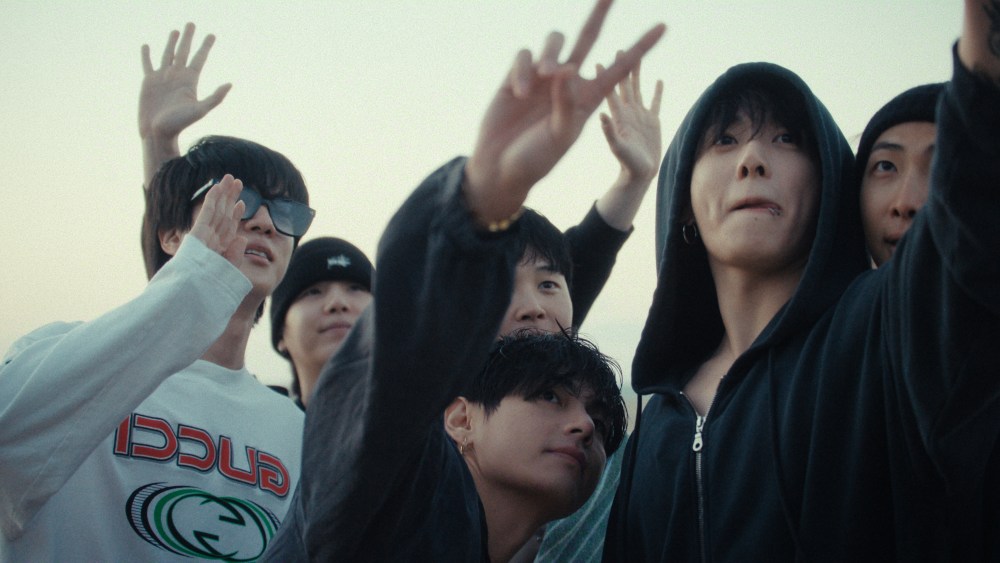
Pay close attention to the end credits of “BTS: The Return,” currently streaming on Netflix. As the credits for the documentary roll, viewers see that Jin, Suga, J-Hope, RM, Jimin, V, and Jung Kook all receive individual “additional cinematographer” credits.
How did this happen?
The documentary follows the band from Los Angeles to Seoul, South Korea as they reunite after completing their military service. All seven members will return to the studio to record and mix their latest album “Arirang”. When director Bao Nguyen began filming his documentary and set out to tell the story of the world’s biggest band, he knew he wouldn’t have access to the band 24/7. “What I thought about was, what if I gave them my own video camera?” Nguyen said at a screening of the documentary in Los Angeles. He added: “They film their own content on their phones, and it’s a very specific visual language.” Adding, “I wanted it to remind me of what it would be like to be filming a vacation with my brother, my mother, my uncle. To give them the camera, I added this texture that I think is very intimate.”
It’s truly up close and personal as they prepare to return to the world stage. He compares their journey to that of Homer’s Odyssey. Nguyen said, “When I first saw them at the So-Fi show, there was something really magical about that show, the connection to ARMY, and the mythical story that I always think about. ARMY was like Penelope, and BTS was like Odysseus.”
When Nguyen gave them video cameras, he chose not to tell them what to film or even when to film. “Coming into this story, I think people think of them as monolithic and just BTS, but they’re individually very unique. Some members said, ‘We need to capture everything. We just let it roll.’ Other members are quiet and want privacy. Whatever we can get from them. I was happy. ”
Between the footage shot by Nguyen’s staff and the footage shot by BTS, there was ultimately more than 40 terabytes of footage.
The high stakes and pressure of their return are at the heart of this documentary.
There’s a scene early on where the members sit around a dinner table and discuss recording an album. RM once said, “It’s a lot of pressure.” This is a raw insight into the group and shows the immense weight of the returns they expect.
Joining Nguyen in conversation were producers RJ Cutler and Jane Cha Cutler. The team joined the album a little later. Nguyen admitted, “They were picking a lot of songs and tweaking them. My fear was, ‘Oh, we’re just capturing the best, like people at their best, and it’s not the best type of storytelling or drama.’ However, for the first few days, live translation was done during filming. But then I watched the video. This pressure, this challenge, and this tension can be seen and heard. ”
Jane Cha Cutler, who produced “Martha,” describes BTS’s story as a “unique” story. “Not many bands have to step down at the height of their popularity, and the expectations for a comeback are so high. But for them, after being away for a while, they need to realize how different they are, as individuals and as a group. How much do they want to change? They talk about it a lot because it’s a high-stakes gamble. They want to create something new and exciting and push themselves, but at the same time they want to remain a band that people love and adore. ”
When the band returns to South Korea after spending two months in Los Angeles, discussions center around Arirang, a traditional folk song featured in standout song “Body to Body.” Chairman Bang (Shihyuk) (HYBE Chairman) and how should we incorporate it into the song.
The integration of Korean lyrics will also be a topic. SUGA says, “I want to write more lyrics in Korean. There are too many English lyrics right now, especially in the rap verses.” RM added, “Reliability is important for this album.”
This is just one of many moments where the group comes together, but also shows their uniqueness to a global audience, along with brotherhood and camaraderie.
RJ Cutler explained that the 92-minute documentary really explores “what it means to be BTS and how that relates to what it means to each be an individual.” He added: “It’s very rare to see that in a legendary band. I think there are very few in the canon of movies and music documentaries that can do that.”
The documentary comes after BTS achieved their seventh No. 1 album on the Billboard 200 with “Arirang,” marking the group’s highest weekly sales for an album in more than a decade.
“Arirang” entered the chart with 641,000 album equivalent sales, of which 532,000 were sold as a single album. This is the biggest opening week for an album by number of units since Taylor Swift’s “The Life of a Showgirl” topped the charts last year with more than 4 million units sold.
As previously reported, BTS’ live concert special reached 18.4 million viewers on Netflix. This statistic provided by Netflix takes into account viewers who watched “BTS The Comeback Live: Arirang” during its initial live broadcast and viewers who watched it the next day. The special, recorded at Gwanghwamun Square in Seoul, South Korea, was ranked among the 10 most-watched Netflix titles in 80 countries during the week from March 16th to 22nd, and was No. 1 in 24 countries.
