

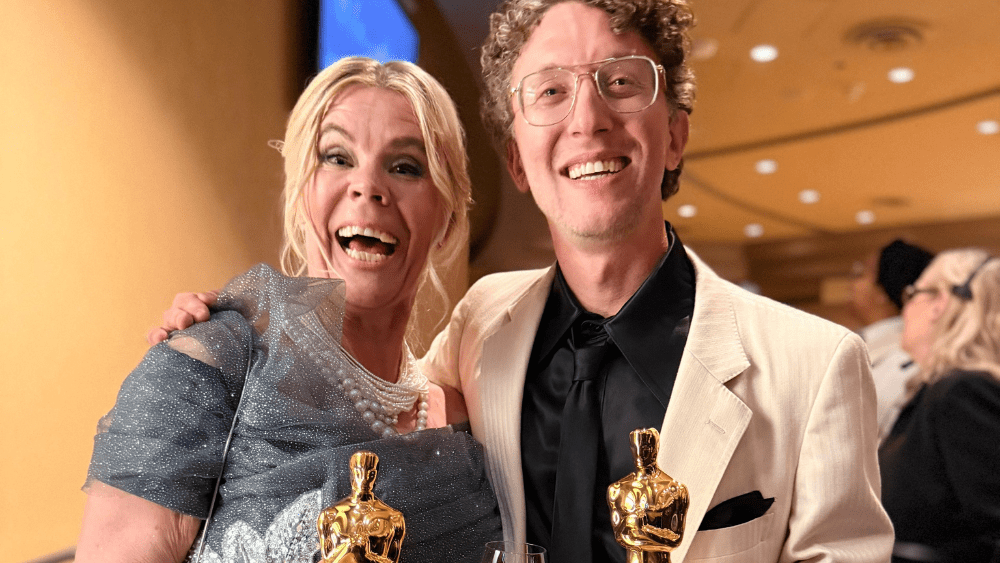
Earlier this week, American director David Borenstein was scheduled to pitch his next project on CPH:DOX’s prestigious forum platform. However, he had to drop out at the last minute, and for good reason. Just five days ago, the director’s life and career changed dramatically when he won the Oscar for best documentary for Mr. Nobody Against Putin, which he co-directed with Pavel Tarankin.
Speaking to Variety as he packed his suitcase to return to Copenhagen from Los Angeles, Borenstein said he could not yet reveal details about his next film, Living in Our Head, which he is currently working on with Helle Faber, the producer of Mr. Nobody Against Putin on Made in Copenhagen. But what he can say is that his experience on the Oscar-winning film will undoubtedly shape his next work.
“One of the things I learned from ‘Mr. Nobody Against Putin’ is the benefit of having a co-director and being open to working with other people, including people you wouldn’t necessarily want to make a documentary with,” he added. “If I had been told that I would be directing a film with a Russian schoolteacher in a town of 8,000 people, I wouldn’t have believed it right away, but Pasha gave everything to this project. He was incredible.”
Borenstein said the project “continues to be an interesting collaboration with someone, and we’re going to use this collaboration to create an interesting cinematic language.” He further added, “There will be a voice in the middle of the film to help write from a very unexpected perspective. I hope it’s an unexpected perspective on a big geopolitical theme. I’m interested in mixing up the tones and approaching the project from an unexpected angle, like I did with Pasha. That’s all I can say.”
The director said that his favorite films of the past year, including Gita Gundbil’s The Perfect Neighbor and Mstislav Chernov’s 2000 Meters to Andriivka, “reflect the idea of this new era, where cameras are everywhere and images are omnipresent.” “I’ve been so inspired by my own films and the films of my colleagues this year, and I think about them when I think about future projects.”

“Mr. Nobody Against Putin” provided by Frantisek Svatos
Courtesy of Frantisek Svatos
Faber notes that he’s already felt a change in the level of interest in the project since winning the Oscar. “When you have the right project, everyone wants to be a part of it, and of course now that we can brag about this little golden guy, I think there will be a lot more interest in our next project.”
Besides industry interest, what other benefits does Faber think the Oscar spotlight will have? “I think it’s going to be a lot easier to get people to talk to David,” she says. “For my next project, I need to reach out to some important people.”
“People can see how David, myself and our production company have been working with Pasha, and they have started coming forward because we really value people in our films,” she continues. “We’re trying to make them visible. It’s more about having access to the talent you need for your next project, and we hope it’s easier.”
But the Oscars’ major platform also brings another level of exhibition, which isn’t necessarily beneficial to documentary directors looking to act secretly and precisely. When asked how this affects his process, Borenstein said that for many years his job has been defined by “gaining access, getting into the field, getting into interesting institutions.” “I think we’re going to have to figure out how to deal with the loss of some of that anonymity.”
Borenstein can’t reveal much about “Living in Our Head,” but he does confirm that his next project in the near future is in collaboration with and support of American broadcaster PBS. “We’re still funding our next project in Denmark. The European public system is very good to me, but I think PBS is absolutely essential for America,” he says. “I am disappointed in what has happened to PBS over the past year under this Trump administration. I want to support PBS in any way I can right now.”
“I look forward to continuing my long-standing collaboration with the PBS science program Nova,” he reveals. “I love this work because it informs the American people, it reaches school children, and it has democratic values in it.”
As for Faber, in addition to working on a new collaboration with Borenstein, the producer is enjoying being able to wrap up the madness of an Oscar campaign and look ahead to what he wants to work on next. “Right now, I’m launching a new development project and I’m working on a really big documentary series that I can’t talk about too much about yet,” she says. “Now is a good time to pitch strong projects, but I told myself that after ‘Mr. Nobody Against Putin’ I’m going to be very selective, because I’d rather work on fewer projects and make them relevant.”
