

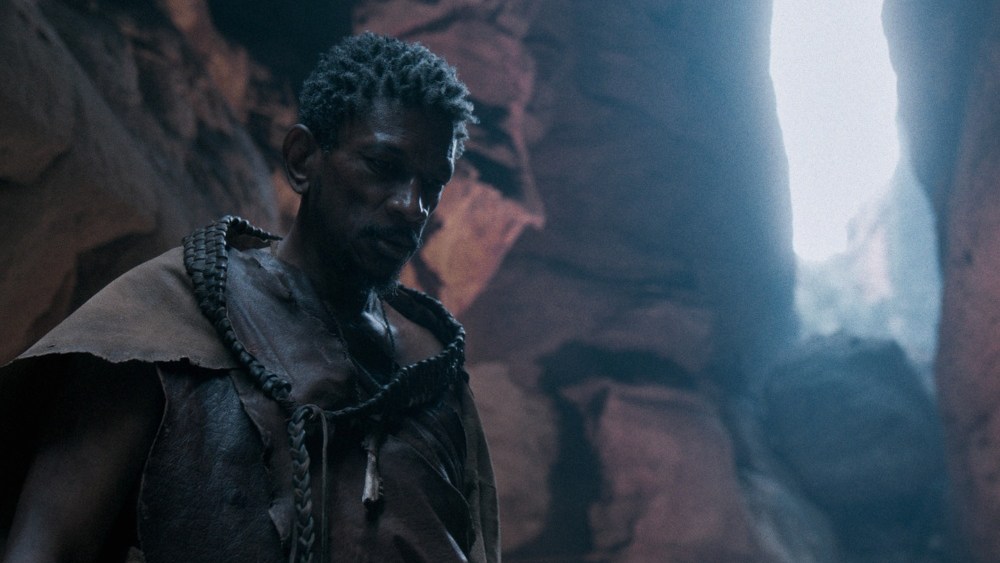
The Trek, an upscale horror western set in Africa’s barren Kalahari Desert, is not an easy movie to watch. But it’s a beautiful thing.
Mikael Adam, one of South Africa’s most daring newcomers, makes his directorial debut with this fascinating story set in 1846. It tells the story of a Dutch-Afrikaans family and their English benefactor as they embark on a perilous journey across the Kalahari Desert, watched over by two shape-shifting spirits.
Produced by the Office of Special Projects, “The Trek” stars Morne Visser, Rob Van Vuuren, Trix Vivier, and Maurice Kalpied as Atsumao, the mysterious cane man who guides the characters through the wilderness.
Are they heading towards salvation or destruction?
The group is attacked not only by the harsh terrain, plagued by hunger and despair, but also by something older and far more unforgiving than the desert itself.
“As the land rights of indigenous communities around the world continue to be under threat today, The Trek reimagines a new mythology inspired by Kane’s folklore, one in which the land itself may rise up and rewrite history,” explains producer James C. Williamson.
Shot in South Africa’s rugged Nieuwtville in the Northern Cape, the film was helmed by Adam, who doubles as director and cinematographer, but Adam told Variety that “The Trek” simply called for a rugged desert location.
“When I read the script, it was kind of a no-brainer. The Trek had to be as remote as possible, and the location itself had to be a character.”
“So we had to commit to going out. We moved everyone to a four-and-a-half hour drive from Cape Town, and it was definitely a challenge to get the whole unit there,” he says.
Adam, 37, explains of being in a remote location similar to his characters on The Trek: “You find the best in each other, just what you have in each other. I think the crew and cast of The Trek really brought something very unique to this movie.”
Speaking about working on The Trek, which is clearly a very ambitious visual and physical project, Adam said: “Any industry, anything scalable, if you treat it from a granular perspective, anything is possible as long as you get the right people on board.”
“And I strongly believe that all success comes from the hands of many people.”
“So it’s not necessarily what I thought was ambitious or challenging. It’s really built into our old anthem of us being problem solvers. If we collectively put our minds together and keep that discussion open, we can solve a lot of problems, because I believe that’s where the concepts really galvanize into something powerful, something actionable.”
Adams revealed that to find the perfect remote location, the production team made three trips to check the ground and then from a drone perspective to ensure that modern civilization wasn’t remotely encroaching on the story they wanted to tell.
We also literally limited the physical footprint of the production site as much as possible.
“Moving through space on screen also means moving with the camera and film crew and everything else that comes with it,” he says.
“And it was a process of finding and thinking about what we could cut back on. So in the case of a reset, it would really just be footsteps and cart wheels. This helped to reduce the kind of far-reaching effects that staff can have on set.”
“I tried to stay as lean as possible. My approach was to not call for a major reset,” says Adam.
“When you work with people in a position like this, where the littlest things can create the biggest flaws in an image, having someone who cares about what you care about, and vice versa, and knowing what they care about, is ultimately why we’re able to do this great work and why we can really feel like we’re in the middle of nowhere,” Adam says.
The second half of “The Trek” brings some incredible setting and cinematography to the screen, where the characters find themselves at the bottom of a canyon, a haunting desert cathedral of rock and brown and light and shadow and despair.
For this, no green screens, virtual walls, or in-studio painted wall sets were used.
All of the unforgettable and moving scenes, lensed within this narrow alcove-like space, were filmed on-site, making for a captivating viewing experience.
“It’s really all on-site,” Adam says with a smile.
“During the recce, we looked at various locations to ensure the depiction of the site was as accurate as possible, but we also had to consider the logistics of how to safely get the crew into those spaces.”
“Then, how do we occupy space and maintain a sense of continuity and geography? Contours play a huge role in ‘The Trek,'” he says.
“That ravine is a dry river bed that we found on the farm, and a few weeks ago water was flowing through it. At that time of year, it was completely dry and, dare I say it, was left perfect for us. We were lucky to find it.”
“It was a 45-minute drive from where we were staying. Working in riverbeds is always difficult because the soil is soft and the equipment is heavy, including everyone moving.”
“For us, it’s all about the talent that occupies that space, and we made sure that’s what it was all about. Once the camera was rolling, that set the boundaries as a technical team and we tried to point the lens in a way that compressed this environment and made it feel as real and intuitive as possible,” he explains.
Speaking about pushing the limits of what can be put on screen as a South African film, Adam gave advice to the industry: “If you get the right people on board with your dreams and ambitions, you can make anything you want.”
“Anything is possible, no matter how limited it is from a budgetary point of view or no matter how difficult it is from a conceptual point of view.”
“I think having the right people around you makes it a lot easier to think about the scale of something, even as a challenge on all fronts. I think it’s great to have a dream, as long as you know how to execute it. What really determines whether you can achieve it or not is the execution.”
“If it was a dream, it means you haven’t found a way to do it physically or actively yet,” says Adam.
“Things change when you have the right people around you. It mobilizes you and them. That’s the basic approach. It’s not necessarily about dreaming. It’s just finding a way to make that dream come true.”
