

THE RUNDOWN
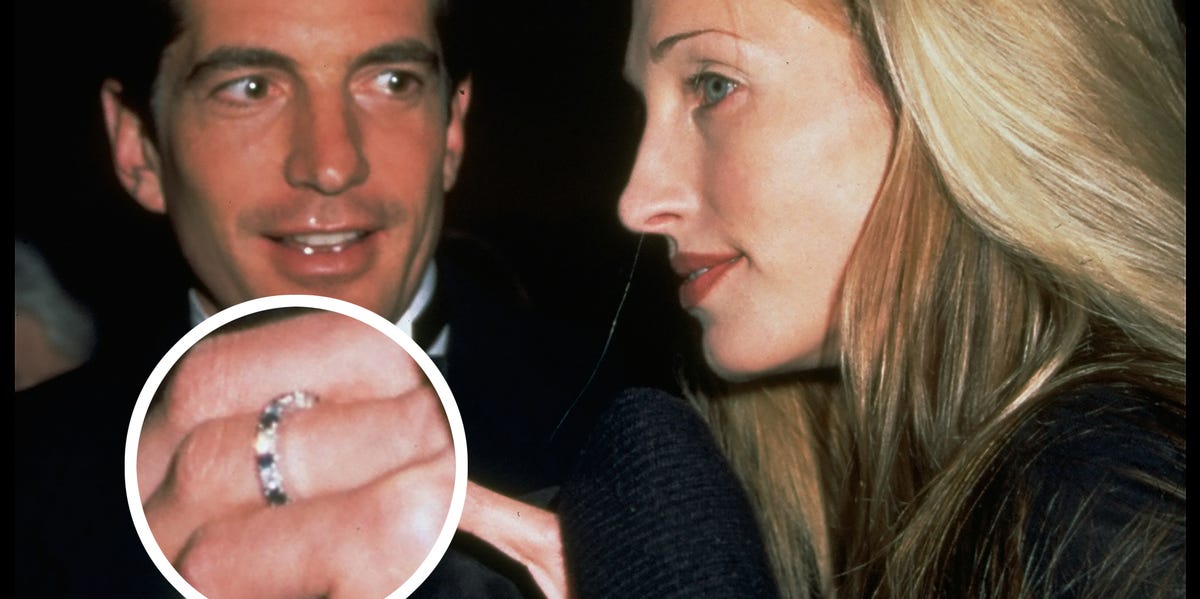
John F. Kennedy Jr. proposed to Carolyn Bessette Kennedy with a sapphire and diamond eternity band back in 1995.
He found two ways to pay tribute to his late mother, Jacqueline Kennedy Onassis, with the ring, making it a deeply sentimental piece.
Jewelers discuss its craftsmanship, symbolism, and impact on bridal jewelry trends.
Carolyn Bessette Kennedy remains a minimalist fashion icon—and her influence naturally extends to engagement rings, too. When John F. Kennedy Jr. proposed in 1995, he didn’t present her with a classic solitaire diamond. Instead, he chose a sapphire and diamond eternity band, inspired by one of his late mother Jacqueline Kennedy Onassis’s “swimming rings”—an eternity band set with diamonds and emeralds.
“At the time, choosing an eternity band over a traditional solitaire was a more unconventional choice,” says Alexandra Samit, founder and CEO of Alexandra Beth Fine Jewelry. “Today, many women opt to wear a diamond eternity band alone, either instead of or alongside a traditional engagement ring. Carolyn’s minimalist and fashion-forward style helped popularize the idea that an engagement ring doesn’t have to follow traditional norms. We continue to see strong demand for eternity bands worn on their own, which reflects her lasting influence.”
Alison Chemla, creative director and designer of Alison Lou, puts it plainly: “Carolyn essentially pre-dated the quiet luxury bridal trend by 25 years.”
As Love Story: John F. Kennedy Jr. and Carolyn Bessette revisits the moment JFK Jr. popped the question to Bessette Kennedy, jewelers spoke to ELLE about her iconic sparkler. Here, all the details behind the piece.
Jump to:
JFK Jr. commissioned Maurice Tempelsman to design the ring, which has two meaningful ties to his late mother, Jacqueline Kennedy Onassis.The eternity band features diamonds and sapphires, with no single stone dominating.The choice of sapphires is especially symbolic, both for the stone’s meaning and its impressive durability.The ring features a simple setting that requires careful craftsmanship. The ring’s stones appears to total between 2 and 4 carats, with a modern equivalent valued at roughly $10,000 to $50,000.Kennedy Jr.’s decision to model the ring after one of his mother’s adds a new layer of meaning to the piece. Bessette Kennedy’s ring was ahead of its time, influencing trends with its quiet luxury look, use of colored stones, and departure from the traditional solitaire design.
JFK Jr. commissioned Maurice Tempelsman to design the ring, which has two meaningful ties to his late mother, Jacqueline Kennedy Onassis.
JFK Jr.’s mother, Jacqueline Kennedy Onassis, passed away in May 1994, a year before he proposed to Bessette Kennedy. He found a touching way to honor her not once, but twice: drawing on one of her rings for the design and tapping diamond magnate Maurice Tempelsman, who had been Kennedy Onassis’s partner in the years leading up to her death, to create the piece.
His assistant and close friend RoseMarie Terenzio wrote in JFK Jr: An Intimate Oral Biography, per People, “John gave Carolyn two rings. There was his mom’s ‘swimming ring’—that was Jackie’s name for the ring she wore when she didn’t wear her wedding ring—designed by Jean Schlumberger. Bunny Mellon (Jackie’s close friend) had it and had given it to John. Jackie’s swimming ring was emeralds and sapphires. Carolyn’s engagement ring from Maurice was in the same style with diamond and sapphires around a band.”
Olivia Landau, founder and CEO of The Clear Cut, tells ELLE that Kennedy Jr.’s nod to his mother was not unusual given the circumstances. “It is not uncommon for a man to take inspiration from his mother’s jewelry or use stones from her heirloom pieces when designing an engagement ring, especially if his mother has passed,” she says. “Since Jackie Kennedy died the year before their engagement, it makes complete sense that JFK Jr. would want to pay homage to her.”
The eternity band features diamonds and sapphires, with no single stone dominating.
Steph Mazuera, who founded her own namesake brand that creates made-to-order engagement rings, calls out the balance of the sapphire and diamond eternity band: “Rather than centering attention on a single stone, the design creates a seamless circle of diamonds and sapphires around the finger,” she says. “The effect is elegant and restrained, which aligns closely with Carolyn’s personal style.”
Logan Hollowell, founder and CEO of Logan Hollowell Jewelry, expands on this, saying, “What has always drawn me to Carolyn’s engagement ring is its restraint—the way it refuses spectacle and instead leans into intention. An eternity band set with alternating sapphires and diamonds creates a quiet rhythm around the finger, light meeting depth in a continuous circle rather than a single stone claiming attention. There is something incredibly confident about that choice because it suggests the meaning of the ring lives in its continuity, not in its scale. It feels refined and intelligent, almost architectural, but still deeply intimate, like a piece chosen to be lived in rather than admired from a distance.”

The choice of sapphires is especially symbolic, both for the stone’s meaning and its impressive durability.
While the Jacqueline Kennedy Onassis ring that inspired Bessette Kennedy’s engagement ring featured emeralds, Kennedy Jr.’s choice of sapphires as the accent stone is deeply symbolic.
“Blue sapphires have long symbolized loyalty, wisdom, and good fortune,” Samit says. “Blue is also historically associated with royalty. Diamonds represent enduring love, strength, and an unbreakable bond. Together, sapphires and diamonds create a beautiful balance of meaning, loyalty paired with lasting love, which makes them a powerful and romantic combination for an engagement ring.”
Hollowell agrees, noting the “a beautiful equilibrium” between the two stones. “Diamonds have long represented clarity, endurance, and truth, their hardness making them symbolic of something unbreakable. Sapphires carry a quieter depth, historically associated with loyalty, wisdom, and spiritual protection, often worn by royalty as a symbol of steadfast devotion. When placed together, the combination feels balanced and thoughtful, brightness anchored by depth, brilliance softened by soul. It is not a pairing chosen for extravagance but for harmony, which makes it feel all the more intentional.”
Chemla points out that sapphire “wasn’t a birthstone for either of them (so) it feels more aesthetic than symbolic. The pairing creates depth and balance rather than sending a specific message.”
Mazuera also emphasizes the literal durability of sapphires, saying they are “almost as enduring” as diamonds. “Together, the two stones create a balance between brilliance and depth,” she says. “The contrast between the crisp white diamonds and saturated blue sapphires gives the band a sense of richness without feeling overly ornate.”
The ring features a simple setting that requires careful craftsmanship.
While the setting on Bessette Kennedy’s ring appears simple, its construction is anything but. “Eternity bands like this depend heavily on precision,” Mazuera explains. “Each stone would be carefully calibrated so that the size, shape, and color match consistently all the way around the ring. In a finely made example, each seat is cut individually to fit the stone exactly, and the ring is set entirely by hand. That level of refinement is subtle, but it’s what distinguishes a truly well-made eternity band from an average one.”
Angie Kennedy, vice president of product merchandising at Zales, stresses that the ring’s platinum setting adds “a more elevated and enduring metal that enhances both the refinement and longevity of the design. The low-profile setting made it exceptionally wearable—a reflection of Carolyn’s preference for effortlessness over extravagance.”
Hollowell calls out the “absence of hierarchy” in the setting: “There is no single elevated center stone commanding attention. Instead, the stones encircle the finger evenly, creating a sense of continuity that subtly shifts the symbolism from presentation to partnership. The ring sits close to the hand, low and wearable, which gives it an intimacy that larger, raised settings often lack. It feels integrated into daily life, as though it was meant to move with her rather than sit apart from her.”
The ring’s stones appears to total between 2 and 4 carats, with a modern equivalent valued at roughly $10,000 to $50,000.
While Bessette Kennedy’s ring doesn’t have a single large center stone, jewelers estimate the total carat weight of its diamonds and sapphires falls between 2 and 4 carats, with modern equivalents varying widely depending on quality.
“A new sapphire ring of that quality and size could sell for anywhere from $10,000 to $50,000 depending on the actual color,” says Eddie Le Vian, CEO and designer of Le Vian. “Sapphires have become among the most appreciated of all gems and have been rising dramatically in price as of late. However, if (Bessette Kennedy’s) actual ring were to come up for auction today, based on its story, it could sell for $3–5 million.”
Samit estimates the ring at “approximately 4 carats combined between the sapphires and diamonds. A modern equivalent would likely range between $20,000 and $50,000, depending on the quality.”
Hollowell offers a similar assessment: “From photographs, the band appears to feature small round diamonds alternating with similarly sized sapphires, likely totaling somewhere between 2 and 3 carats combined weight across the full circle, depending on calibration and spacing. If recreated today using high quality sapphires and well-matched diamonds in a fine setting, a modern equivalent would likely range between $30,000 and $50,000. That said, with a piece like this, its narrative and provenance would always elevate it beyond its material valuation because the story embedded within the design becomes part of its worth.”
Chemla provides a more conservative estimate: “Today, I’d estimate a similar ring (would be worth) around $10,000 to $15,000 depending on stone quality. The total carat weight is likely modest, probably under two carats combined, but proportion matters more than size here.”
Mazuera believes the ring is “about 2.5 total carats total of diamonds and sapphires, but it depends on both the width of the band and her finger size. A modern equivalent made with well-matched sapphires and high-quality diamonds would likely fall somewhere in the range of $20,000 to $30,000. Because eternity bands require a large number of precisely matched stones, they are often more labor-intensive than they appear.”

Kennedy Jr.’s decision to model the ring after one of his mother’s adds a new layer of meaning to the piece.
Hollowell believes that Kennedy Jr.’s decision to model Bessette Kennedy’s engagement ring on one of Kennedy Onassis’s rings goes beyond a simple tribute. “When jewelry carries history within a family, it naturally becomes part of the emotional language of love, so it is not uncommon for someone to look backward in order to move forward,” Hollowell says. “The detail about Jackie’s swimming ring feels especially layered because that was the piece she wore when she was not wearing her wedding band—a ring that symbolized her independence and her identity outside of marriage. Reimagining that design for Carolyn feels less like imitation and more like continuity, a way of honoring the woman who shaped him while welcoming the woman he chose into that lineage. Jewelry holds memory in a way few objects can, and when inspiration comes from a mother’s ring, it often reflects reverence, protection, and a desire to weave stories together.”
Chemla notes that it’s a less common approach “since engagement rings usually center the couple’s future rather than family history,” the jeweler says. “But given the timing and the loss of Jacqueline Kennedy Onassis, it feels less traditional and more emotional. It adds continuity to a new chapter.”
Bessette Kennedy’s ring was ahead of its time, influencing trends with its quiet luxury look, use of colored stones, and departure from the traditional solitaire design.
Bessette Kennedy’s ring is iconic for good reason: it not only popularized an alternative to traditional solitaire engagement rings, but also helped promote sapphire engagement rings, minimalist designs, and the idea that brides should choose rings that reflect their personal style.
Hollowell sums up the ring’s lasting impact: “Choosing an eternity band instead of a solitaire was subtle but forward thinking, and over time that quiet departure from tradition has echoed through modern bridal trends. In the decades since, more women have gravitated toward engagement rings that feel personal and symbolic rather than centered on a single large diamond. Colored stones, eternity bands, and designs that prioritize meaning over magnitude have become increasingly embraced, and Carolyn’s ring helped validate that shift, proving that restraint can feel just as powerful as scale.”
Chemla agrees, sharing that the ring’s design was progressive: “It reads more like a modern eternity band than a traditional engagement ring,” she explains. “The restraint is what makes it powerful. It embodies quiet luxury long before that term existed.”
Landau credits Bessette Kennedy with inspiring more women to choose eternity bands as engagement rings, saying she “pioneered” the trend. “We see so many more brides going against traditional engagement ring norms these days, but Carolyn was truly a style icon and trailblazer of the time.”
Kennedy Jr. made a choice that fit his bride’s lifestyle—and that is a love story in and of itself, Mazuera says: “Carolyn was known for a minimalist aesthetic, and an eternity band would have likely felt more natural and wearable for her. There’s something very romantic about proposing with a piece that reflects the wearer’s style rather than tradition or expectation.”
And other people have followed suit. “In recent years, there has been a noticeable shift toward engagement rings that feel personal rather than conventional,” she adds.
