

James Cameron’s Avatar: Fire and Ash picks up where The Way of Water left off. The Sally family is in hiding as they deal with the loss of their son Neteyam (Jamie Flutters). When they take Spider (Jack Champion) to live with the Wind Traders, Varan (Oona Chaplin) leads the Ash People to ambush the convoy. The marine creature Iru, which the Na’vi ride, is also used in action scenes. Avatar: Fire and Ash required more than 3,000 total visual effects shots.
Weta FX Senior Visual Effects Supervisor Eric Saindon details how some key scenes are created.
I came with you.
Kiri, Spider and Iru

Avatar: Fire and Ash VFX progression frames
20th century studio
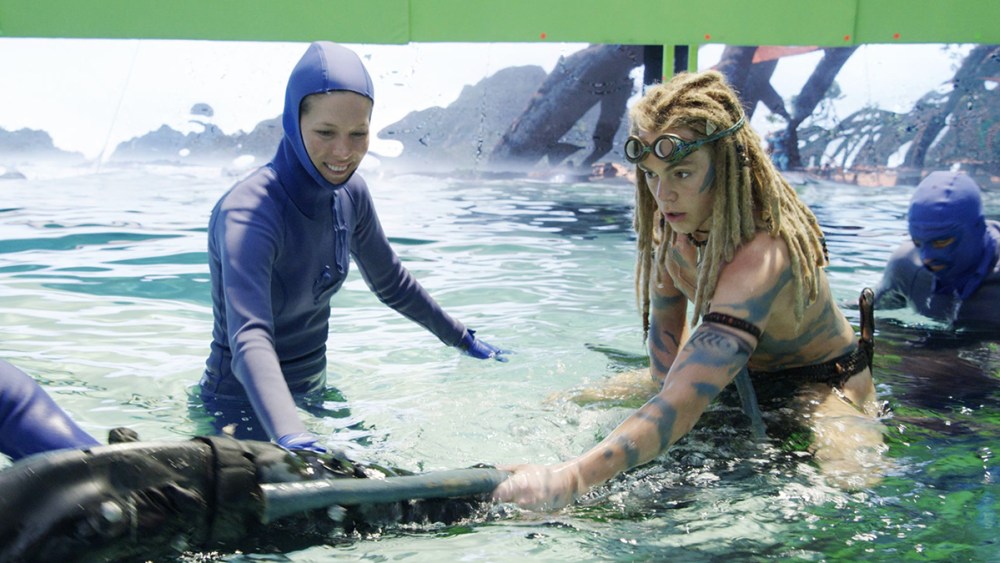
“The live-action plate for Jack Champion was shot in a shallow pool in New Zealand. The actor sat in the saddle with the camera ready, while Ile’s movements were performed by a stunt team in blue suits, with LED screens mirrored to project the surrounding environment and reflections on the water,” says Saindon.
The excavator was operated with slightly offset timing and fitted with practical paddles designed by Steve Ingram’s SPFX team to produce the gentle, overlapping waves that are characteristic of protected bays.
“Using an in-house live depth compositing tool, James Cameron was able to view footage in real time.
A world where live-action and CG worlds are fused. The same setup also allowed us to generate the frame-by-frame geometry of the water surface used to run the FX simulation. ” he says.
“For the final compositing, we used rotoscoping to extract Jack Champion and all water interactions from the plate. We then combined the matched FX simulation with the CG bottom half of Jack and the underwater elements. A full CG environment and aperture were added, depth-based haze and physically accurate depth of field were applied, and composited together.”
Turkun Council
For the Tulkun Council scene, the animation team created an animation of Tulkun, a giant whale-like marine creature, rising through a block simulation of the water surface. In the simulation, we calculated the momentum and volumetric displacement of Turkun as it rises and breaks through the surface.
“When Turkun breaks the surface and forces water out, the resulting volume is combined into the simulation to generate large amounts of water movement and droplets that affect the surrounding sea level,” Saindon says. “Thin film simulations were used to model the water flowing along the surface of Turkun and reintegrating into the bulk water simulation.”
He notes that the water flowing out of Tulkun’s head changes from a bulk simulation to droplets, fog, and atmospheric droplets depending on speed and prevailing atmospheric conditions.
“The final compositing used an in-house renderer to calculate physically accurate atmospheric haze. Depth of field was set based on lens data, and all compositing was performed using deep data,” he says.
