

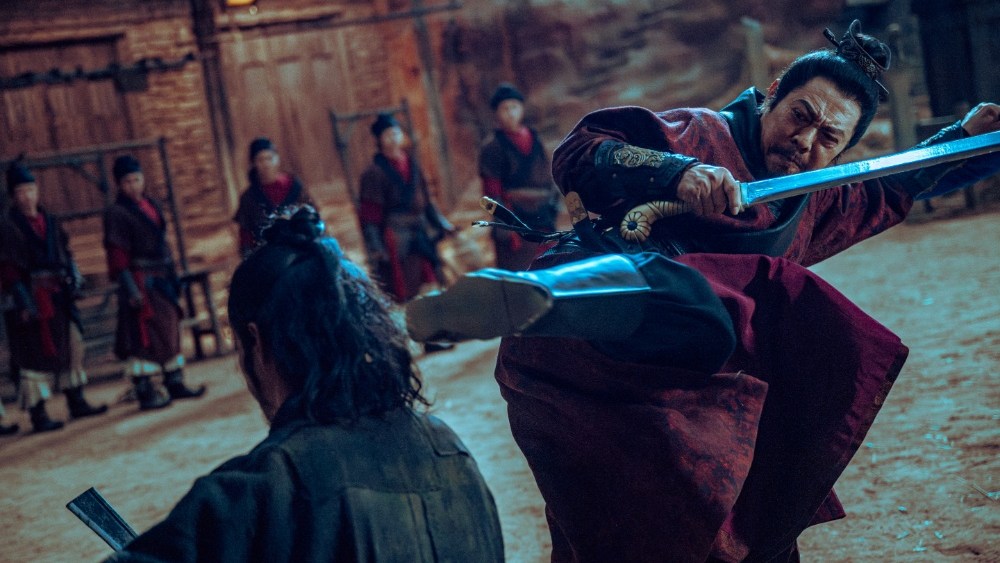
When Yuen Wooping needed a horse, he used a real horse. When I needed a desert landscape, I shot in an actual desert. And when he needed actors who could perform Hong Kong-style wirework and martial arts sequences without relying on digital processing, he assembled a cast of martial arts champions, led by Wu Jing and Jet Li, who could physically faithfully represent the vision he wanted for “Blades of the Guardians.”
“Taking shots with a camera has always been the way I work,” the director told Variety. From choreographing Jackie Chan’s Drunken Master to defining the visual language of the Matrix trilogy and Crouching Tiger, Hidden Dragon, Yuen’s influence on martial arts films spans decades. For Blades of the Guardians, that meant returning to a hands-on approach to filmmaking. “Many stylistic choices in Hong Kong filmmaking were born out of necessity and limitations. We didn’t have visual effects, so we invented wirework, which became a hallmark of Hong Kong filmmaking. For this film, we wanted to shoot on location because we couldn’t recreate the desert or use visual effects to work with real horses or skilled stuntmen.”
Well Go USA Entertainment has released the historical action film in North America. The cast also includes Nicholas Tse (Raging Fire), Yoshu Yu (Creation of the Gods I: Storm Kingdom), and K-pop artists Seventeen’s Jun (Wen Junhui) and NCT’s Winwin. Based on a graphic novel by Xu Xianzhe, the film follows a skilled mercenary named Biao Ren as he navigates the harsh deserts of the Western Regions during the Sui Dynasty under the rule of the oppressive Emperor Yang Guangdi. While completing what at first appears to be a simple escort mission, he becomes embroiled in a dangerous conspiracy.
The filmmaker’s approach to choreography emphasizes what he calls clarity, weight, and results. “For me, fight scenes are like conversations between characters,” Yuen says. “There is context, and every move has consequences. Dialogue that doesn’t need to be said should be cut out. The same goes for fight scenes. Every move should move the story forward.”
The film’s road movie structure allows this storytelling approach to unfold across a variety of encounters and locations. “‘Blaze of the Guardians’ is a road movie in a way. We meet different characters, visit different places, and encounter all kinds of trouble along the way,” Yuen points out. The key storyline revolves around Dao Ma and Di Ting, who were once comrades-in-arms. “Their final battle is a spectacular sequence, but in the final moments we suddenly end up seeing their differences in a completely different light,” he reveals. “A journey that begins with a physical journey through the desert culminates in an emotional character journey that, in an instant, transports us back to where it began.”
Assembling the ensemble presented unique challenges. “Casting was a huge part of this movie,” Yuen says. “Firstly, since this is an adaptation of a graphic novel, I wanted to capture the spirit of the characters created by Xu Xianzhe. Being an action actor who does the actual stunts is not an easy job. Besides, they have to be good actors, which is even more difficult. Every generation produces a few talented actors, but I tried to fit the best actors for every role in the graphic novel.”
Co-starring with Jet Li, the decades-long history of martial arts films has come together once again. “The challenge in casting Governor Chan is that since Wu Jing is Dao Ma, Governor Chan has to be Jet Li to make it seem like he could be Wu Jing’s enemy,” Yuen explains. “Jet Li is a very skilled martial artist, and the other actors do their best on set every day. Wu Jing, Jet Li, and Max Chan have dozens of injuries between the three of them, but it’s rare that you get to work with such skilled performers, so they did their best every day.”
Wu Jing, Jet Li and Chan are all martial arts champions, which Yuen says creates a unique physicality on screen. “Wu Jing is a martial arts champion like Jet Li and Max Chan, so they all ‘speak’ the same language when it comes to martial arts,” he says. “There is an elegance to the movement and physicality of martial arts that makes it perfect for a historical drama like this.”
Tony Leung Ka-fai, known more for his genre-crossing versatility than his martial arts expertise, brought a variety of strengths to the production. “Tony is a very professional actor. He’s not a trained martial artist, but he was ready to learn,” Yuen says. “Hong Kong has a small film industry, but Tony and I had not had the opportunity to work together until this film. He was able to bring emotional weight to the character of Chief Mo, which is the emotional core of Ayuya’s storyline.”
For his young cast members, who have undergone extensive physical training, Yuen emphasizes the importance of finding their individual voice within the genre rather than simply replicating what came before. “I think the most important thing I can convey is that every filmmaker and actor should find their own voice in this genre. That’s the only way to generate new ideas and new stories,” he says. “When I first started directing, I realized that my specialty was mixing action and comedy. This combination was unproven, but it was very popular. In my experience, I tried to recreate works that usually do not work.”
Yuen, who has been shaping action films in Hong Kong and Hollywood for decades, believes this film establishes Hsu’s graphic novel world for potential future work. “I always want to do something new, but I try not to think too far ahead,” he says. “I think this movie establishes the graphic novel world. There are so many books, so many characters, so many ways to continue the story. This movie took four years to put together, so we’re going to take a few months off first!”
Peace Film Production produced the project, and Yu Baimei, Chao-pin Su, Chan Tai Lee, and Larry Yang wrote the script.
