

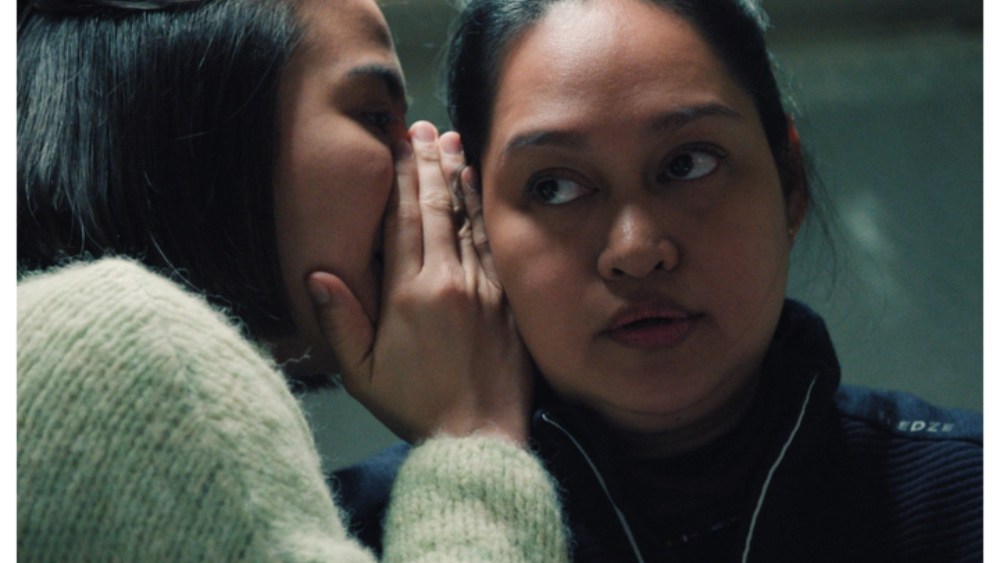
Dominique Rocher aired Switzerland’s dirty laundry, focusing on undocumented workers in the Berlinale premiere of Enjoy Your Stay.
“These are people who work in the shadows but contribute to the wealth of this country,” he says. Locher is also behind “Goliath.”
“Switzerland has this postcard-like image. It makes you think of the Red Cross and the League of Nations (known as the predecessor of the United Nations). We wanted to turn this postcard over and see the other side.”
With the help of co-screenwriter Honeylyn Joy Alipio, Locher tracks down Luz (Mercedes Cabral), a cleaner who has been working in Switzerland for years, but always without papers. Now, it looks like she’s finally got her big break with a cushy gig at a luxury ski resort. But a violent incident shakes up her small community.
Produced by Close Up Films and co-produced by JBA Production, “Enjoy Your Stay” is distributed by Be For Films.
“The concept of solidarity is very close to my heart,” he says. “After my parents divorced, they lived on opposite sides of the mountain. We had to travel back and forth through tunnels built in Switzerland by Italian workers. Many of them died. Even at the time, this seemed like a great injustice and an important topic to talk about.”
Still, it was Alipio who came across an article about illegal cleaners at ski resorts. “When I first pitched this project at Locarno, I said it was as if the Dardenne brothers had written a script for the Safdie brothers to shoot with a Filipino woman in a luxury resort in Switzerland,” he recalls.
“If you have documents that allow you to be here, that protects you. If workers don’t have rights, they’re at increased risk of exploitation. It’s a vulnerable position, and we wanted to show that without painting them as victims.”
“It’s not the same thing that happens with ICE in the United States, but if someone calls the police they get deported. Yet in most mountain resorts, the local police turn a blind eye because they know that’s what keeps the place running. If they don’t have to check anyone’s documents, they won’t.”
Women struggle with constant fear of repercussions, sexual violence, and local workers who see them as a threat. “They work long hours for little pay. Even my relatives from the area used to complain about it.” Some want to return as soon as possible. Some people want to stay.
“In fact, it was Mercedes who said, ‘Maybe Luz doesn’t want to be tied down to this patriarchal system[of her hometown]?'” Going abroad for work was an opportunity to find out if there was more to life than that. ”
“Some of the people they meet are kind, but it’s too optimistic to think that everyone can form real friendships. There are conflicts of interest and too many risks.”
Locher and Alipio didn’t want the characters to feel disposable. “They are strong and have their own ambitions and goals.”
“During our research, we also spoke to undocumented workers and encountered many moments of joy and kapwa (meaning ‘together’ in Filipino), of being together and supporting each other,” he says.
“What intrigued me about Luz is that she realizes that ultimately it’s not just about money. There’s another concept of family, and it’s more feminist, which is to look out for the people who are close to you, even if they’re not blood related.”
Yet, before we get there, Luz comes very close to betraying herself. Even when they need her the most.
“She’s ambitious, and this ambition tests her moral limits. But it’s not a story of ‘good guys’ versus ‘bad guys,’ it’s people versus humans. Their employer, Thibault, isn’t all evil either.”
For Roche, Thibault (played by Alexis Manenti) and Luz are “soulmates from two different worlds.”
“They remind me of Honeylynn and I. Sure, he’s testing her, but then it’s Luz who’s pushing him. When they were filming ‘Breaking Bad,’ there always seemed to be someone from the writers’ room on set who could overwhelm the director. It was the same with us. I checked with Honeylynn, ‘What can we improve on? How can we push the envelope even further?'”
Currently, the two are working on another project together. “‘Partner Zone’ is the story of a Swiss supply chain due diligence specialist working for an NGO funded by mining companies in the Philippines. We want to tell social stories that have an impact on the world,” he says.
“In a country like Switzerland, it is important to think about who we are and who we want to be. We need to decide whether we really want to commit to this ‘tradition of solidarity’ that we claim to have.”
