

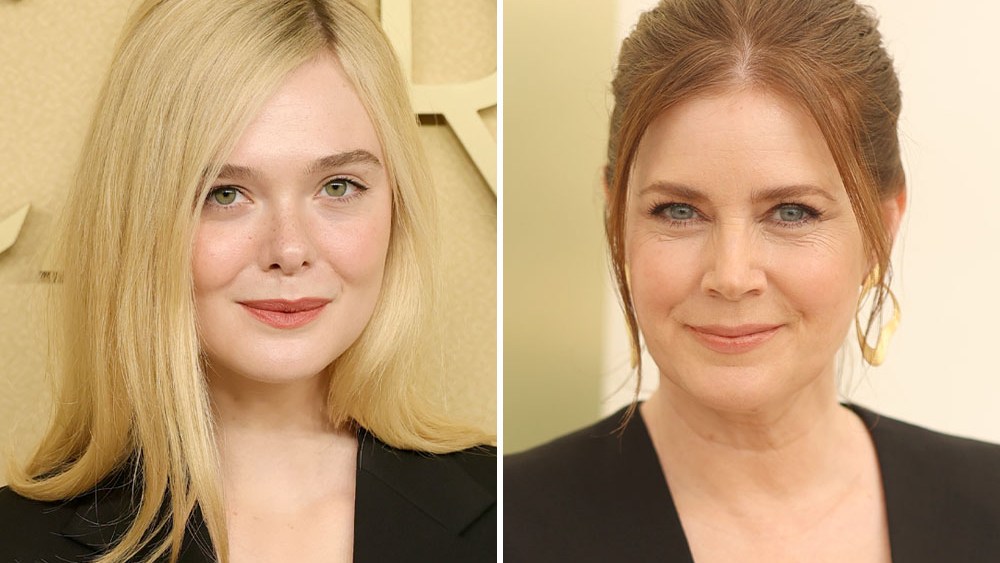
Two of the hottest and most star-studded films to have their world premieres in competition at this year’s Berlin Film Festival, Rosebush Pruning and At the Sea, are the works of two decidedly non-Hollywood filmmakers, but they feature top American and British talent.
“Rosebush Pruning,” a biting family satire directed by Brazilian writer Karim Ainouz, which premiered on Saturday, boasts an impressive heavyweight ensemble including Callum Turner, Riley Keough, Elle Fanning, Jamie Bell, Lucas Gage, Tracy Letts and Pamela Anderson. Shot in Spain, the film follows an American family wandering stranded in Catalonia who are forced to confront distorted power relations.
Meanwhile, the highlight of Monday’s lineup is the drug addiction drama “At the Sea,” directed by Hungarian director Cornel Mundruczó. Lead actress Amy Adams is already generating Oscar buzz. The rest of the cast is made up of some of the biggest names in American, British, and English-speaking cinema, including Murray Bartlett, Brett Goldstein, Chloe East, Dan Levy, Jenny Slate, and Rainn Wilson. Mundruzo is no stranger to the US awards race, with star Vanessa Kirby nominated for best actress for her 2020 film Piece of a Woman, but At the Sea is likely to be his most high-profile project to date.
The European film market is full of high-profile projects that bring together European directors and American stars. For example, Quentin Dupieux’s StudioCanal-backed comedy Full Fill, starring Kristen Stewart and Woody Harrelson, and Ruben Østlund’s The Entertainment System Is Down, starring Kirsten Dunst and Keanu Reeves, were early acquisitions by A24.
This continues a growing trend of big-name stars moving away from Hollywood productions to work with international directors, as seen in recent award-winning films such as Coralie Falget’s body horror film The Substance, starring Demi Moore, and Jacques Audiard’s crime musical Emilia Perez, starring Zoe Saldaña and Selena Gomez. The same goes for Halina Lane’s subversive erotic drama “Babygirl,” starring Nicole Kidman, which opened in Venice in 2024.
“Hollywood actors are looking for alternatives to blockbusters and series,” says Charles Gillibert. The Paris-based company CG Cinema produced Stewart’s directorial debut, “The Chronology of Water,” as well as Alice Winocourt’s “Couture,” starring Angelina Jolie.
“American independent film is losing momentum. It’s expensive to make, and distributors willing to sell it are becoming increasingly rare,” he says.
“In Europe, we believe that culture should be partially protected from the market, because it gives writers more freedom and leads to unique works. Big actors want this kind of experience,” he says, adding, “Hollywood actors are also learning to build lasting careers by managing their value and income between commercial projects, art-house films (often in Europe) and brand deals.”
Ainuz, the director of “Pruning the Rosebush,” said he feels the international reach of American talent has been steadily on the rise since his English-language debut in 2023’s “Firebrand,” starring Jude Law and Alicia Vikander.
“I think the freedom that we can bring to English-speaking films is appealing to actors who work in formats that are sometimes a little too industrial,” Ainouz says. “Ten years ago we were invited to collaborate with American and British films as a kind of service provider. And I think what’s different now is that they’re hiring us.”
Ainuz says a big part of what makes working with international directors so appealing to A-list stars is the element of risk, which can often lead to critical acclaim and awards buzz. He cites Emma Stone’s long-standing collaboration with Greek helmsman Yorgos Lanthimos as a prime example.
“Taking risks is something every actor wants to do. Every actor wants a challenge, and every actor doesn’t want to be in their comfort zone,” he says.
Fanning, who stars in “Pruning the Roses”, was unable to attend the Berlinale for this film, perhaps because she is eyeing an award with her latest international collaboration, Joachim Trier’s “Sentimental Value.” This was the American actress’ first Oscar nomination.
Ainouz believes this partnership is beneficial for both parties, as having a star on his film means more people will watch it. “When we say, ‘Great ensemble, great cast,’ we want audiences to see our film,” he says. “And I think it’s a really unique time for us as writers to be able to collaborate with an international cast.”
This also comes as the political situation in the United States becomes increasingly unstable under the second administration of Donald Trump. A-list stars such as George Clooney and Eva Longoria have moved outside the United States, citing political and privacy concerns.
“Before, there was a sense that America was a very self-contained and autonomous place,” Ainuz says. “And I think the positive side of this is that Americans are now more interested in other parts of the world, other languages, other ways of storytelling.”
Although this trend is mostly about drama, American actors are also following lighter European material. In addition to Østlund’s Palme d’Or winner “Triangle of Sorrow” and his star-studded new film “The Entertainment System Is Down,” Quentin Dupieux is another European director who has cast big-name actors like Kristen Stewart and Woody Harrelson in his upcoming burlesque comedy “Full Fill,” which he described to Variety as “the ‘Emily of Paris’ from hell.” Mr. Serignac of Si Fu Mi Productions said that “the coolest American actors” are drawn to Dupieux’s films because they tend to be bolder than American comedies. “When we send them Quentin’s movies, they’re shocked, because if you look at American comedies today, it’s a little dead.”
Nathanael Kermitz, whose MK2 Films is reproducing At the Sea, Albert Serra’s Out of This World starring Riley Keough, and Anatomy of the Fall director Justin Torrier’s next film Fonda starring Mia Goth and Andrew Scott, says film history is full of examples of “European directors who imported to the United States, American stars who made films in France and Italy.”
The change today is that “it’s primarily Americans, whether directors, producers or actors, who are looking to Europe,” Kermitz says.
“We have a film industry that is naturally open to others, and we have a regulatory system that protects artists from market forces and allows them to take risks, innovate, and tell free and different stories. This is clearly something that many people lack, and something that Europe continues to preserve for the time being,” says Kermitz of MK2 Films, which also runs one of France’s leading arthouse cinema chains.
Berlinale chief Tricia Tuttle points out that these films often involve many producers from around the world, such as “At the Sea,” which was backed by Ukrainian producer Alexander Rodnyansky, as well as several producers from the United States and Hungary.
“This is an international business now, and that’s very important,” she said, adding, “Audiences are showing an appetite for films that are adventurous, that surprise, that do something different, that break the mold.”
