

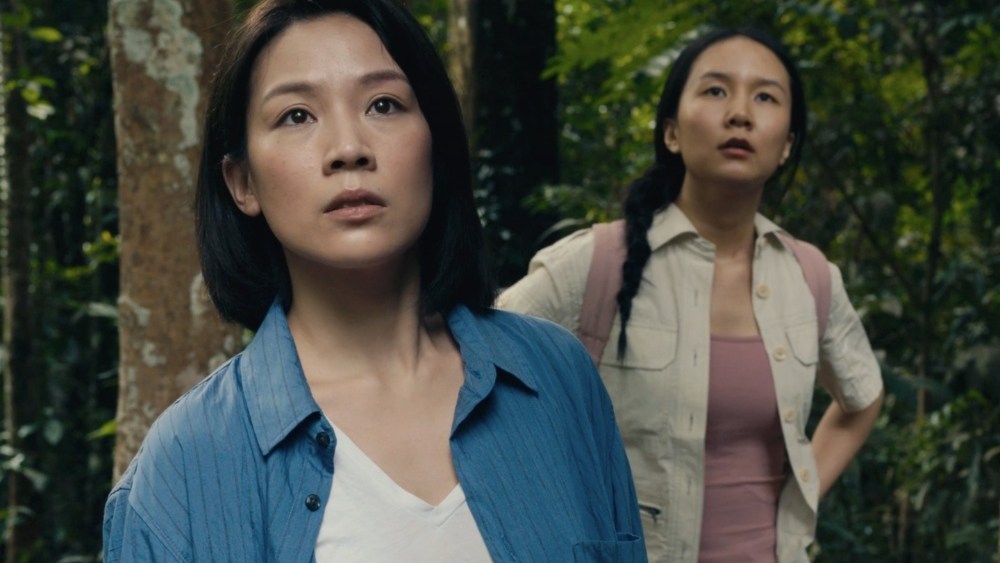
Agnis Shen Zhongmin’s debut feature Shanghai Girl approaches China’s Down to the Countryside movement through an unconventional lens, treating the southwest rubber plantation to which her late father was sent during the Cultural Revolution as what she calls “a geological theater that already contains all the information for the script.”
The film, which is in the Panorama section of the Berlin Film Festival, is about a Shanghai woman who travels alone to a rubber plantation in southwestern China, searching for a mysterious woman as strangers unexpectedly drift in front of her. The project, starring Liang Kuixian and non-professional performers, deliberately blurs the line between fiction and documentary.
“I have never believed that there is such a thing as pure fiction or pure reality,” says Shen Zhongmin. Her hybrid approach extended to treating her non-professional cast as creative collaborators rather than traditional actors. “For me, they were ‘screenwriters’ and even ‘on-set producers,'” she explains. “None of the non-professional actors in this movie received what we would call a ‘script.’ They had no preconceptions of what they were going to shoot or say.”
The director’s methodology emerged organically from an initial exploration of her father’s old farm residence, but the process was characterized by uncertainty and improvisation due to limited archival material. “This is not a project that started out as a research or research-based endeavor. It was born purely out of a very primal intuition and emotional impulse within me,” she says. The experience of drifting and exploring directly shaped the film’s narrative structure.
Rather than treating rubber plantations and forests as mere backdrops, Shen Zhongmin positions the natural environment as an active narrative force. “Rubber trees can produce latex for only 20 to 30 years, which is not that different from when we were young,” she observes. “I feel that on many levels, trees are similar to humans: they have sentience, they have life cycles, and they have the same impermanence of fate.”
The filmmaker’s approach to collaboration created what she describes as a kinship-based power relationship on set. The only professional actor in the cast, Liang “has a natural, almost unprofessional quality” with strong empathic abilities that allowed him to blend seamlessly into the ensemble. “The conditions on the set were exactly a combination of reality and fictional creation. For example, we could eat the food on the table and continue the conversation even after the camera cut,” says Shen Zhongmin.
The director, who comes to film from a background in literature, journalism, and contemporary art, sees filmmaking as a particularly expansive medium. “Compared to these, films are perhaps more expansive and complex, but also more ambiguous and multifaceted,” she says. “It can borrow from, transform, and include all the fields listed above.”
The film avoids overt didacticism, touches on themes of ecofeminism and social history, and prioritizes what Shen Zhongmin calls a “space for recognition” over comprehensive explanation. “Sometimes ambiguity actually activates our senses and thoughts more effectively,” she points out, adding, “I think it’s even perfectly fine for audiences to fall asleep in the theater, because even while we’re asleep our perceptions are being challenged.”
Commenting on the film’s Berlin world premiere, she said, “This film contains both Chinese cultural specificity and universal aspects of human experience. We hope that this premiere in Berlin will serve as a window through which local Chinese filmmakers can convey new reflections on history and the present, as well as forms of subjective lived experience, to international audiences.”
The cast also includes Zhu Yufei, Kong Chuanzhen, and Li Xiuqiong. “Shanghai Girl” is produced by Twelve Oaks FilmArt. Parallax Films will handle international sales.
